




In IB Physics, collisions can feel like a magic trick you’re expected to explain with a calculator. Two objects touch for a blink, the force spikes, the graph turns jagged, and then the objects leave with new velocities as if the universe edited the footage.
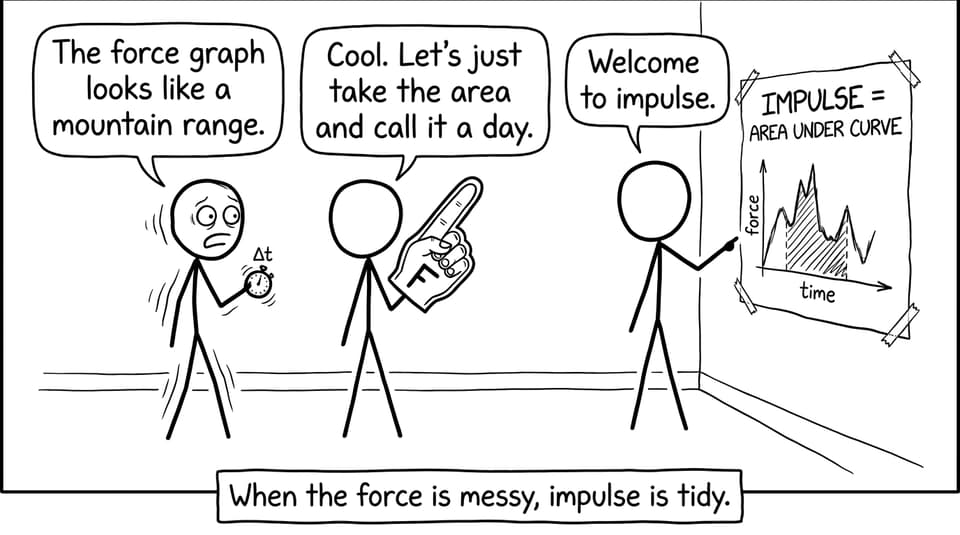
Impulse is the tool that makes the trick fair. It doesn’t ask you to track every twitch of force. It asks one calmer question: what was the total effect of that force over the short time it acted? In IB Physics, that single idea is often the difference between guessing and understanding.
The IB Physics collision checklist (quick and exam-friendly)
Before you dive into algebra, run this mental checklist:
-
Identify the system (what objects are included?)
-
Decide if external forces are negligible during the collision
-
Use impulse: (\vec{J} = \Delta \vec{p})
-
If needed, connect it to force-time: (\vec{J} = \int \vec{F},dt) (area under the graph)
-
Then apply momentum conservation for the whole system
For clean syllabus-aligned definitions, keep Linear momentum and impulse (A.2.2) notes open while you practise.
Why impulse is so useful in IB Physics collisions
In real collisions, the force is rarely constant. It surges, dips, and peaks depending on deformation, material, and contact time. That’s exactly why impulse matters in IB Physics: it bundles messy force details into one measurable outcome.
The impulse-momentum theorem tells you:
-
A collision is not “about force” in isolation
-
A collision is about how momentum changes
So instead of chasing (F(t)) second-by-second, you focus on (\Delta p), which is directly tied to what you actually observe: the before-and-after motion.
To reinforce this with exam-style practice, use the Momentum and impulse Questionbank and mark questions you miss for spaced repetition.
Impulse explains momentum transfer, not just momentum totals
Momentum conservation is a system-level rule: total momentum in equals total momentum out (if external impulse is negligible). But IB Physics questions often ask what happens inside the interaction.
Impulse answers that: during contact, each object experiences a force for a time, and therefore an impulse. Those impulses are equal and opposite (Newton’s third law), which is how momentum gets transferred between objects.
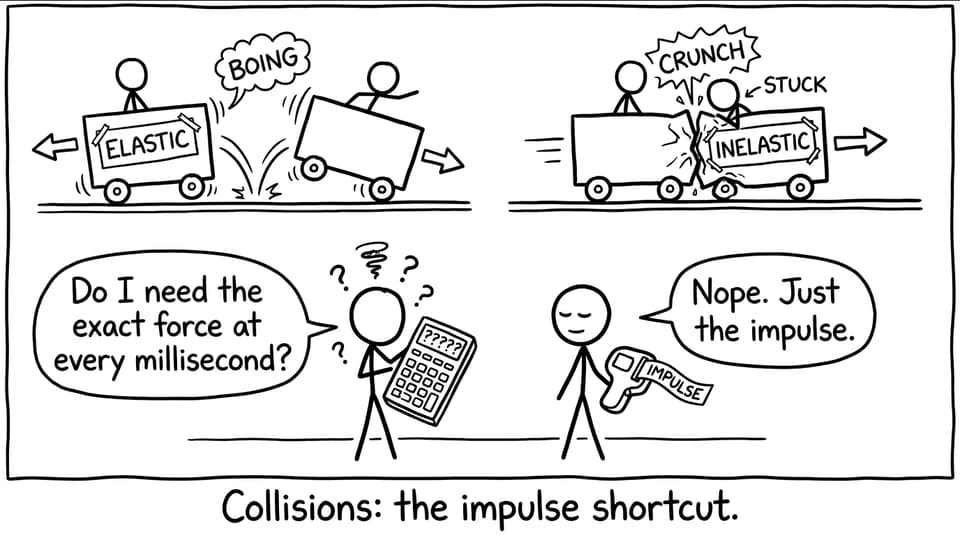
If you’re also revising collision types, pair this with Collisions and explosions (A.2.3) notes so you can link impulse to elastic vs inelastic outcomes.
The safety insight: same impulse, smaller force
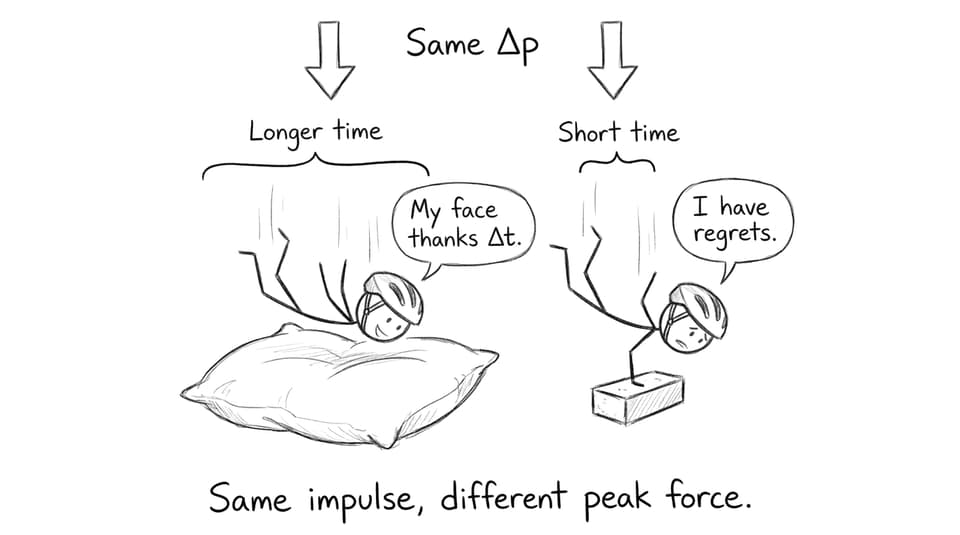
One of the most memorable IB Physics ideas is that safety devices don’t “remove” the collision. They stretch it.
If the momentum change (\Delta p) is fixed (you must go from moving to not moving), then impulse (J) is fixed too. But if you increase the collision time (\Delta t), the average force drops:
That’s why helmets, airbags, crumple zones, and padding work: same impulse, lower peak force.
Bringing it home with RevisionDojo
If IB Physics collisions feel chaotic, impulse is the calm statement hiding underneath: the interaction changes momentum by a predictable amount. That’s why it’s so useful, and why it keeps appearing in markschemes.
To turn that understanding into marks, RevisionDojo helps you practise the skill from every angle: concept refreshers in Mechanics, targeted drills in the Questionbank, quick recall with Flashcards, and confidence-building Mock Exams and Predicted Papers. When you’re stuck, AI Chat can walk you through the impulse setup step-by-step, and Grading tools help you see what an examiner would reward. For structured support, the Tutors and Coursework Library round out a full plan.
For more IB Physics help, browse all IB Physics posts and keep impulse as your go-to lens for every collision question.