



The moment your IB choices start to matter
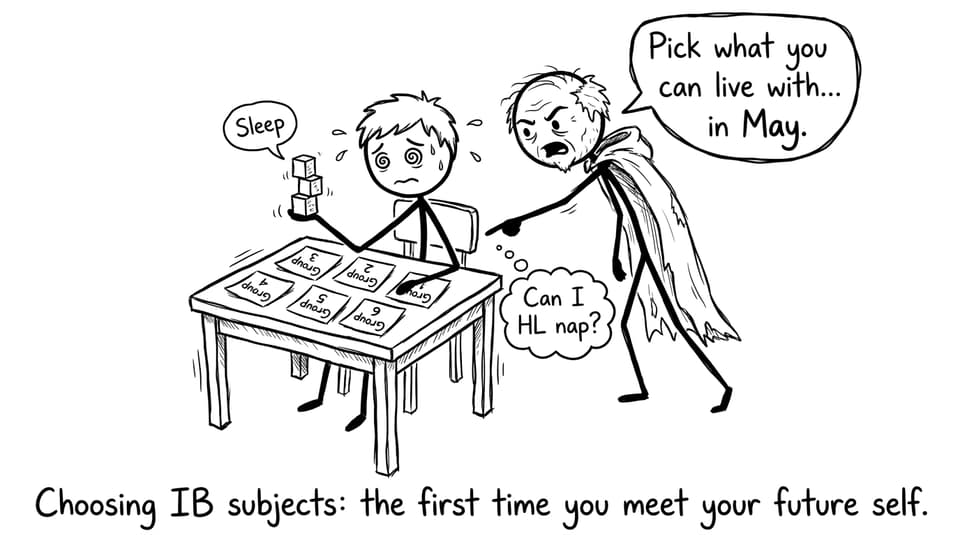
Most IB students remember the first time the subject form lands on the desk. It looks harmless: a few boxes, a couple of “HL” tick marks, maybe a short deadline. But the form is really a compass. It quietly determines what your evenings feel like, what your mock weeks look like, and which university doors stay open.
The best IB subject choices are rarely about picking the “hardest” lineup. They’re about picking the lineup you can practice consistently. Because in the IB, consistency is what turns effort into marks.
A quick IB subject-picking checklist (save this)
Before you lock anything in, run this fast IB checklist:
-
University constraints: Do any programs require specific IB subjects (often Math, Sciences, or specific HLs)?
-
Skill balance: Are you mixing writing-heavy, calculation-heavy, and memory-heavy subjects?
-
HL realism: Can you sustain 3 HL subjects without sacrificing sleep for months?
-
Exam fit: Do you like how the assessment works (essays, data questions, problem sets)?
-
Revision resources: Do you have a clear plan to practice exam-style questions all year?
If you want the clean structural overview of how the diploma is typically built (6 subjects + Core), read How Many Subjects Do You Take in the IB?
Understand the IB structure before you choose
The IB Diploma generally means:
-
Six subjects across the subject groups
-
Usually 3 Higher Level (HL) and 3 Standard Level (SL)
-
Plus the Core: TOK, EE, and CAS
That Core matters more than people admit. It’s not just “extra.” In a busy month, TOK presentations and EE drafts behave like another subject. So when you choose your IB subjects, you’re really choosing a workload ecosystem.
To explore the full set of supported IB subjects and what each includes, start from the IB hub.
How to choose your HL subjects (where most regrets come from)
HL is where ambition meets reality. A strong IB HL choice has two qualities:
You can practice it weekly
HL subjects punish last-minute revision. If you can’t imagine yourself doing weekly timed work, consider SL.
RevisionDojo helps here because you can build a routine around Study Notes, Flashcards, and the Questionbank. Start with the Questionbank feature page to see how students run high-volume practice with feedback.
It matches your future direction (even if it’s vague)
If you’re STEM-leaning, HL Math and a science are often the safest pair. If you’re humanities-leaning, HLs like History or Economics can be strategic.
Useful starting points for common IB paths:

Picking the “right” IB Math: AA vs AI
Math is the IB subject that quietly controls options.
-
Math AA tends to suit students aiming for calculus-heavy STEM degrees.
-
Math AI tends to suit students who like statistics, modelling, and real-world interpretation.
If you’re undecided, use these guides:
A practical rule: in the IB, it’s better to take the course you can revise steadily than the course you “should” take but avoid all year.
Balancing your IB workload (the underrated strategy)
A balanced IB set usually includes:
-
One reading-and-writing heavy subject (often Group 1 or Group 3)
-
One numbers-heavy subject (Math, Physics, Economics)
-
One memory-and-process heavy subject (Biology, Chemistry, Psychology)
Why? Because the IB doesn’t just test knowledge. It tests stamina across different types of thinking.
And remember: Internal Assessments stack. If you want a reality check on how different subjects’ IAs feel, see Comparing IA Expectations Across Different IB Subjects.
Use RevisionDojo to pressure-test your IB choices early
Here’s a calm way to know if a subject fits your brain: try the work.
On RevisionDojo, you can sample what revision will actually look like using:
-
Study Notes to learn content in exam language
-
Flashcards to lock in definitions and processes
-
AI Chat to get unstuck in the moment you’re confused
-
Questionbank to practice mark-scheme thinking
-
Grading tools to see why your response earns (or loses) marks
-
Mock Exams and Predicted Papers to rehearse timing and stress
-
Coursework Library for exemplars and structure
-
Tutors when you want human strategy, not just more content
If you want a simple system for using all of that as an exam prep loop, read RevisionDojo App: The Smarter Way to Prep for IB Exams.
Closing: choose an IB set you can revise, not just survive
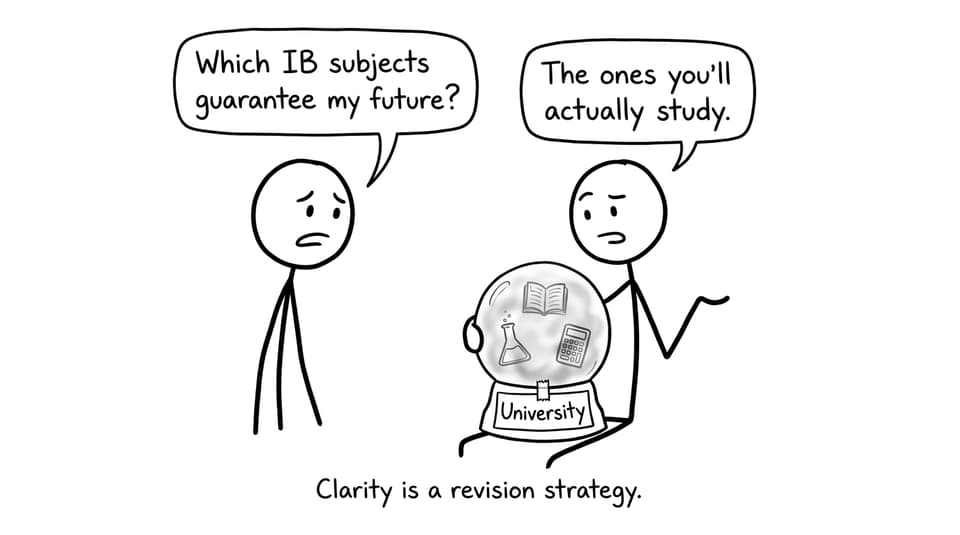
The best IB subject combination is the one that makes steady practice possible. Not perfect. Not flashy. Sustainable.
If you want to make your choices with more certainty, use RevisionDojo to test-drive them: start from the IB hub, review Study Notes, run a short Questionbank set, and finish with a timed mini-session in Mock Exams or Predicted Papers. In the IB, clarity comes from rehearsal. And RevisionDojo is built to make that rehearsal feel repeatable, not overwhelming.