



A small curve that changes everything (IB Physics)
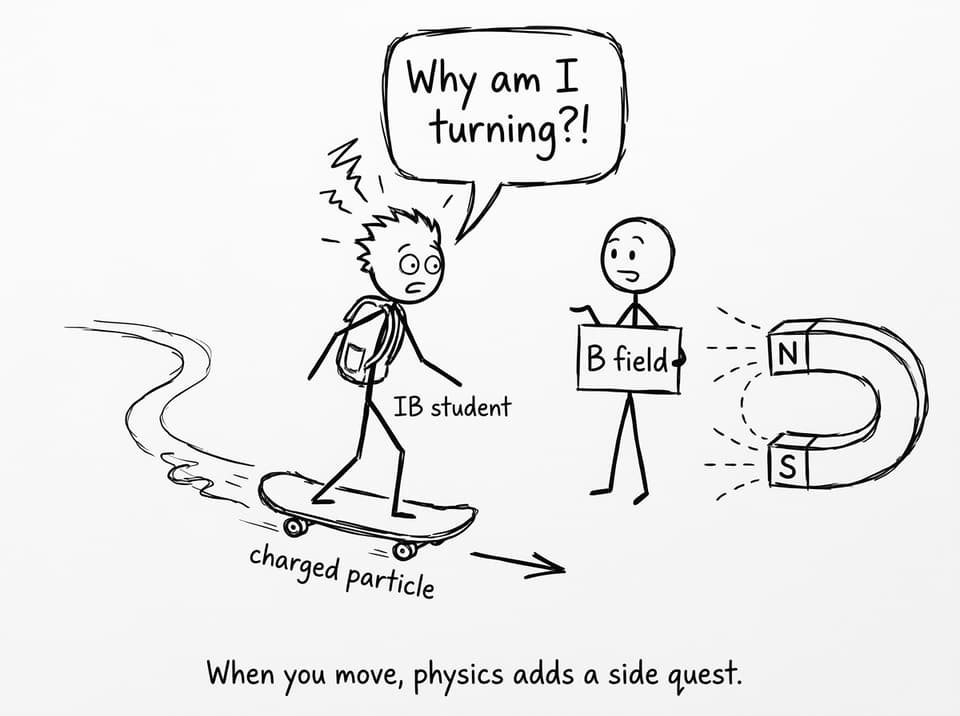
You’ve seen it in demos and diagrams: a charged particle enters a magnetic field, and instead of speeding up, it bends. That single bend is a quiet clue about the world that IB Physics wants you to notice: not all forces behave the same way, and some forces only show up when you’re moving.
Gravity doesn’t ask how fast you’re going. Tension doesn’t either. But magnetism does. The behavior of charges in fields reveals a special class of forces called velocity-dependent forces. And once you see the pattern, exam questions start to feel less like memorization and more like reading the story the motion is already telling.
Quick checklist: what to say in exam answers (IB Physics)
-
Magnetic force exists only if the charge has velocity: (\vec{F}_B = q\vec{v}\times\vec{B})
-
Direction is perpendicular to both (\vec{v}) and (\vec{B}) (right-hand rule)
-
Magnetic force changes direction of motion, not speed (so it does no work)
-
If velocity reverses, magnetic force reverses
-
Electric force (\vec{F}_E = q\vec{E}) can change speed because it can act along motion
For a clean syllabus-aligned reference, use IB Physics Topic D - Fields Notes & Questions (SL/HL).
What this behavior reveals about velocity-dependent forces
Magnetic force is “switched on” by motion
In IB Physics, a magnetic field can be present in space, but a stationary charge won’t feel a magnetic push from it. The moment the charge moves, the situation changes: the magnetic force appears and depends on how the particle moves relative to the field.
That’s why the magnitude is written as:
The (\sin\theta) term is the giveaway: direction matters. If (\vec{v}) is parallel to (\vec{B}), the force is zero. If it’s perpendicular, the force is maximum.
If you want the fuller motion-in-fields explanation, see IB Physics D.3.2 Charged Particle Motion in Magnetic Fields and IB Physics D.3.3 Motion in Combined Electric and Magnetic Fields.
The force is perpendicular, so it steers instead of accelerates
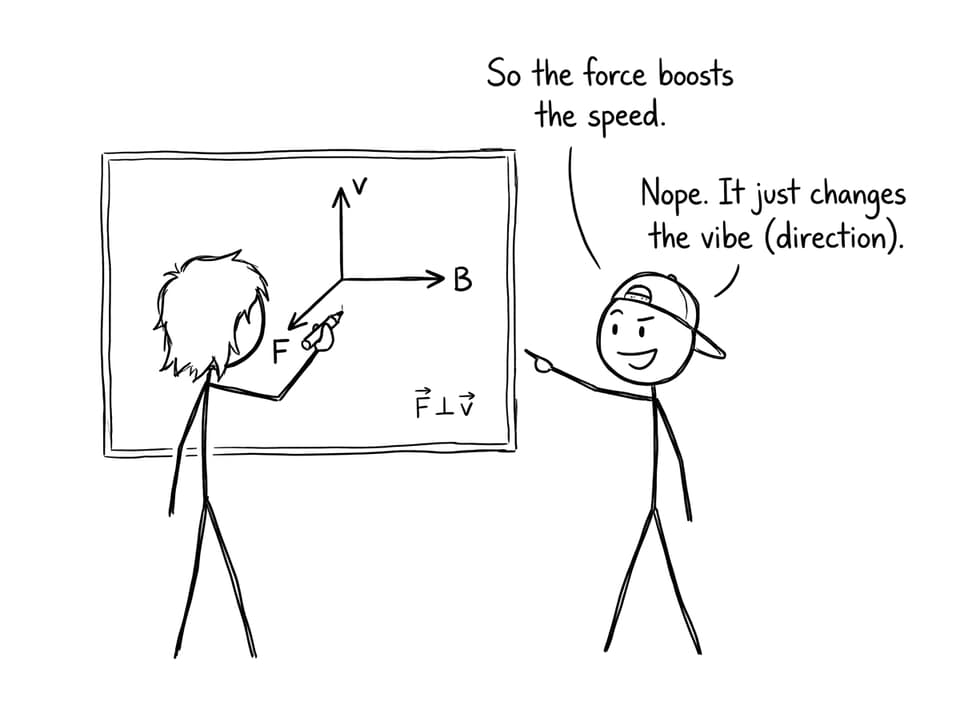
The most exam-useful insight in IB Physics is this: the magnetic force is perpendicular to velocity. A perpendicular force can bend a path without changing kinetic energy.
So the “behavior” you observe: circular or helical motion, which reveals that magnetic fields mainly act like a steering wheel, not an engine. The speed can stay constant while the direction keeps changing.
That’s also why charges trace:
-
Circles if (\vec{v}\perp\vec{B})
-
Helices if (\vec{v}) has both perpendicular and parallel components
A helpful companion read is Why Do Charges Follow Circular Or Helical Paths In Magnetic Fields.
Velocity-dependent forces reveal “geometry” inside electromagnetism
Because the magnetic force depends on a cross product, it’s deeply geometric: flip the velocity direction, and the force flips. Rotate the field, and the curvature changes. In other words, magnetism cares about orientation.
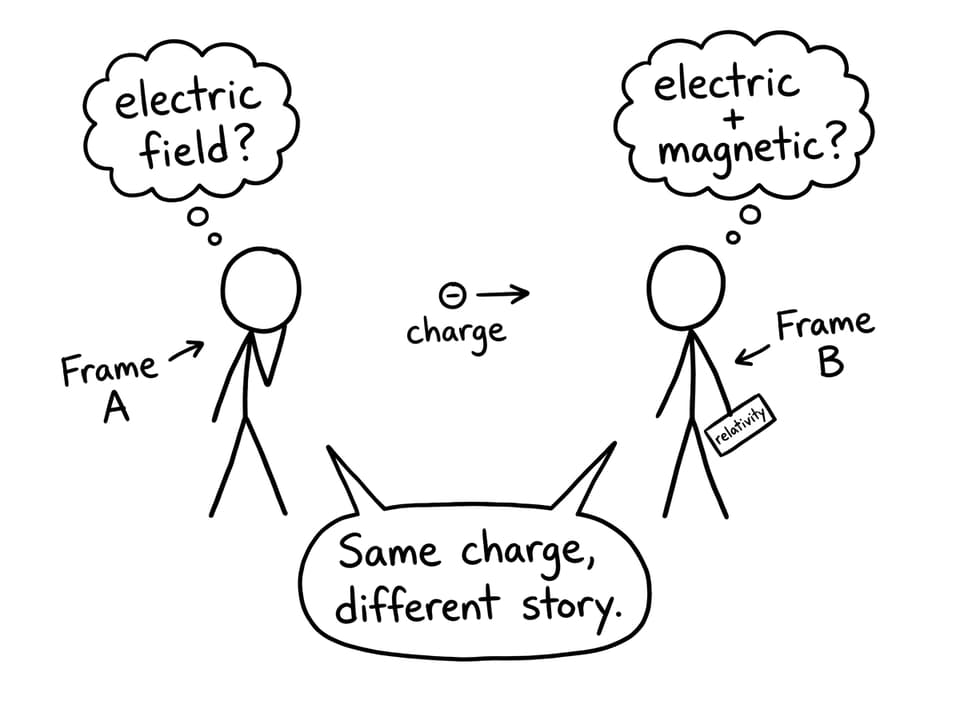
This is a nice contrast with electric fields, which can push along the motion and change speed. If you want a clean comparison written in the style IB markers like, use How do Electromagnetic Fields Guide the Motion of Charged Particles and the broader IB Physics D.2 Electric and Magnetic Fields.
How to practice this fast with RevisionDojo
Velocity-dependent force questions become predictable when you drill the same few ideas across different contexts. RevisionDojo makes that easier because you can move from concept to application without changing platforms:
-
Use the Topic D - Fields Questionbank to practice direction, radius, and helix reasoning.
-
Use D.2 Electric and magnetic fields - IB Questionbank when you need electric vs magnetic comparisons.
-
Reinforce definitions and relationships with Flashcards for D.2.3 Applications of electric and magnetic fields.
Behind the scenes, students typically combine RevisionDojo’s Questionbank, Study Notes, Flashcards, AI Chat, and Grading tools to tighten explanations to examiner style, then use Predicted Papers and Mock Exams to check timing and accuracy.
Closing: the “bend” is the message
The curved path isn’t a decorative detail: it’s the evidence. In IB Physics, that behavior reveals a force that depends on velocity, points perpendicular to motion, and reshapes trajectories without rewriting the energy. If you can explain that calmly, you’re already writing like the markscheme.
When you’re ready to turn that understanding into points, go straight to RevisionDojo’s notes and question practice for fields, then use the platform’s AI Chat and Grading tools to refine explanations until they sound inevitable. That’s how velocity-dependent forces stop being a topic you “revise” and become a pattern you recognize.