



A quick thought before the equations
You nudge a ruler hanging off a desk and it insists on wobbling back. You pull a doorstop spring and it snaps toward its original length. Even your backpack strap has that same stubbornness. In IB Physics, that “stubbornness” has a name: the restoring force.
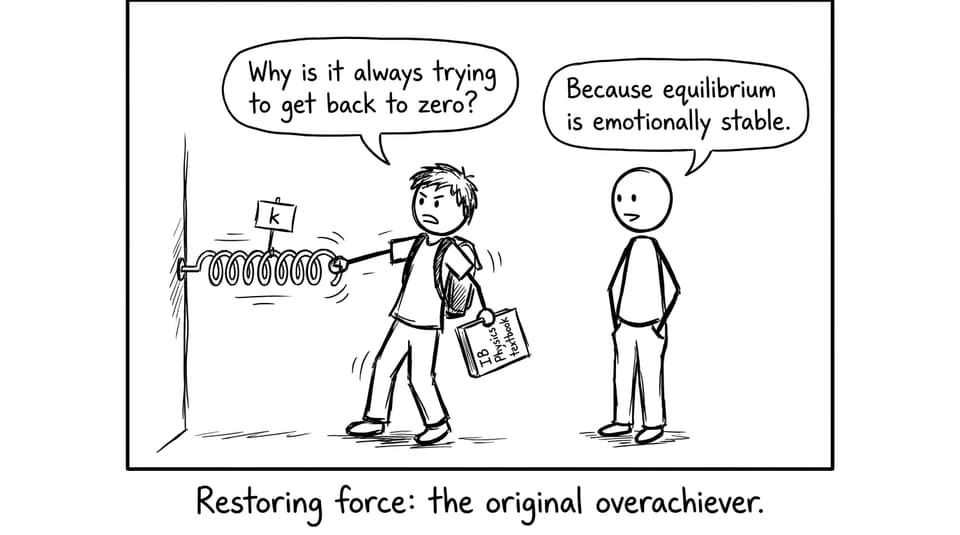
The restoring force is what appears when a system is displaced from equilibrium, and it always points (in some way) back toward equilibrium. The big exam idea is simple: what determines the restoring force is the physical interaction that stores potential energy when you displace the system.
The exam checklist for restoring force (SHM-ready)
Use this checklist any time a question mentions oscillations in IB Physics:
-
Identify the equilibrium position (net force is zero).
-
Ask: what interaction changes when the object is displaced? (elasticity, gravity, tension, electromagnetic bonding)
-
Check the SHM condition: is the restoring force proportional to displacement?
-
If yes: (F \propto -x) and you can use SHM tools.
-
If no: the motion may still oscillate, just not perfect SHM.
-
For a focused revision path, the best hub is IB Physics C.1 Simple Harmonic Motion.
IB Physics restoring force: the “why” behind the direction
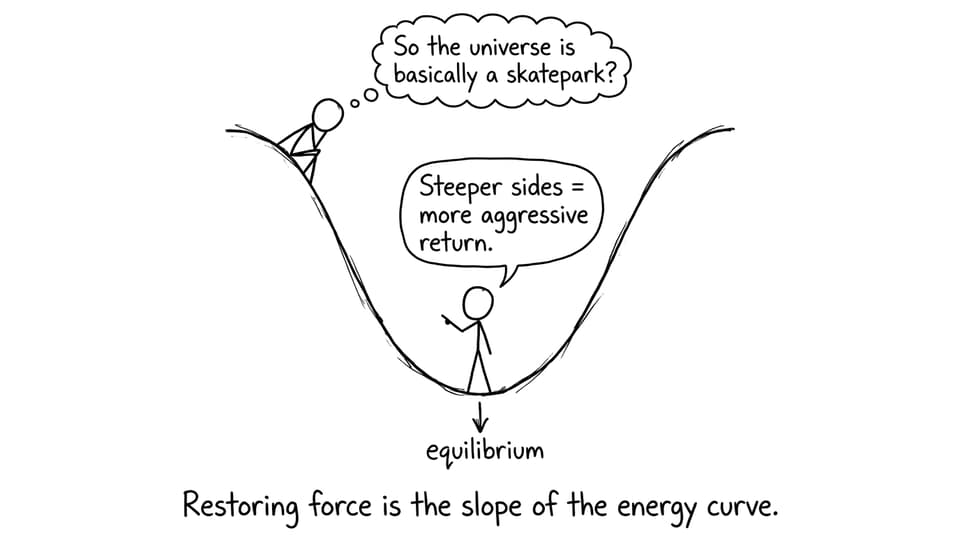
A restoring force points toward equilibrium because equilibrium is where the potential energy is lowest. Displace the system, and you store energy. Release it, and the system “tries” to roll back down the energy hill.
That energy picture matters because it works across almost every oscillator you meet:
-
Springs store elastic potential energy.
-
Pendulums exchange gravitational potential energy.
-
Vibrating strings store energy through tension and shape change.
-
Molecules vibrate due to electromagnetic forces in bonds.
If you want a clean definition and the math form used in questions, see Defining and analyzing simple harmonic motion (C.1.1) notes.
Springs: elasticity sets the restoring force
In a mass-spring system, the restoring force comes from elasticity: stretch or compress the spring and internal forces pull it back. For ideal springs:
That minus sign is your IB Physics shortcut: force is opposite to displacement. This proportionality is exactly why springs give clean SHM.
To practise this with exam-style prompts, use IB Physics C.1 Simple Harmonic Motion Questionbank or the additional 9.1 Simple harmonic motion Questionbank.
Pendulums: gravity provides the restoring force (approximately)
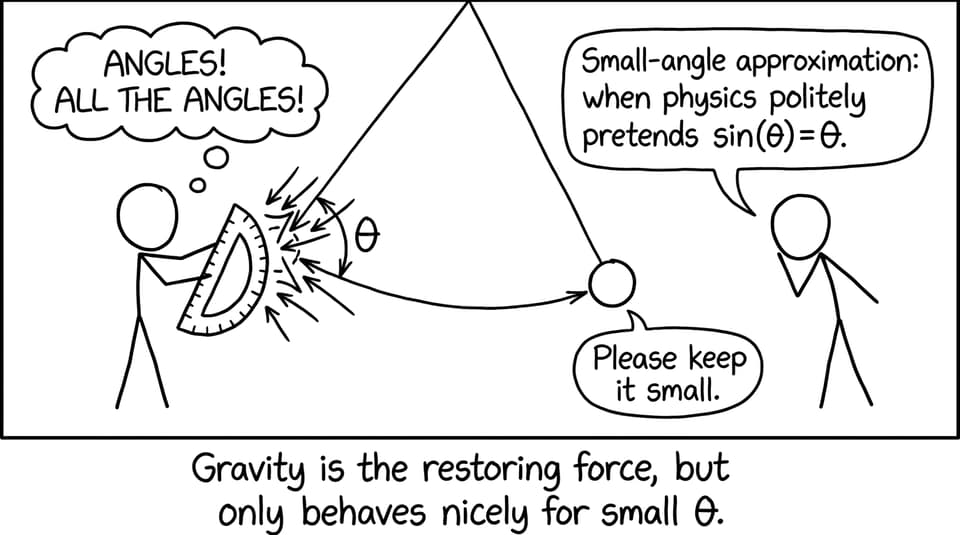
For a pendulum, gravity is always downward, but only the component along the arc pulls the bob back toward the centre. That component is (mg\sin\theta), which is not perfectly proportional to displacement for large angles.
For small angles, (\sin\theta \approx \theta), and the restoring effect becomes proportional to angle (and therefore to arc displacement). That’s why small-angle pendulums behave like SHM in IB Physics questions.
If you’re revising periods and what changes them, link this idea with Time period of oscillatory systems (C.1.2) notes.
Tension and electromagnetic forces: the quiet restoring forces
Not every oscillator is a spring on a table. A stretched string vibrates because tension resists sideways displacement. The restoring force depends on both the tension and the curvature of the string. The details can get mathematical, but the concept is the same: displacement increases stored energy, and the system responds with a force back toward equilibrium.
At the microscopic level, molecules oscillate because electromagnetic attraction and repulsion change as bonds stretch or compress. Near equilibrium, many bonds behave “spring-like” (approximately linear), which is why SHM shows up from atoms to bridges.
The energy lens: what really determines “how strong” the restoring force is
A powerful way to summarise restoring force in IB Physics is this: it’s connected to the slope of the potential energy curve near equilibrium. A steeper curve means a stronger restoring force for the same displacement, which typically means faster oscillations.
That’s also why “stiffer spring” (larger (k)) and “shorter pendulum” (smaller (L)) lead to shorter periods.
For energy transformations across the cycle, revise with Energy transformations in oscillations (C.1.3) notes.
Bring it home with RevisionDojo
If you can look at an oscillator and say, “this is the interaction storing energy, so this is the restoring force,” you’re already thinking like a top scorer in IB Physics.
To turn that understanding into marks, use RevisionDojo’s IB Physics Resources alongside the SHM Lessons for C.1 Simple harmonic motion and Videos for C.1 Simple harmonic motion. Then lock it in with the Questionbank, Flashcards, AI Chat, and grading tools, and build a targeted Mock Exam set when you’re ready. The restoring force brings systems back to equilibrium; RevisionDojo brings your revision back to what matters.