



A chain reaction is a strange kind of mirror. It reflects back whatever you set up at the start: a system built for balance stays calm; a system built for speed becomes a runaway.
In IB Physics, controlled vs uncontrolled fission is ultimately a story about neutron management. Not the dramatic kind of “nuclear” you see in movies, but the quiet exam-friendly kind: how many neutrons are produced, how many escape, how many get absorbed, and how many actually cause another fission.
The one idea that decides everything: the neutron multiplication factor k
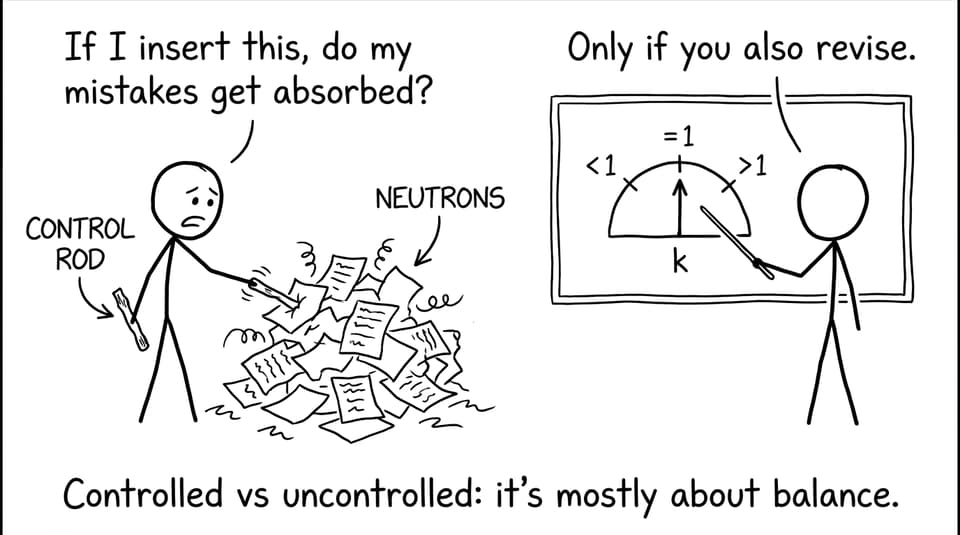
In IB Physics, you’ll often see the chain reaction summarized by the neutron multiplication factor k:
-
k < 1: the reaction dies out (subcritical)
-
k = 1: the reaction is steady (critical): this is what reactors aim for
-
k > 1: the reaction grows (supercritical): this is the pathway to uncontrolled behavior
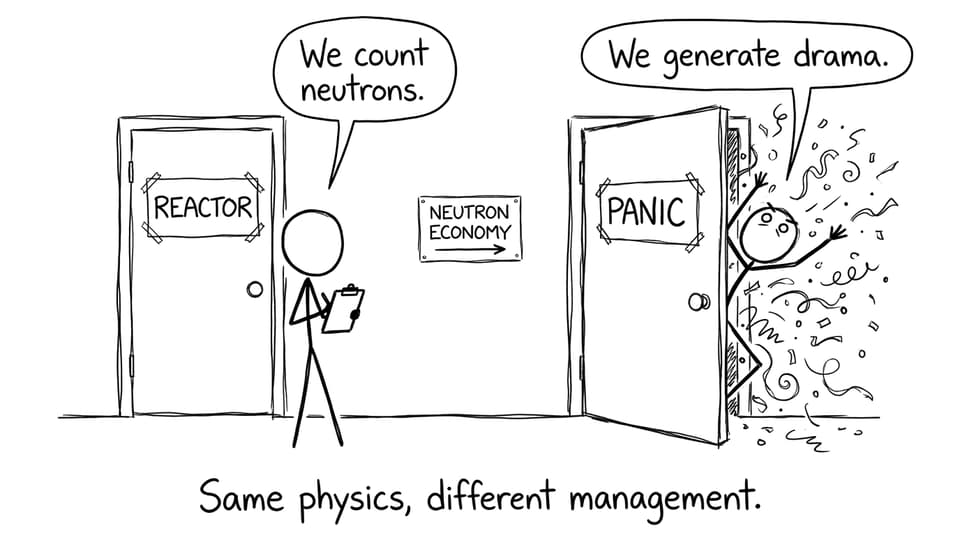
This is the cleanest way to explain controlled vs uncontrolled fission in an exam: controlled fission means engineering the system so that, on average, exactly one neutron from each fission triggers one more fission.
If you want a syllabus-aligned refresher on the mechanism itself, use E.4.1 Mechanisms of nuclear fission.
Conditions that allow controlled fission (reactor-style)
Controlled fission is not “weak fission.” It’s fission with feedback and brakes.
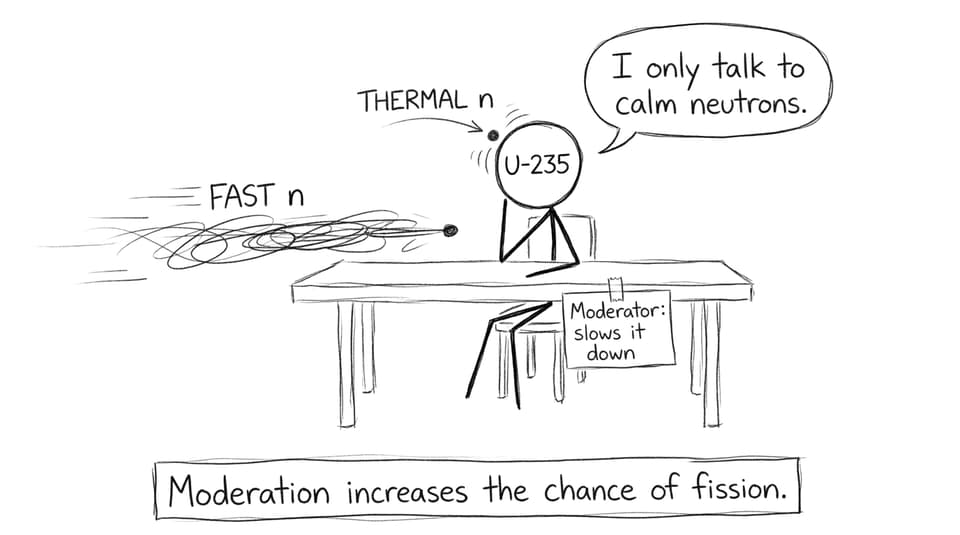
Moderation: slowing neutrons to make fission more likely (and manageable)
Many reactor designs rely on thermal (slow) neutrons, because slow neutrons are more readily captured by fissile nuclei like U-235.
A moderator (often water or graphite) reduces neutron speed through collisions. This increases the probability of further fission, but it does so in a predictable way that can be regulated.
For the reactor-focused details, see E.4.2 Nuclear reactors notes and the broader E.4 Fission notes.
Control rods: absorbing excess neutrons to keep k near 1
A reactor’s core produces neutrons continuously. Without a way to remove some of them, k drifts above 1.
Control rods (materials like boron or cadmium) absorb neutrons. Inserting them deeper absorbs more neutrons and reduces the fission rate; withdrawing them increases the rate. That is the operational meaning of “controlled” in IB Physics.
You can practise exam-style questions on this with the IB Physics Topic E.4 Fission Questionbank.
Critical geometry and fuel arrangement: preventing too many neutrons escaping
Even with the right isotope, a chain reaction only sustains if enough neutrons stay inside the fissile region long enough to collide again.
So reactors use carefully designed fuel geometry, reflectors (in some designs), coolant/moderator layout, and operating conditions to maintain criticality (k = 1) rather than racing away.
Conditions that allow uncontrolled fission (runaway chain reaction)
Uncontrolled fission is what happens when the system is arranged so that neutron losses can’t keep up with neutron production.
Supercritical configuration: enough fissile material in the right shape
If the mass, density, and geometry produce high neutron containment, fewer neutrons escape. More neutrons cause subsequent fissions. k rises above 1.
Little to no neutron absorption control
If there is no effective neutron absorber (or no ability to adjust absorption), the system lacks a stabilizing feedback mechanism. Small increases in effective neutron production lead to rapid growth.
Very short timescales where “feedback” can’t act fast enough
In runaway scenarios, the key idea for IB Physics is exponential growth occurring on extremely short timescales. Before heat expansion can reduce density (and therefore reduce k), the reaction can surge.
For an intuition-building explanation of chain reactions, read How Do Chain Reactions Illustrate Energy Amplification?.
Quick exam checklist (what to write under pressure)
When a question asks for conditions for controlled vs uncontrolled fission, hit these points:
-
Define k and state what k < 1, k = 1, k > 1 mean
-
Controlled fission: moderation + adjustable absorption (control rods) + critical geometry
-
Uncontrolled fission: supercritical arrangement + insufficient absorption + rapid multiplication
Bring it home with RevisionDojo (and lock in the marks)
If you’re revising IB Physics, don’t stop at reading definitions. Train the exam reflex: identify k, state the condition, and connect it to moderation, absorption, and geometry.
RevisionDojo helps you do that efficiently: use the IB Physics resources hub to jump between Study Notes, Flashcards, and the Questionbank, then test yourself with Mock Exams, Predicted Papers, and grading tools. When your explanation feels shaky, open AI Chat to debug the misconception, then immediately reattempt another fission question. That loop is how IB Physics turns from “I get it” into “I can score it.”