


When the universe refuses to budge
In IB Physics, time dilation and length contraction can feel like the syllabus is gaslighting you: “No, your clock is fine. It’s just… different now.” But relativity isn’t a trick. It’s what happens when two stubborn ideas are both true at the same time.
The first idea says the speed of light in vacuum is constant for all inertial observers. The second says different observers don’t agree on what “at the same time” means. If you accept those two ideas, then in IB Physics the rest isn’t optional: time dilation and length contraction are the universe balancing its books.
Quick exam checklist (what to remember)
-
In IB Physics, special relativity begins with two postulates: physics is the same in all inertial frames, and light travels at the same speed (c) in all inertial frames.
-
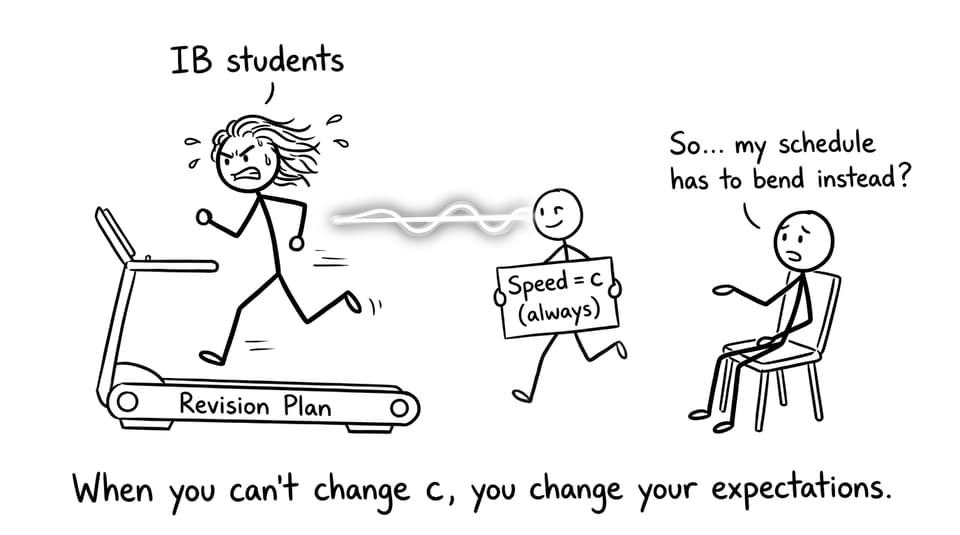
If (c) can’t change, then measurements of time and distance must.
-
“Simultaneous” is frame-dependent, which collapses the idea of one universal clock.
-
Time dilation and length contraction are geometric consequences of spacetime, not objects “getting squished.”
For the official syllabus pathway, start with A.1: The Beginnings of Relativity and then move into the HL content in A.5 Galilean and special relativity.
Conceptual idea 1: the speed of light is the same for everyone
Classical physics teaches you to add velocities. If you run forward on a train, your speed (to someone on the platform) is “train speed + your running speed.” That intuition works beautifully for daily life.
But in IB Physics, light doesn’t play along. Whether you chase a light beam or run away from it, you still measure the same speed (c). The universe refuses to let the “+ v” part happen for light. So something else must adjust.
That “something” is your measurement of time and distance.
If a light clock must tick using light moving at speed (c), then different observers (moving relative to that clock) must disagree on the time between ticks. This is the conceptual doorway to time dilation, formalized in A.5.2 Postulates of special relativity (HL).
Conceptual idea 2: simultaneity is relative
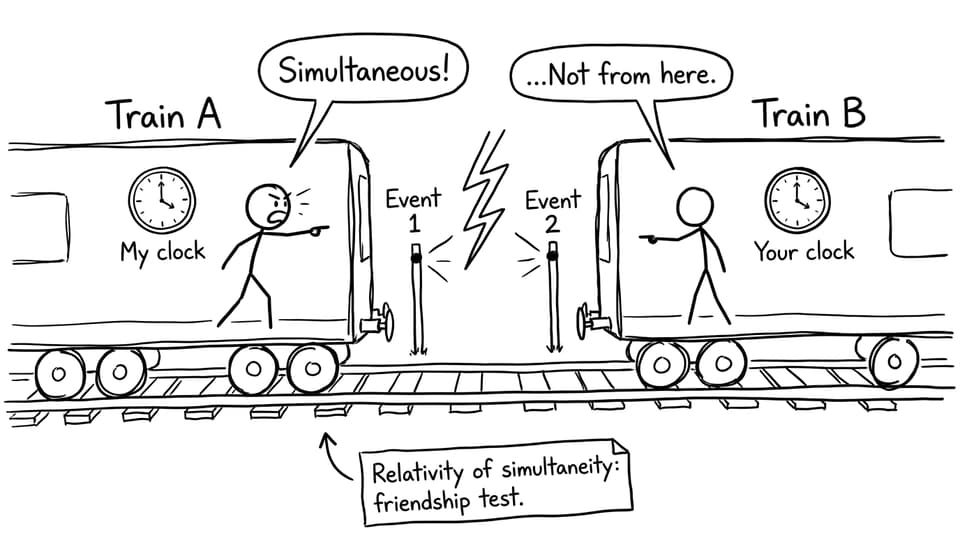
Here’s the quieter idea that causes the bigger headache: two events that are simultaneous in one frame may not be simultaneous in another.
In IB Physics, this matters because “time” isn’t just what a clock reads; it’s also how you define “now” across space. If observers disagree about simultaneity, then they disagree about time intervals between separated events.
That disagreement isn’t due to slow reactions or bad equipment. It’s built into spacetime. And once simultaneity becomes relative, there’s no single master timeline to keep everyone’s clocks synchronized.
How those two ideas force time dilation and length contraction
Put the two ideas together:
-
Light must always be measured at (c).
-
Observers don’t share a universal “same time.”
Now imagine measuring how long a moving process takes. If you can’t change (c), and you can’t rely on universal simultaneity, the only consistent outcome is that moving clocks run slow relative to you: time dilation. In IB Physics, you’ll express that with (\Delta t = \gamma \Delta t_0) and the Lorentz factor (\gamma). You can keep your formula work aligned by bookmarking the IB Physics data booklet.
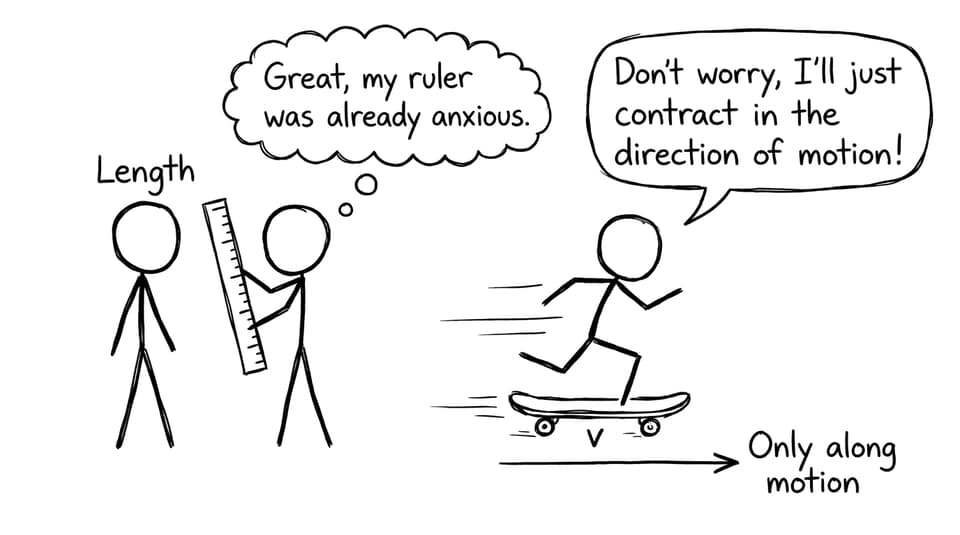
Length contraction arrives from the same logic. If one observer sees a moving object cover a distance in a certain time while still respecting (c), then distances along the direction of motion must transform too. The moving object’s measured length becomes smaller along the motion: (L = \frac{L_0}{\gamma}). The key phrase for IB Physics markers is “in the direction of motion.”
If you want the deeper mathematical bridge (HL), see Lorentz transformations notes and reinforce with the A.5 cheatsheets.
Make this topic exam-proof with RevisionDojo
The fastest way to master IB Physics relativity is to combine concept clarity with exam-style repetition. Use RevisionDojo’s Option A: Relativity hub and drill with the Option A Relativity Questionbank. Then tighten recall using the Relativity flashcards and fill gaps with the structured Relativity lessons.
If you remember nothing else, remember this: in IB Physics, time dilation and length contraction aren’t random “effects” to memorize. They’re the price the universe pays to keep (c) constant while simultaneity stays relative. And RevisionDojo gives you the Questionbank, Study Notes, Flashcards, AI Chat, and grading-focused practice to make that price feel predictable on exam day.