


TOK rarely feels urgent until it suddenly does.
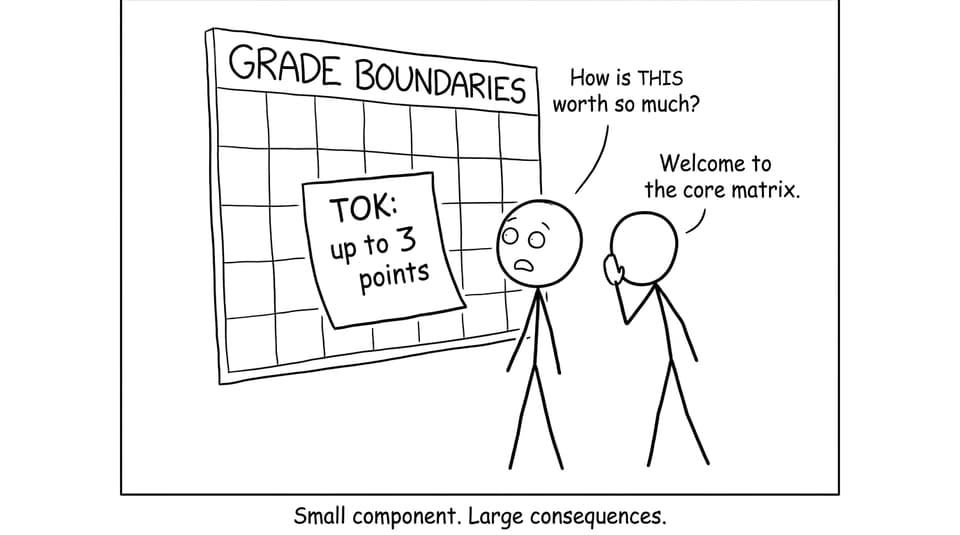
One day you are calmly revising your subjects, and the next you realize that TOK can swing your final IB outcome by up to 3 points. Not because it is “harder” than HL Physics or Biology, but because it sits in a strange place: small on the timetable, large on the transcript.
The good news is that TOK is predictable once you understand the weighting. The assessments are clear, the trade-offs are real, and you can plan your time like someone who wants certainty, not last-minute hope.
TOK weighting: the quick checklist
If you want the whole story in 30 seconds, here is the practical map:
-
TOK has two assessed components: the TOK essay and the TOK exhibition.
-
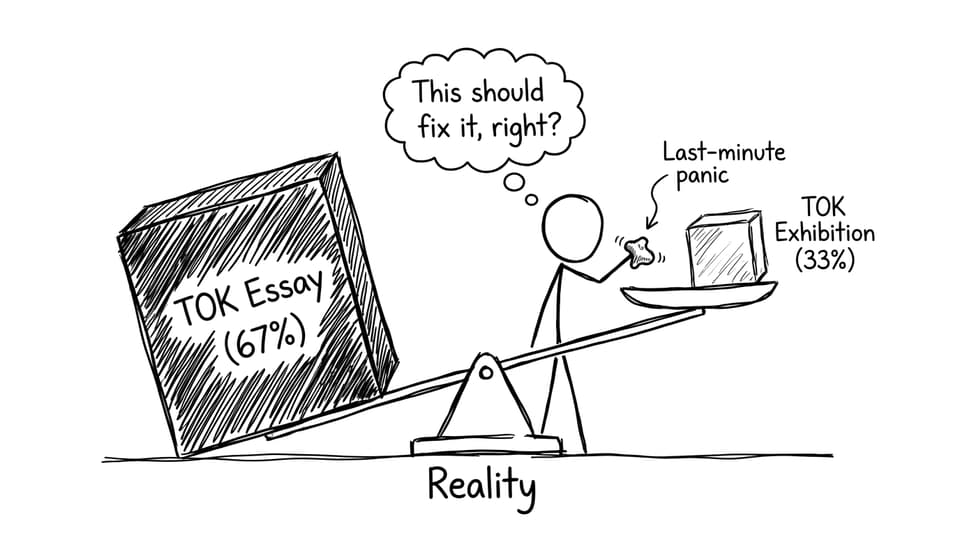
The TOK essay weighting is 67% of your final TOK grade.
-
The TOK exhibition weighting is 33% of your final TOK grade.
-
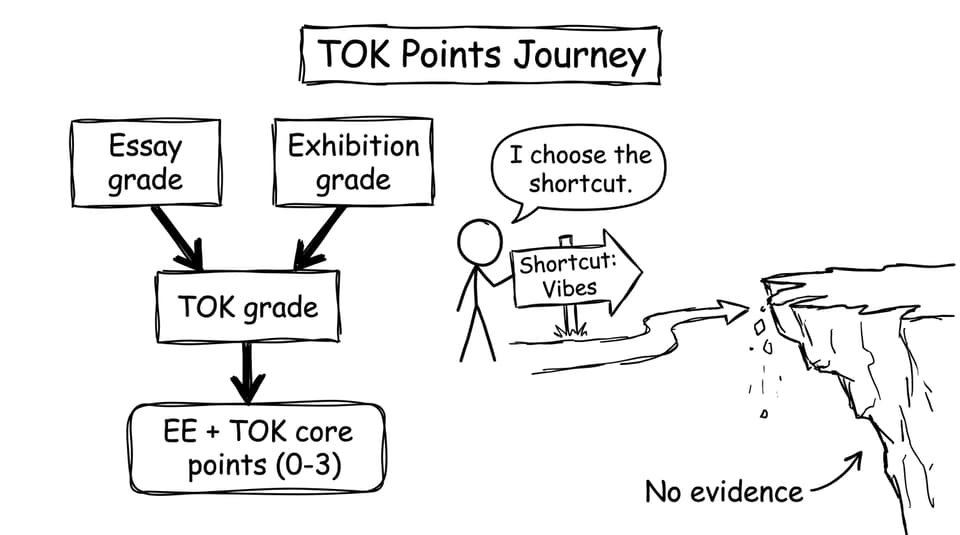
Your final TOK grade is combined with your Extended Essay grade using the IB core matrix to award 0 to 3 additional points.
-
A weak TOK or EE outcome can create serious risk for the Diploma.
For the official-style overview of the course and components, start with IB Theory of Knowledge resources.
What exactly is assessed in TOK?
Think of TOK as two different lenses on the same skill: showing how knowledge is built, justified, challenged, and limited.
TOK essay: the big lever
The TOK essay is externally assessed. You choose one prescribed title, build a focused knowledge question, and develop a line of argument with claims, counterclaims, and real-world examples.
If you are still getting comfortable turning a title into a real knowledge question, use TOK essay titles and knowledge questions. And if you are drafting, IB Theory of Knowledge 4.2 the TOK Essay helps you keep the basics tight.
TOK exhibition: smaller weighting, common point leak
The TOK exhibition is internally assessed and moderated. You pick one prompt, choose three objects (or images of objects), and write a single commentary showing how each object reveals something about knowledge in the real world.
Students often underestimate this piece because it feels “short.” But the examiner does not grade your display aesthetics or confidence. They grade the clarity of your knowledge-focused thinking.
If you want a grounded start, read IB TOK Exhibition: your complete guide to success, then tighten object choice using selecting the right objects for your TOK exhibition. For rubric clarity, how is the TOK exhibition graded? is a fast fix.
TOK weighting: essay vs exhibition (and why it matters)
The weighting is straightforward:
-
TOK essay weighting: 67%
-
TOK exhibition weighting: 33%
That means the essay has roughly double the impact on your final TOK grade.
But the psychological trap is this: students hear “67%” and treat the exhibition like spare change. In practice, a sloppy exhibition can drag the overall TOK grade down a band, which can then reduce your core points when combined with the EE.
So the smart move is not “essay only.” It is consistent competence across both.
How TOK contributes to your final IB score
Your TOK grade does not directly add to the 42 subject points. Instead, TOK and the Extended Essay combine using the IB core matrix to award 0-3 additional points.
That is why TOK can feel like a lever: you do not need it to be perfect for it to matter, but you do need to avoid preventable mistakes.
A helpful way to think about it is risk management. In the same way you would not leave a whole HL topic untouched because “it might not come up,” you should not leave TOK to vibes and timing luck.
To strengthen the connection between TOK thinking and your EE writing, see how to use TOK to enhance your Extended Essay. For EE support more broadly, bookmark IB Extended Essay guides.
Practical strategies to score higher in TOK
Build your TOK essay around decisions, not definitions
A high-scoring TOK essay is a sequence of thoughtful choices: what you mean by the key terms, what counts as evidence, why your examples fit, and where your argument breaks under pressure.
Use structure as your safety rail. If you need a blueprint, structuring for success in IB TOK essays is designed for exactly that.
Then test your draft the way examiners think. RevisionDojo’s Grading tools do this quickly: try the IB TOK Essay Grader to see which rubric signals you are missing.
Treat the TOK exhibition like three mini-arguments
The exhibition is not three descriptions. It is three small arguments tied to one prompt.
A reliable method is:
-
One prompt, stated clearly
-
Three objects that create three different angles
-
For each object: context, link to the prompt, then the knowledge insight
If you are rewriting your commentary, how to create an engaging TOK exhibition commentary is a clean reset. And if you want quick feedback before submission, use the IB TOK Exhibition Grader.
Use RevisionDojo to make TOK feel concrete
What makes TOK stressful is that it can feel invisible: you are never sure whether you are “doing it right.” RevisionDojo is built to reduce that ambiguity.
-
Use Study Notes to clarify AOKs, WOKs, and common argument moves.
-
Use Flashcards to keep key terms and examples ready.
-
Use AI Chat to pressure-test claims and counterclaims before you commit.
-
Use Grading tools to iterate drafts without waiting.
-
Use the Coursework Library for exemplars that show what “good” looks like.
-
Use Tutors when you need a human second set of eyes.
If you want a broader sense of how RevisionDojo supports TOK across a cohort, improving IB Theory of Knowledge (TOK) engagement through RevisionDojo is worth reading.
Closing: make TOK work in your favour
TOK is small on paper and large in effect. The weighting is clear, the essay matters more, and the exhibition still counts enough to hurt you if you treat it casually.
If you want the calm advantage, build a system: draft early, get feedback fast, and iterate with purpose. Use RevisionDojo’s Questionbank and Mock Exams for your subjects, then keep TOK moving with Study Notes, Flashcards, AI Chat, Grading tools, the Coursework Library, and Tutors when you need precision.
Treat TOK like what it is: a few points that can change everything.