Introduction
The hardest part of an IB Social Studies IA often happens before you write a single paragraph: choosing a topic that is interesting, small enough to finish, and rich enough to analyze.
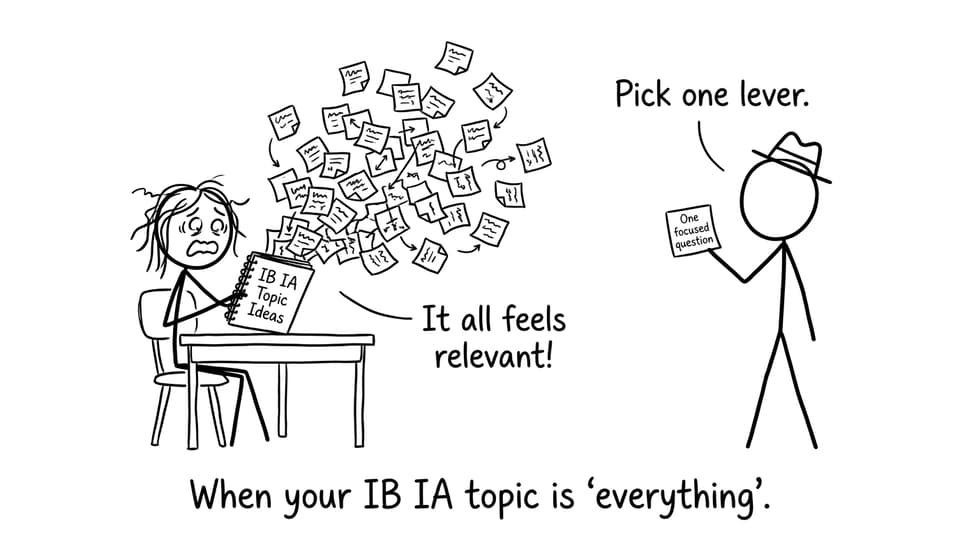
Most students don’t struggle because they lack ideas. They struggle because they have too many. A topic becomes a personality. It becomes a “big issue.” And then the word count arrives like a hard ceiling.
This guide is designed as Social Studies IB IA topic inspiration you can actually use: ideas you can shape into a focused research question, plus a calm method for deciding what to keep and what to drop.
A quick IB IA topic checklist (save this)
Before you commit to any IB topic, run it through this short filter:
-
Focus: Can you answer it in the official word limit without summarizing a whole textbook?
-
Evidence: Can you access sources, data, participants, or an engagement experience you can describe honestly?
-
Analysis: Does the topic naturally create debate, comparison, evaluation, or explanation?
-
Syllabus fit: Can you clearly connect it to course concepts and terms?
-
Personal angle: Is there a genuine reason you care, beyond “it sounds impressive”?
If you want a broader roadmap of what IAs are trying to assess across subjects, keep IB IA Guides open while you brainstorm.
What makes Social Studies IB IA topic inspiration “strong”
A strong IB IA topic is not the most dramatic one. It’s the one that behaves.
That usually means:
-
One location, one time frame, one case (or one clear comparison)
-
A question with a verb that demands judgement: evaluate, assess, to what extent, how significant
-
A clear method: sources to analyze, fieldwork to conduct, an experiment to replicate, or an engagement activity to reflect on
When students earn top marks, it’s often because their topic forces them to interpret evidence instead of narrating events.
IB History IA topic inspiration (questions you can actually finish)
The IB History IA rewards investigation, not storytelling. Choose a question where you can compare interpretations, weigh evidence, and evaluate sources.
Try these as starting points:
-
Causes of conflict: To what extent did propaganda contribute to the Spanish Civil War?
-
Impact of leadership: How significant was Churchill’s leadership in Britain’s resistance during 1940?
-
Social history: How did women’s roles in the workforce change during WWII in Canada?
-
Historiography shift: How have historians’ interpretations of the Cold War’s origins changed since the 1950s?
To keep your investigation rubric-aligned, skim IB History Internal Assessment Explained, then use 10 Proven Tips for a Strong IB History IA Analysis when you start writing evaluation.
For quick self-checking, the IB History IA Grader is a fast way to see whether your draft is leaning too descriptive.
IB Geography IA topic inspiration (fieldwork that stays manageable)
For IB Geography, your best topic is one you can collect data for without your plan collapsing in bad weather, schedule problems, or unrealistic sampling.
Fieldwork-inspired ideas:
-
Urban patterns: What factors influence foot traffic in different zones of a city center?
-
Environmental change: How does water quality vary along a local river system?
-
Tourism impact: What is the environmental impact of tourism on a nearby coastal area?
-
Local sustainability: How effective are recycling initiatives in reducing local waste levels?
If you need to see what “good” looks like before you commit, browse IB Geography IA HL Examples and IB Geography Exemplars. For revision alongside coursework, IB Geography Resources helps you link IA ideas to syllabus concepts.
IB Psychology IA topic inspiration (replications that behave)
In IB Psychology, high scoring IAs are often simple, ethical, and consistent. You want a design you can replicate with classmates, with one clear independent variable and one dependent variable.
Replication-friendly ideas:
-
Memory and questions: Loftus and Palmer style investigation on leading questions
-
Perception and attention: Stroop effect with different word-color combinations
-
Learning strategies: Chunking and recall performance
-
Social influence: Conformity using line-judgment style tasks
For structure and criteria clarity, use IB Psychology IA Explained and keep Psychology IA IB Tips nearby as you refine your method.
IB Global Politics IA topic inspiration (engagement you can prove)
The IB Global Politics IA is powered by real engagement. Examiners value authentic involvement, not abstract opinions.
Engagement-based ideas:
-
Human rights: Volunteer with a refugee support group and analyze policies affecting integration
-
Conflict and discourse: Attend a public debate and evaluate competing narratives and interests
-
Development: Interview an NGO about poverty alleviation programs and discuss effectiveness and constraints
-
Climate politics: Engage with a local youth climate group and analyze how global frameworks translate into local action
To plan your experience and reflection, use IB Global Politics IA Engagement Project Guide Notes. To calibrate against strong samples, browse IB Global Politics IA: Engagement Activity Grade 7 Examples.
A calm way to brainstorm your IB IA topic in 20 minutes
When you’re stuck, don’t brainstorm “topics.” Brainstorm constraints. In IB, constraints create clarity.
-
Minute 1-5: List 5 class ideas you genuinely remember (memory is a clue that you care).
-
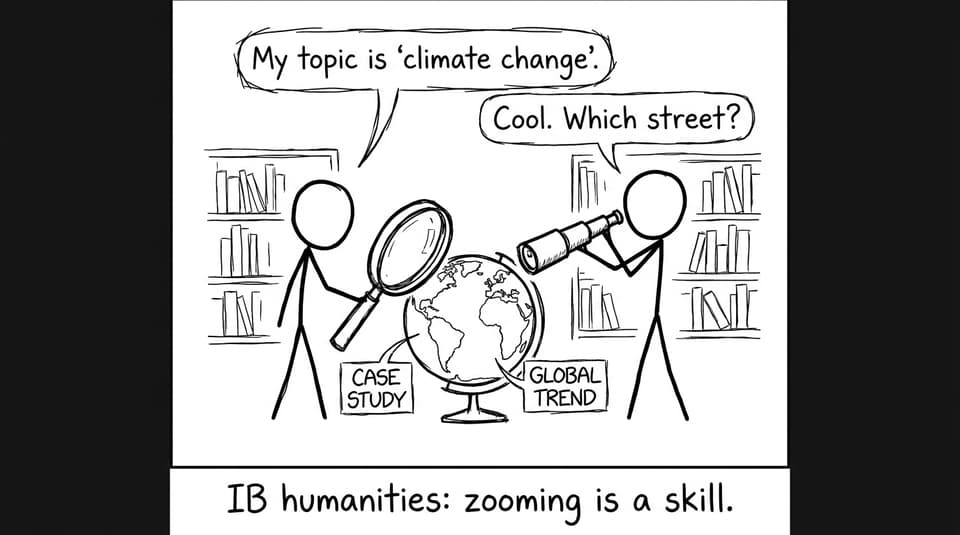
Minute 6-10: For each, force a zoom: one place, one group, one event, one dataset, one stakeholder.
-
Minute 11-15: Draft one research question per idea using a judgement verb.
-
Minute 16-20: Stress-test feasibility: if one key source/data point fails, can you still answer?
If your question still feels blurry, Refine Your IA Research Question for Clarity and Focus is the quickest way to tighten wording without overthinking.

Common mistakes that quietly lower IA marks
These are the traps that make an IB IA feel “hard” even when you’re working a lot:
-
Too broad: “The causes of World War II” becomes summarizing, not investigating.
-
No proof plan: You love the idea, but can’t access usable sources, data, or engagement.
-
Weak analysis: You describe what happened, but don’t explain why it matters.
-
Rubric blindness: You write what feels logical, not what earns marks.
If you’re in History, it’s worth scanning Common IB History IA Mistakes early, because it prevents painful rewrites later.
Conclusion: turn IB IA topic inspiration into a scoring plan
The right IB topic doesn’t just sound impressive. It makes the next steps obvious: what you will collect, what you will analyze, and what judgement you will defend.
Once you have a focused question, build your workflow inside RevisionDojo: use the Coursework Library to see exemplar quality, use Grading tools to self-check against criteria, ask AI Chat to help you tighten wording, and keep exam preparation moving with Study Notes, Flashcards, and the Questionbank. When timing matters, add Mock Exams and Predicted Papers to train your technique without panic.
If you came here for Social Studies IB IA topic inspiration, leave with one concrete next action: write one focused research question, then test it against the checklist above today.

