


If you have ever watched two people disagree about religion and felt the air change, you already understand why TOK treats knowledge and religion with extra care. The point is not to decide who is right. It is to notice what each person is using as their ladder: faith, testimony, tradition, reason, emotion, lived experience, or evidence. In TOK, religion becomes a mirror. Not because it answers every question, but because it reveals how we decide what counts as an answer.
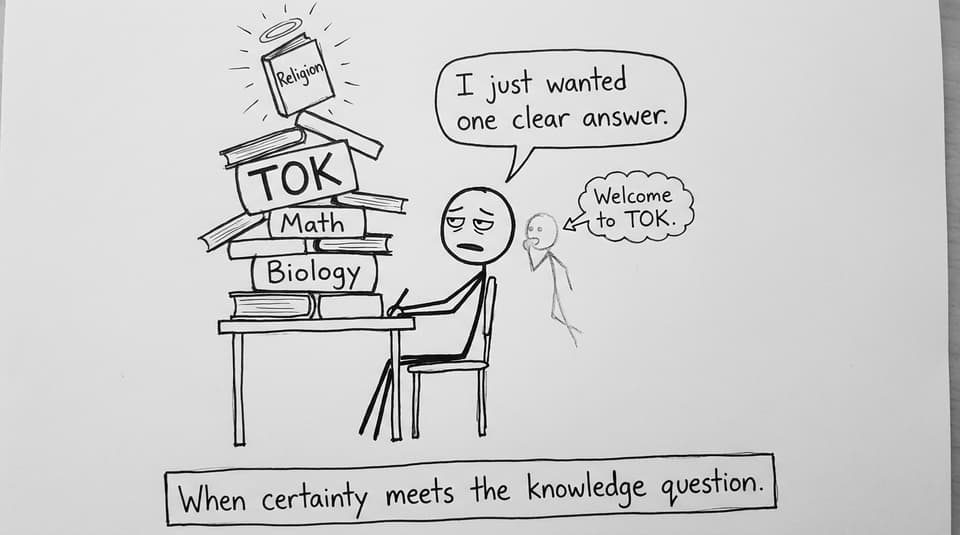
Knowledge and religion in TOK: what you are actually analysing
In TOK, “religious knowledge” is best treated as a set of knowledge claims and practices shaped by communities over time. Your job is to explore how those claims are:
-
Produced (revelation, interpretation, community teaching)
-
Justified (faith, authority, coherence, experience)
-
Shared (language, ritual, institutions)
-
Challenged (pluralism, science, history, internal disagreement)
A strong starting point is RevisionDojo’s dedicated hub for the theme, which helps keep your vocabulary precise: 2.4 Knowledge and Religion.
A fast TOK checklist before you write about religion
Use this checklist to keep your TOK analysis respectful and high-scoring:
-
Define the knowledge claim (not just the belief)
-
Identify the method of justification (faith, authority, reason, experience)
-
Add a counterclaim that targets the method, not the people
-
Use one real-world example and explain what it shows about knowledge
-
Link to at least one AOK (often Ethics, History, Human Sciences, or Religious knowledge systems)
If you want a broader map of where religion sits among AOKs, this guide helps: TOK Areas of Knowledge (AOK) explained with examples.
Framing strong TOK knowledge questions about religion
The best TOK questions stay open-ended and transferable. They do not ask “Is this religion true?” They ask how knowledge works.
Good TOK knowledge question stems include:
-
To what extent can faith justify knowledge claims?
-
How does language (metaphor, symbol, story) shape what is understood as knowledge?
-
Under what conditions can religious knowledge be shared across cultures?
For turning a vague idea into a clean KQ, use: TOK Essay Titles: What Are Knowledge Questions?.
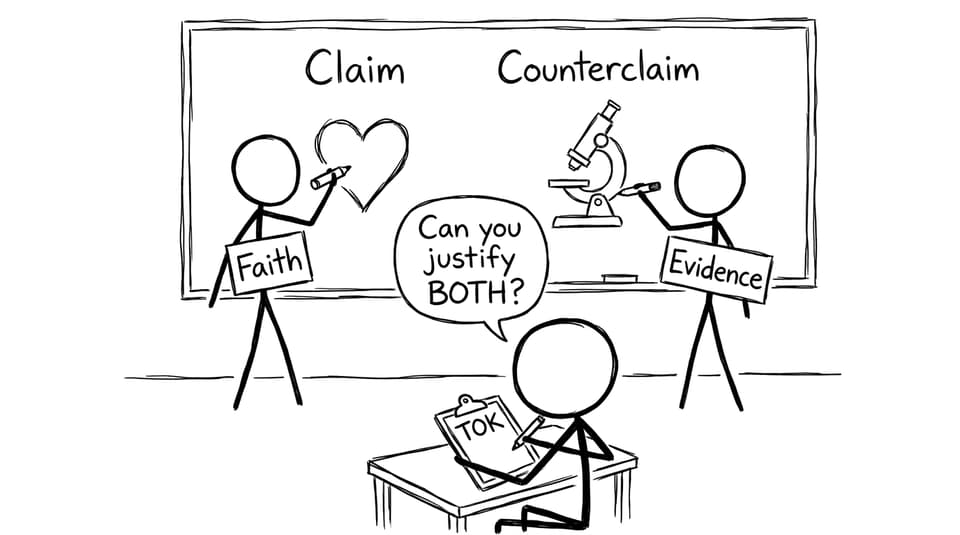
Claims and counterclaims: keep the debate about knowing, not believing
Religion is a gift to TOK because it naturally creates tension between different standards of proof.
A claim you can build
Religious knowledge can offer forms of understanding (meaning, identity, moral orientation) that are not reducible to empirical testing. Faith and communal tradition can function as justifications inside a system with shared assumptions.
A counterclaim that stays analytical
If knowledge requires public standards of evidence, religious claims may be difficult to validate across communities. When justifications depend heavily on authority or personal experience, disagreement becomes hard to resolve.
Your paragraph quality often depends on structure. If your ideas feel scattered, anchor them with: Structuring for Success in IB TOK Essays or the more detailed blueprint: Comprehensive Guide to IB TOK Essay Structure.
Using real-world examples in TOK religion discussions
In TOK, examples are not decoration. They are evidence of how knowledge is formed and contested.
Try examples like:
-
A debate where a scientific explanation and a religious interpretation coexist or clash (analyse what each side treats as “good justification”).
-
A religious ritual strengthening community identity (analyse how shared practice transmits knowledge and values).
-
Historical change in interpretation of religious texts (analyse the role of language, context, and authority).
If you need a reminder of how communities shape what people accept as knowledge, these notes are useful: How Groups Shape What We 'Know' (notes).
Ways of knowing: why religion is a TOK pressure test
Religion touches nearly every Way of Knowing, which is why TOK examiners like it.
-
Faith can operate as trust in a framework when evidence is limited.
-
Emotion can intensify certainty and commitment, making beliefs feel self-evident.
-
Language (symbol, metaphor, sacred text) can expand meaning but also create ambiguity.
-
Reason appears in philosophical arguments, but also in internal consistency checks.
To build these links with more confidence, RevisionDojo’s broader TOK toolkit is a strong base: IB Theory of Knowledge Resources.
Conclusion: the calm way to score higher in TOK on religion
The knowledge and religion theme is not a trap. It is a training ground. TOK rewards students who can hold two ideas at once: that faith can be meaningful and that justification standards matter. Build knowledge questions that focus on how knowing happens, balance claims and counterclaims, and make examples do analytical work.
When you want that process to feel structured, not overwhelming, use RevisionDojo as your home base: the TOK resources, Study Notes, Flashcards, AI Chat, Grading tools, and Questionbank are designed to turn big themes into clear exam-ready writing.