


In the last week before a lab report is due, a strange kind of gravity appears.
It pulls your results toward what you wish they were.
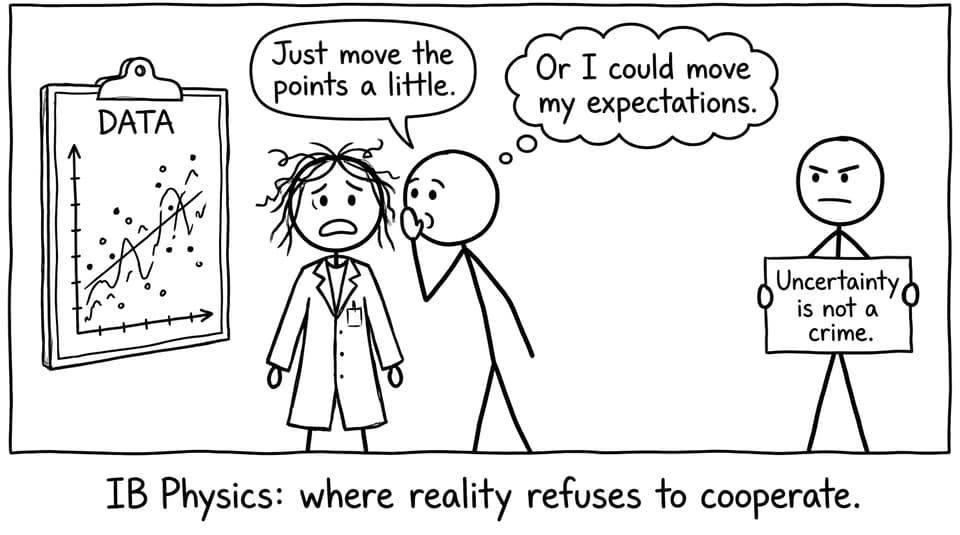
You look at a graph that is almost perfect, almost. One point sits slightly off the trendline like a stubborn truth. And in that moment, IB Physics stops being only about forces, fields, and formulas. It becomes about character: whether you treat measurement as evidence or as decoration.
Integrity in IB Physics is not a soft, optional value. It is the core operating system of science. A clean method, honest data, and transparent thinking are what turn a messy experiment into meaningful learning, and what turn exam revision into real confidence.
If you want a home base for the course while keeping your work ethical, start with the IB Physics Resources hub and build your habits from there.
Quick integrity checklist for IB Physics students
Use this as a fast self-audit before any practical write-up, IA draft, or exam-style practice:
-
Record data as measured, not as expected.
-
Keep raw data safe: photos, tables, sensor files, and timestamps.
-
State uncertainties and significant figures consistently.
-
Justify any removal of anomalies (with reasons, not vibes).
-
Show your full processing method (so someone else could reproduce it).
-
Credit every borrowed idea: constants, diagrams, simulations, and definitions.
-
Use tech (and AI) to support reasoning, not replace it.
This is the quiet secret of IB Physics: examiners and teachers reward clarity and honesty more than perfect-looking numbers.
What integrity means in IB Physics (in real student terms)
When students hear “academic honesty,” they often imagine plagiarism rules and scary consequences. In IB Physics, integrity is more practical than that.
It means:
-
Ethical experimentation: your setup is safe, fair, and designed to test a question rather than confirm a belief.
-
Data honesty: your measurements are reported as they happened, including imperfections.
-
Transparent analysis: you show how you processed data, not just the final values.
-
Crediting sources: you acknowledge where ideas or information came from.
The aim is simple: if another student repeated your work, they should understand what you did and why, even if they get different numbers.
Ethical experiment design: fairness begins before the first measurement
Most integrity problems don’t start with cheating. They start with panic and poor planning.
Ethical design in IB Physics looks like this:
Keep it safe and approved
Labs can involve electricity, heat, moving objects, lasers, and glassware. If you are unsure about risk, you ask early. Safety is not a formality; it is part of scientific responsibility.
Control variables like you mean it
A “fair test” is not a slogan. It is the structure that makes your conclusion credible. If you are investigating how force affects acceleration, you keep mass constant. If you can’t keep something constant, you measure it and discuss the impact.
To strengthen core mechanics thinking (and reduce experimental confusion), revise the fundamentals with the Mechanics topic hub and practise with the Mechanics questionbank.
Design for measurement, not miracles
Students sometimes choose experiments that require precision equipment they don’t have. Ethical planning means choosing a method where your tools can actually detect change. A humble investigation with clear uncertainties beats an ambitious one that forces you to “fix” the data later.
Data honesty: how to collect results you can defend
In IB Physics, honest data collection is a habit: you document reality as it is, not as you hope it will be.
Write down raw data immediately
Raw data should be recorded directly from the instrument output. Avoid rewriting numbers from memory. If you use a phone stopwatch, note reaction-time limitations. If you use sensors, keep the original file.
Use uncertainties and significant figures consistently
Uncertainty is not an apology. It is part of measurement.
-
Match decimal places to instrument resolution.
-
Record uncertainty alongside measurements.
-
Keep sig figs consistent throughout processing.
A good way to stay aligned with exam expectations is keeping formula use tidy. The Physics Data Booklet is a useful reference point while you practise.
Calibrate and describe conditions
Tiny details can matter: angle alignment, room temperature, background light, friction, and power supply drift. Honest data includes notes about the environment, especially when conditions could influence the trend.
Processing and graphing without “massaging” results
A clean graph can be honest. A clean graph can also be a lie. The difference is whether the cleanliness comes from clear method or hidden manipulation.
Don’t delete anomalies unless you can justify them
An “anomalous” point is not the same as an “inconvenient” point.
Valid reasons to exclude a point might include: sensor error, a clear slip in procedure, or an equipment malfunction you documented. If you remove a point, explain why, and show what happens if you include it anyway.
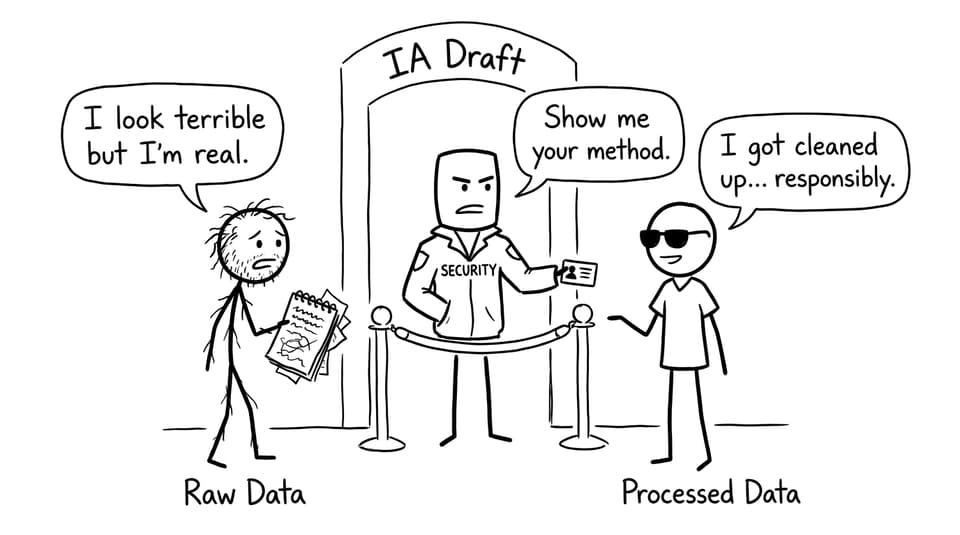
Show your method, step by step
If you linearise, explain what you plotted and why. If you average repeats, show the repeats. If you propagate uncertainties, state the approach. Integrity is often just visibility.
RevisionDojo helps here because the platform encourages you to practice the reasoning, not just the final answer: use IB Physics Lessons to see worked thinking, then drill the same idea in the IB Physics Questionbank until it feels natural.
Citing sources in IB Physics: give credit without overthinking it
Physics is shared knowledge. Your job is not to pretend you invented it; your job is to show you understand it.
Cite when you use:
-
Constants and reference values (when not provided by the data booklet).
-
Diagrams or images you didn’t create.
-
External datasets or tables.
-
Simulations and tools.
-
Definitions or niche explanations that clearly come from a specific source.
A simple consistent style is enough. What matters is that the reader can trace what you borrowed.
If you want a broader integrity framework across IB components, keep this guide bookmarked: How to Uphold Academic Integrity in IB Assessments.
Ethical tech and AI use: assistance is fine, autopilot is not
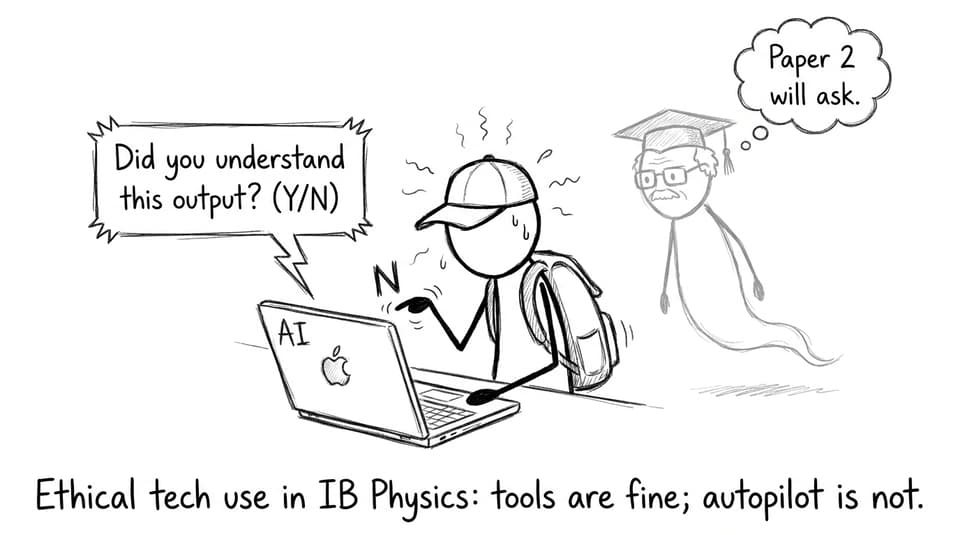
Modern IB Physics students use spreadsheets, graphing tools, video analysis apps, and sometimes AI chat tools. The ethical line is not “never use tech.” The ethical line is “never outsource understanding.”
Use tech ethically by:
-
Disclosing the tool you used (especially for processing/graphing).
-
Checking outputs with a small hand-calculation sample.
-
Being able to explain the steps in words.
-
Avoiding AI-generated analysis that you cannot defend.
RevisionDojo’s AI Chat is best used like a tutor at your desk: ask for explanations, alternative methods, and error-checking, then write in your own voice. Pair it with Study Notes and Flashcards to build understanding before you attempt timed sets.
Collaboration vs collusion: working together without crossing the line
Physics labs are often collaborative, and discussion is part of learning. The integrity risk comes when collaboration turns into shared wording, shared calculations, or shared conclusions.
Safe collaboration in IB Physics usually looks like:
-
Sharing equipment and collecting data together (if your teacher allows it).
-
Discussing how to improve method.
-
Comparing whether results are broadly consistent.
Risky collaboration includes:
-
Copying someone’s processing steps or spreadsheet.
-
Writing the same evaluation paragraphs.
-
Reusing another person’s graph format so closely it becomes identical.
A helpful mindset: you can share the experiment, but you cannot share the thinking.
If you are doing the IA, make sure you understand the expectations from the start: IB Physics Internal Assessment Guide and especially Essentials of the Internal Assessment.
Exam season integrity: honest practice is the fastest path to marks
Integrity is not only about coursework. It is also about how you prepare.
When students “kind of” do questions with notes open, they get the warm feeling of progress without the reality check. Honest practice means simulating the conditions that will actually exist.
To train properly:
-
Use timed sessions.
-
Mark carefully.
-
Keep an error log.
-
Reattempt similar questions later.
RevisionDojo makes this loop simple: use Mock Exams and Predicted Papers for realistic rehearsal, then return to the Questionbank to target weaknesses.
Try these pages:
FAQ: Integrity in IB Physics
What counts as misconduct in IB Physics, and what is just a mistake?
Misconduct in IB Physics usually involves misrepresentation: plagiarism, fabricated data, altered results, collusion, or submitting work that is not genuinely yours. A mistake, on the other hand, is a real error in method, calculation, or interpretation that you openly show and discuss. The key difference is intent and transparency. If your uncertainty calculation is wrong but your steps are visible, that is fixable learning. If your data suddenly becomes “too perfect” because you changed it, that damages credibility. In science and in IB Physics, the honest version of imperfect work is always safer and often scores better.
Can I use group data for my IB Physics IA or lab write-up?
Sometimes you can, but only if your teacher explicitly allows it and you acknowledge it clearly. Even when data collection is shared, your processing, graphs, uncertainty work, evaluation, and conclusion must be your own. In practice, the risk is that shared spreadsheets lead to identical analysis, which can look like collusion. A good protection is to keep your own lab notebook and build your own processing from raw measurements, even if the raw set is shared. You should also be able to explain, out loud, what each column in your table means and why you processed it that way. In IB Physics, ownership is demonstrated through reasoning, not through possession of a file.
What should I do if my results don’t match the theory I expected?
You report them honestly, then treat the gap as the most interesting part of the investigation. In IB Physics, unexpected results often come from uncontrolled variables, instrument limitations, systematic errors, or assumptions in the model that aren’t perfectly true in a school lab. Your job is to discuss these possibilities calmly, with evidence from your method and observations. You can compare percentage difference, evaluate whether uncertainties overlap, and suggest realistic improvements. A thoughtful evaluation can turn “wrong” results into a strong scientific report. The examiner is not grading you on whether nature behaved; they are grading you on whether you noticed what nature actually did.
Is it okay to use AI tools while studying IB Physics?
Using AI for learning support can be okay, but you must use it responsibly and within your school’s rules. The safe use case is asking for explanations, alternative solution approaches, or help identifying which topic a mistake relates to, then doing the work yourself. The unsafe use case is copying AI-generated answers, analysis, or evaluation text into assessed work. Even during exam prep, relying on AI to “solve” questions can create a false sense of understanding that collapses under timed conditions. If you use RevisionDojo’s AI Chat, treat it like a tutor: it can guide your thinking, but it cannot sit the exam for you. In IB Physics, your best protection is being able to reproduce the reasoning without the tool.
Conclusion: in IB Physics, the truth is the point
The best scientists are not the ones who never get messy data.
They are the ones who refuse to lie about it.
If you build integrity into your daily IB Physics habits, ethical experiment design, raw data discipline, transparent processing, and honest reflection, you don’t just protect your coursework. You train the exact mindset that scores marks under pressure: clear method, clear communication, and calm evaluation.
When you’re ready to revise with the same honesty you want in your lab work, use RevisionDojo as your system: Study Notes to learn, Flashcards to retain, Questionbank to expose weaknesses, AI Chat to clarify confusion, Grading tools to improve written responses, Predicted Papers and Mock Exams to rehearse timing, plus the Coursework Library and Tutors when you need examples and guidance.
Build the habit once. Let it carry you through every IB Physics paper.