


When the exam clock starts, IB Physics stops being “what do I know?” and becomes “what can I find, fast, and use correctly?” That’s the quiet power of the data booklet. It’s not a safety net for students who forgot formulas. It’s a tool for students who want their thinking to stay clean when pressure gets loud.
If you’ve ever lost marks because you chose the right-looking equation with the wrong symbol, or because your units drifted halfway through a calculation, you already know the truth: using the booklet is a skill. And like any skill in IB Physics, it improves with deliberate reps.
Quick checklist: your IB Physics data booklet routine
Use this checklist for every IB Physics revision session so the booklet feels normal long before the 2026 exams:
-
Download and practise with the same format you’ll see in exams (use a clean copy).
-
Learn where the “high-frequency” equations live (kinematics, energy, circuits, waves).
-
Always copy the equation first, then substitute values (method clarity matters).
-
Circle units and symbols in the question before hunting formulas.
-
Build a one-page “navigation map” (separate from the booklet) for your most-used pages.
Start with the official-style reference here: IB Physics Data Booklet (RevisionDojo).
Why the data booklet matters in IB Physics (especially under time)
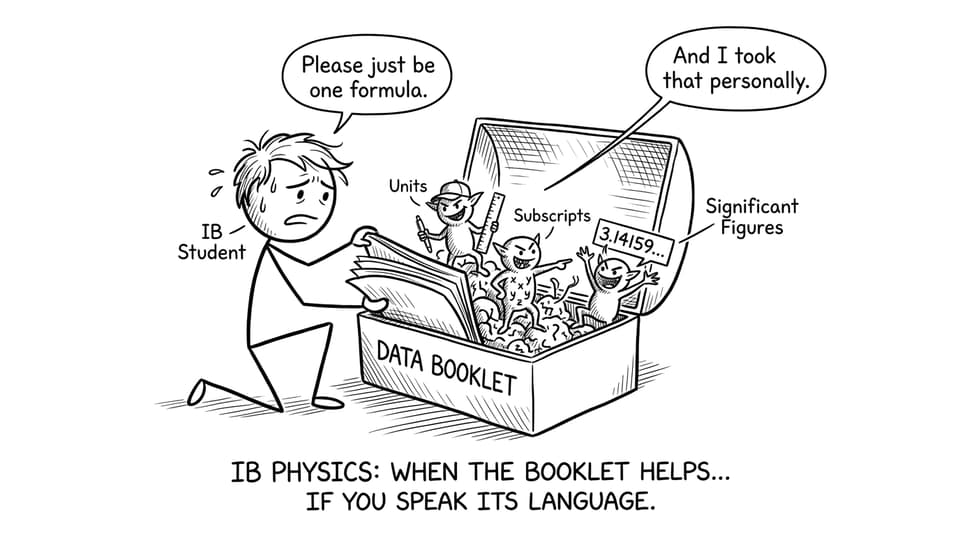
The data booklet isn’t just a list of equations. In IB Physics, it’s a decision-making aid. It helps you:
-
verify constants quickly,
-
avoid inventing equations from memory,
-
keep notation consistent (subscripts are not decoration),
-
reduce cognitive load so you can focus on modelling the situation.
But the booklet only saves time if you’ve trained with it. Otherwise, it becomes a slow scavenger hunt.
To make that training easy, anchor your revision in a single hub and branch outward: IB Physics Resources connects the Data Booklet with Study Notes, Questionbank practice, Flashcards, Predicted Papers, Mock Exams, and AI Chat support.
Learn the structure once, then practise like it’s part of the question
Most students “understand” the data booklet, but they don’t move through it. That’s the difference.
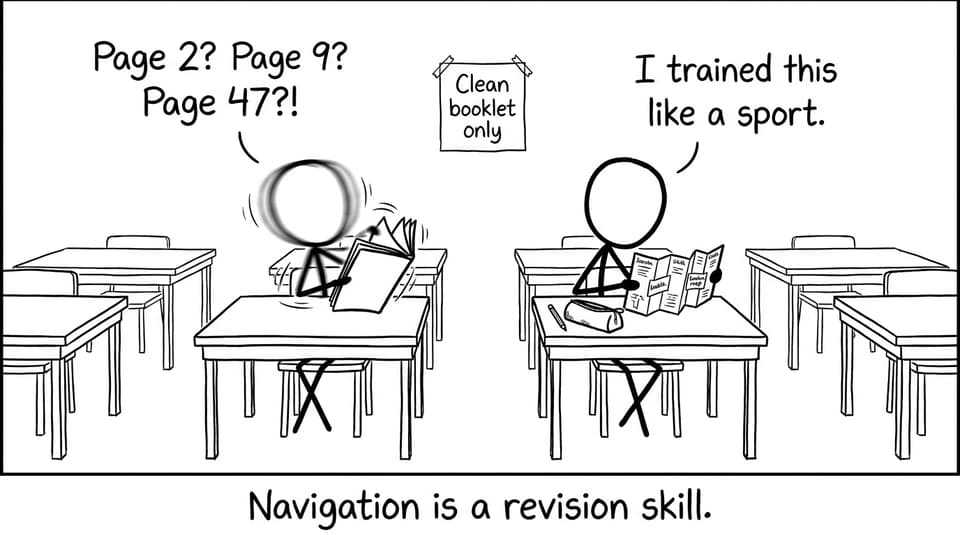
Build a bookmark map (without touching the exam booklet)
You can’t bring an annotated booklet into the exam, so don’t rely on highlights. Instead, create a separate “map” during revision:
-
Page where kinematics equations appear
-
Page where key constants live
-
Page where wave relationships sit
-
Page where circuit symbols remind you what’s what
Then practise until the map becomes automatic.
Use the booklet to earn method marks, not just answers
In IB Physics, working is part of your grade. A dependable pattern is:
-
Write the equation exactly as shown in the booklet.
-
Define symbols as needed (especially if multiple meanings exist).
-
Rearrange algebraically before substituting numbers.
-
Substitute with units.
-
Final answer with sensible significant figures.
If you want extra clarity on what to memorise versus what to lean on the booklet for, read: IB Physics Equations: What to Memorize and What to Understand.
The three most common data booklet mistakes (and how to stop making them)
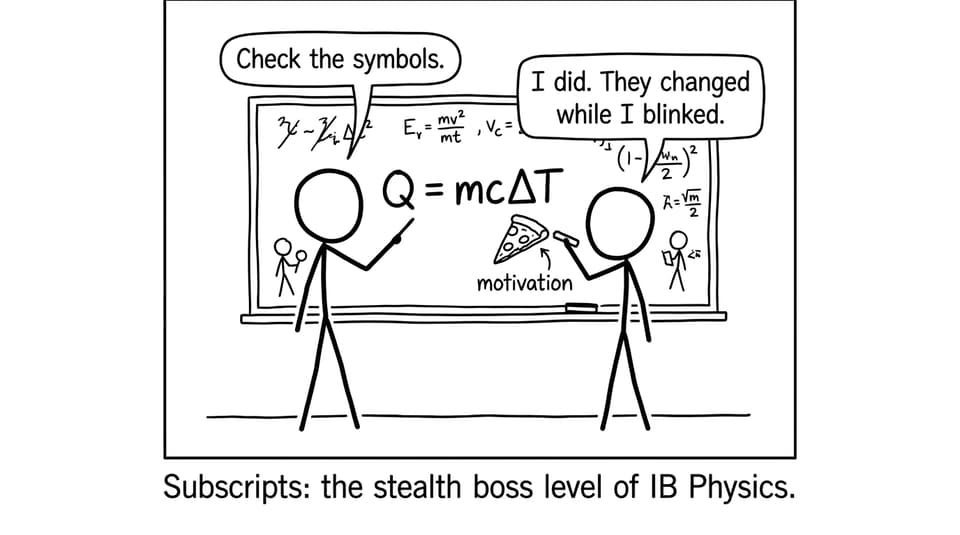
Confusing symbols and subscripts
A single subscript can change the meaning of a whole line of working. Treat symbols like names, not vibes.
A fast fix: after you choose an equation, point to each symbol and say what it represents in this question. If you can’t do that, you haven’t chosen yet.
Forgetting units (or switching them mid-solution)
The booklet is excellent for unit discipline, but only if you actually use it that way. Keep units beside every substituted value, and sanity-check dimensions before the final line.
For targeted practice, drill calculation accuracy and unit consistency with topic sets from RevisionDojo’s Questionbank, like Uncertainties and Errors Questionbank.
Treating the booklet as a last resort
The best IB Physics students open the booklet early, not late. They use it to decide the model: “Is this an energy approach, a momentum approach, or kinematics?” That decision is where marks are won.
If you want a high-pressure routine for doing this daily, use: How to Cram IB Physics (New Syllabus) in 1 Week.
How to practise for the 2026 exams with the booklet (a simple loop)
Here’s a loop that keeps IB Physics revision honest:
-
Study Notes for a topic overview (aim for “I can explain it simply”). Example: IB Physics A.1 Kinematics Notes.
-
Flashcards to lock definitions and relationships (RevisionDojo Flashcards keep recall tight).
-
Questionbank to apply under mild time pressure. Example: B.5 Current and Circuits Questionbank.
-
Predicted Papers / Mock Exams to rehearse full-paper pacing with the data booklet on your desk. Start here: Physics Predicted Papers.
-
AI Chat + Grading tools to diagnose what went wrong quickly (wrong model, wrong equation choice, unit slip, or algebra breakdown).
That’s RevisionDojo’s advantage: it turns the data booklet from a PDF you “have” into a tool you actually use, across notes, questions, feedback, and timed rehearsal.
Conclusion: make the IB Physics data booklet feel boring
The goal isn’t to “use the booklet.” The goal is for the booklet to feel boring in the best way, like a calculator button you don’t think about. In IB Physics, calm comes from repetition: navigating quickly, copying equations cleanly, respecting units, and choosing models with confidence.
If you want a single place to train that skill with Study Notes, Flashcards, Questionbank drills, AI Chat support, Grading tools, Predicted Papers, Mock Exams, and even Tutors when you need a human explanation, start here: IB Physics Resources on RevisionDojo.