When one number refuses to change
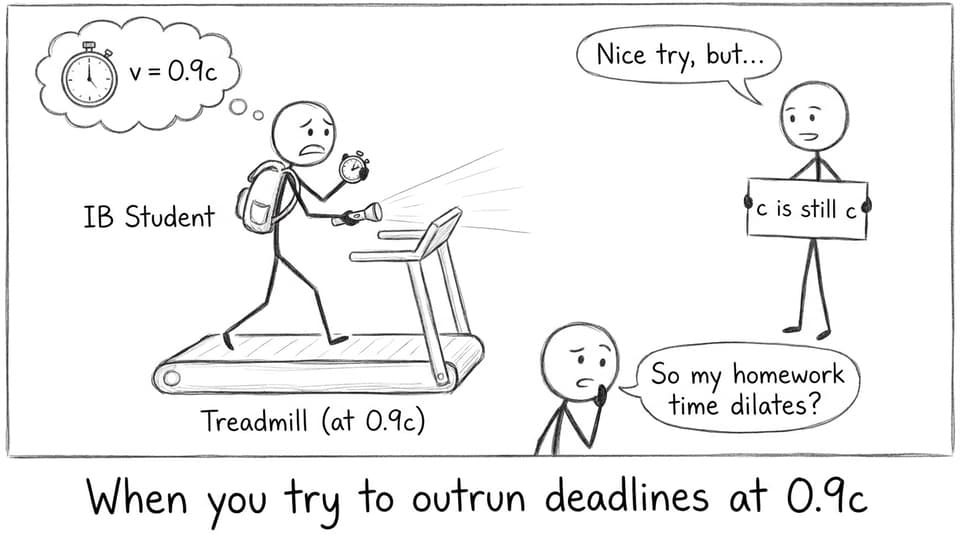
In IB Physics, there’s a moment that feels almost unfair: you learn that the speed of light in vacuum, (c), is the same for every inertial observer. Not “almost the same.” Not “after corrections.” Just the same. And once you accept that constancy, everyday intuition quietly breaks.
Because if you and I are moving relative to each other, classical thinking says our measured speeds should add or subtract. But light refuses to play along. So time and space, the things you thought were the fixed stage for physics, have to adjust instead.
Quick exam checklist (what to say in a strong explanation)
For a top-mark IB Physics response on this topic, hit these points clearly:
-
State the postulate: (c) is constant for all inertial observers.
-
Explain the conflict with Galilean velocity addition.
-
Conclude: to preserve (c), time dilates and length contracts.
-
Add the deeper twist: simultaneity becomes relative.
-
Name the big picture: space and time form spacetime.
If you want the syllabus-aligned version, use the A.5 Galilean and special relativity topic hub.
Why the constancy of light forces time to bend
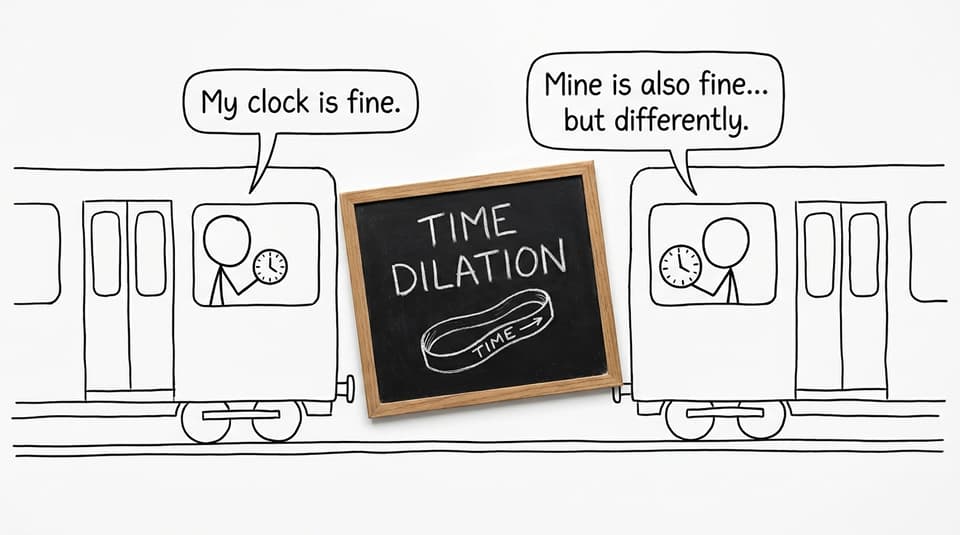
Imagine timing a flash of light inside a moving spacecraft. Inside the craft, the light travels “straight up and down,” and the clock measures a certain interval (\Delta t_0) (the proper time). To an outside observer, that same light traces a longer diagonal path because the craft moves sideways during the trip.
Here’s the problem: if (c) must stay constant, and the distance is longer, the time must also be longer. That’s time dilation:
where (\gamma = \frac{1}{\sqrt{1-v^2/c^2}}).
RevisionDojo’s A.5.2 postulates notes lay out the logic and the equations in an exam-friendly way.
Why space has to contract (yes, really)
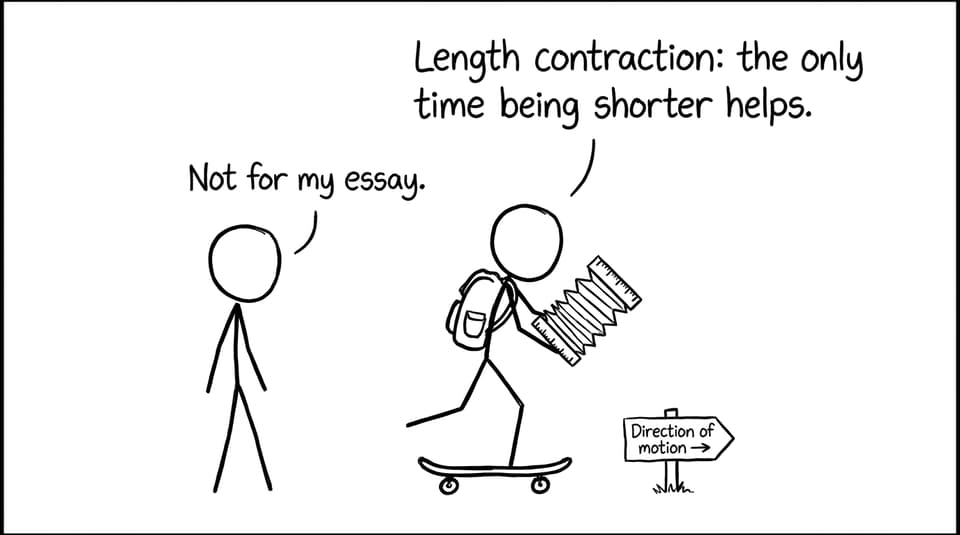
Time dilation alone isn’t the full repair. Distances measured in different frames also shift, specifically along the direction of motion. To keep (c = \frac{\text{distance}}{\text{time}}) consistent for all observers, moving lengths become shorter:
That’s length contraction. It’s not “objects get squashed by a wind.” It’s geometry in spacetime: different observers slice spacetime into “space” and “time” differently.
To practise applying this under pressure, use the A.5.2 Questionbank and aim for full-method solutions, not just final answers.
The sneakiest change: simultaneity breaks
The deepest reshaping of time and space is this: two events that are simultaneous in one frame may not be simultaneous in another. That single idea explains why there can’t be a universal cosmic clock everyone agrees on.
In IB Physics, this is often where explanations get vague. Don’t let it. Say it plainly: observers moving relative to each other disagree on what counts as “at the same time,” so they also disagree on measured time intervals and lengths. Spacetime stays consistent; our measurements depend on the frame.
If you want a conceptual walkthrough to sharpen your phrasing, read What Conceptual Ideas Lead to Time Dilation and Length Contraction?.
How RevisionDojo helps you revise IB Physics relativity faster
Relativity rewards calm, structured practice. RevisionDojo supports that with IB Physics Resources, targeted Flashcards for A.5, step-by-step Relativity lessons, and the wider Questionbank, Study Notes, AI Chat, Grading tools, Predicted Papers, Mock Exams, Coursework Library, and Tutors when you want feedback, not guesswork.
Also keep the Physics Data Booklet reference open during practice so your exam workflow becomes automatic.
Closing: the universe keeps its promise
The constancy of light’s speed is the universe keeping one promise at all costs. In IB Physics, that promise reshapes everything: time can stretch, lengths can contract, and simultaneity can split depending on the frame, yet the physics stays consistent.
If you’re revising this for exams, don’t just reread it. Go practise it: use RevisionDojo’s notes, flashcards, and Questionbank to turn “I get the idea” into “I can explain it in 4 clean sentences under time pressure.”