



A small idea that paints bright and dark stripes
In IB Physics, interference can feel like magic the first time you see it: a clean set of bright and dark fringes appearing out of “nothing,” or a quiet spot in a room where sound seems to vanish. But the trick isn’t hidden in the equipment. It’s hidden in a simple rule: when waves overlap, they add.
That rule is superposition. And once you treat interference patterns as a map of “where adding helps” and “where adding hurts,” the topic stops being mysterious and starts being predictable, the best kind of predictable for exam day.
Quick checklist: what you must say in IB Physics answers
When an IB Physics question asks you to “explain interference using superposition,” you’re usually aiming for these points:
-
State the principle of superposition: resultant displacement = sum of individual displacements.
-
Link phase difference to the type of interference.
-
Define constructive interference (in phase) and destructive interference (antiphase).
-
Mention coherence for a stable pattern (constant phase difference).
-
(If relevant) connect to double-slit or thin films, and describe bright/dark fringes.
For syllabus-aligned phrasing and examples, use RevisionDojo’s 9.3, Interference Notes.
Superposition: the entire engine behind interference
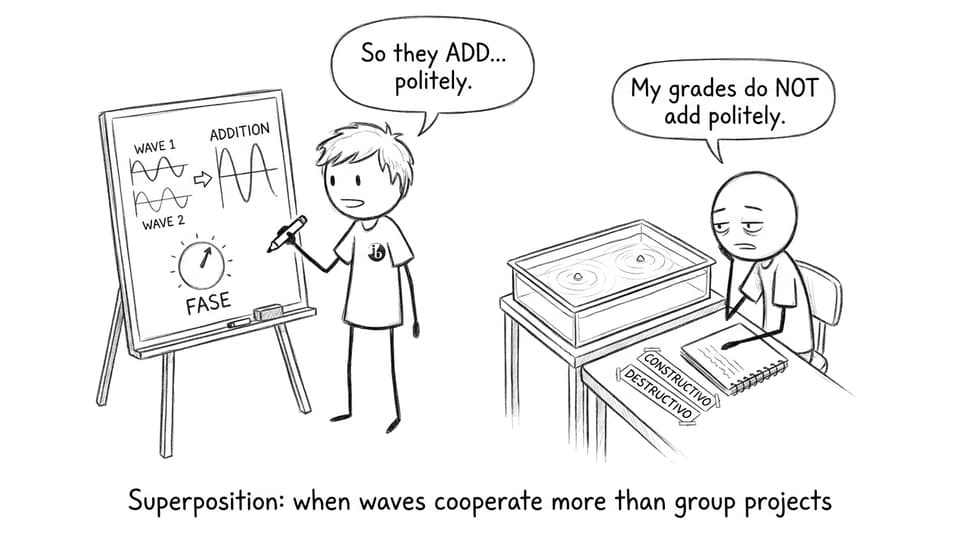
Superposition in IB Physics means this: if two waves meet at a point, the displacement you observe is just the sum of what each wave would have done on its own. The waves don’t “fight,” and one doesn’t permanently change the other. They overlap, add up, and then continue on.
That “add up” is where interference patterns come from. Not from new physics, just from the same addition repeated at every point in space.
If you want targeted practice on exactly this wording (including markscheme-style phrasing), use the 9.3, Interference Questionbank.
Constructive vs destructive interference (phase is the decider)
In IB Physics, constructive and destructive interference are just two outcomes of the same addition.
Constructive interference
When two waves arrive in phase (crest with crest, trough with trough), their displacements add to give a larger amplitude. In optics, larger amplitude means higher intensity, so you see a bright fringe. In sound, it can mean a louder region.
Destructive interference
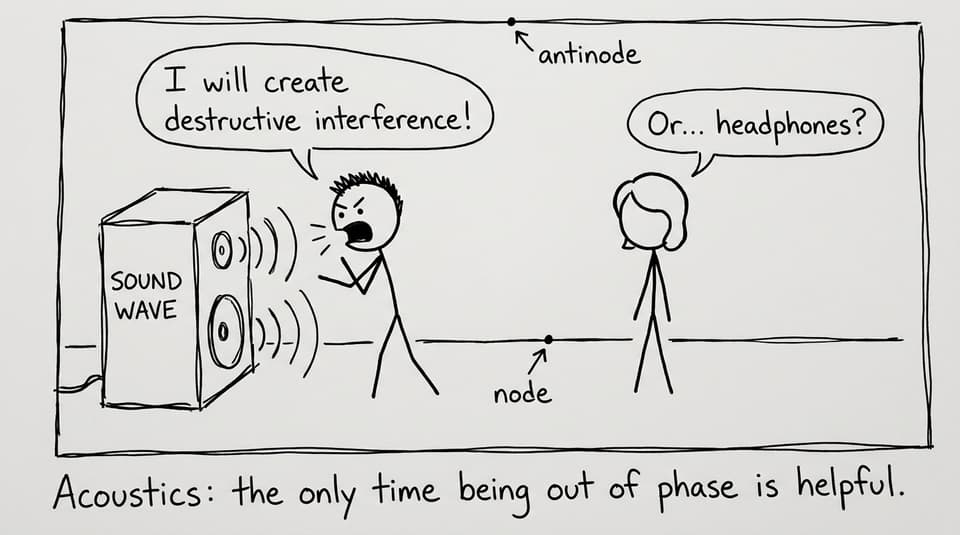
When waves arrive out of phase by (\pi) radians (crest with trough), the displacements subtract. If the amplitudes match, the resultant displacement can be zero at that point. In light this produces a dark fringe; in sound it produces a quiet region.
A useful RevisionDojo drill is to memorize the definitions with spaced repetition using Flashcards for Interference of waves.
Why coherence creates a stable interference pattern
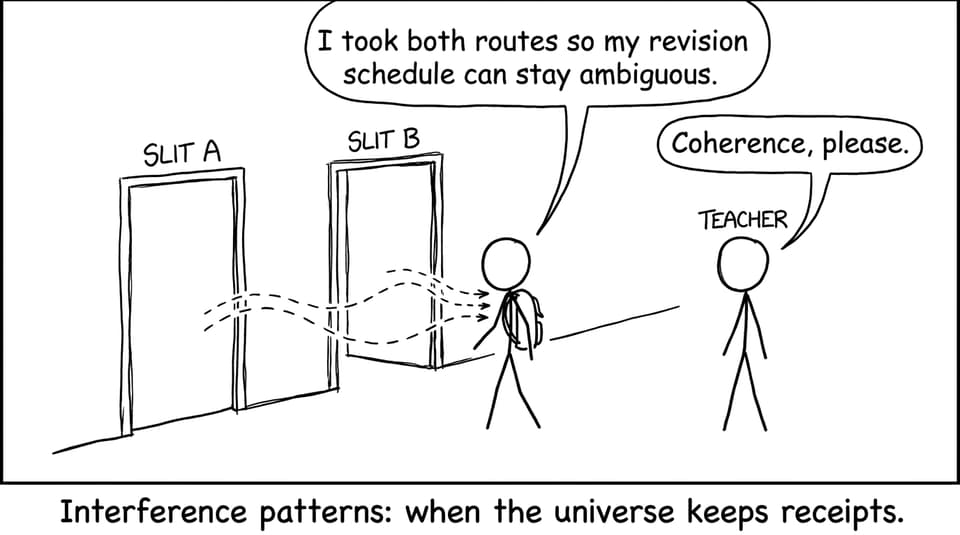
A clear interference pattern isn’t guaranteed. In IB Physics, you need coherent sources: waves with a constant phase difference. That’s why a laser works beautifully in double-slit, while many everyday light sources wash the pattern out.
Think of it like this: superposition is always true, but the pattern only becomes visible when the phase relationship is consistent enough that the “add” and “cancel” regions stay put.
To connect this to the full wave topic, RevisionDojo’s Notes for Wave Phenomena help you place interference alongside diffraction and refraction.
Interference is reversible (a quiet exam-friendly point)
A subtle but powerful detail in IB Physics: interference is temporary. After overlapping, each wave continues as if nothing permanent happened. That’s a clean way to show you understand superposition as “adding displacements,” not “waves damaging each other.”
This idea links naturally to standing waves too, where repeated constructive/destructive interference creates nodes and antinodes. See How two traveling waves form a standing wave for that bridge.
How to revise this fast with RevisionDojo
If you’re prepping for IB Physics exams, don’t just reread definitions. Do a tight loop:
-
Read the core explanation in 9.3, Interference Notes.
-
Test recall with Interference flashcards.
-
Switch to application questions in the C.2 Wave model Questionbank and C.3 Wave phenomena Questionbank.
-
If you get stuck, use RevisionDojo’s AI Chat for step-by-step reasoning, then verify your understanding with the Grading tools.
That combination (concept + recall + application) is what turns superposition from “I’ve seen it” into “I can explain it under pressure.”
The takeaway for IB Physics exam answers
Interference patterns are superposition made visible. In IB Physics, every bright fringe is a place where waves arrive in phase and add; every dark fringe is where they arrive out of phase and cancel. Keep your explanation anchored on displacement addition, phase difference, and coherence.
When you’re ready to lock it in, RevisionDojo gives you the full loop: Study Notes, Flashcards, AI Chat, Grading tools, Predicted Papers, Mock Exams, and a deep Questionbank that trains you to write what examiners reward. Explore more wave topics via All IB Physics posts.