



A strange shortcut at the heart of every star (IB Physics)
If you tried to push two magnets together the wrong way, you would feel the refusal in your hands: invisible repulsion that gets brutally stronger as the distance shrinks. Now imagine doing that with two positively charged nuclei in a star. Classical logic says they should almost never get close enough to fuse.
And yet the Sun shines.
In IB Physics, the reason isn’t “because it’s hot.” It’s because nature allows a quieter, probabilistic shortcut called quantum tunneling. Tunneling is the difference between a star that burns steadily for billions of years and a universe that never gets its long, patient light.
Quick exam checklist: what you must say
When a question asks how quantum tunneling enables fusion (very IB Physics-coded), hit these points:
-
The Coulomb barrier is electrostatic repulsion between nuclei.
-
Core temperatures are huge, but not enough for classical “over-the-top” barrier crossing at the observed fusion rate.
-
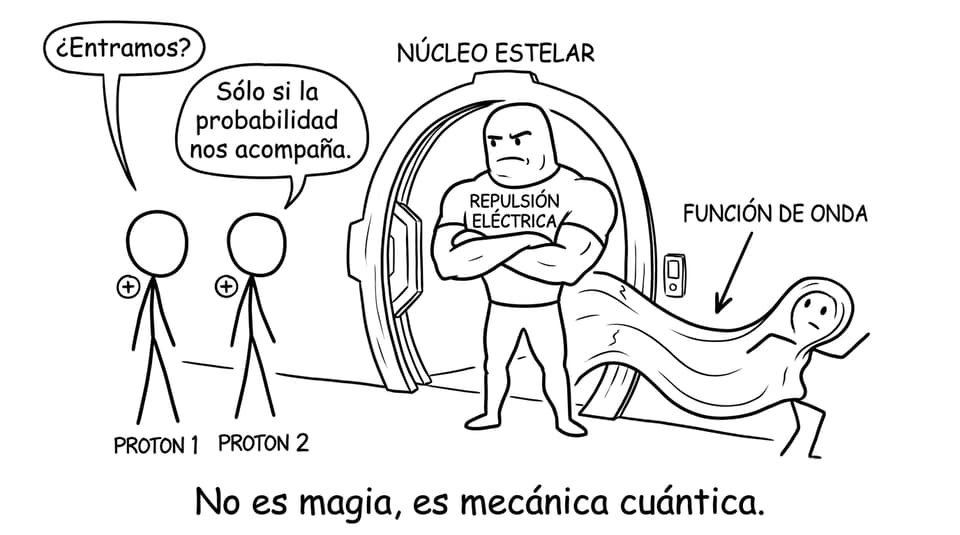
Nuclei have wave-like behavior; the wavefunction can extend into a classically forbidden region.
-
There is a non-zero probability to appear on the other side of the barrier.
-
In stellar cores, enormous collision numbers make rare events matter.
For the syllabus framing and terminology, keep Topic E close: Topic E: Nuclear and quantum physics.
What quantum tunneling changes (and what it doesn’t)
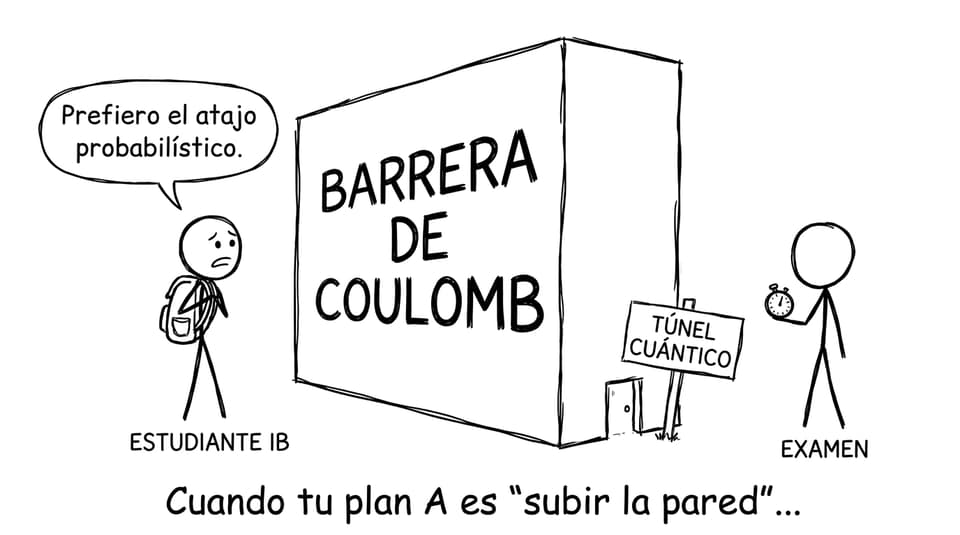
Classically, to fuse, two nuclei must approach within about a femtometer so the strong nuclear force can take over and bind them. The problem is that before they get that close, electrostatic repulsion creates the Coulomb barrier.
Quantum mechanics doesn’t remove the barrier. It doesn’t “give extra energy.” In IB Physics language: tunneling does not violate conservation of energy. Instead, it changes what “allowed” means. Particles are described by a wavefunction, and that wavefunction can leak into the barrier region. If the wavefunction has amplitude beyond the barrier, there’s a real probability the nuclei will be found close enough for the strong force to act.
If you want to review the quantum foundations that IB expects you to use in explanations, anchor yourself in: E.2 Quantum physics (HL) lessons and the matching E.2 notes.
Why stars can “afford” tiny probabilities
Here’s the part students often understate in IB Physics answers: stars don’t need tunneling to be likely, they need it to be possible.
Inside a stellar core, density and temperature mean nuclei collide constantly. Even if only one in an absurd number of collisions results in tunneling, the total number of fusion events per second is still enough to power the star.
This also explains a famous comparison: the Sun’s core is around 15 million K, but without tunneling, classical estimates push the required temperature toward about 10^9 K for comparable fusion rates. Quantum tunneling is what lets hydrogen fusion proceed at the temperatures stars actually have.
To practice turning this into exam wording, use RevisionDojo’s targeted practice: Topic E Questionbank: Nuclear and quantum physics or the broader Atomic & Nuclear Physics Questionbank.
Why fusion rates are so sensitive to temperature
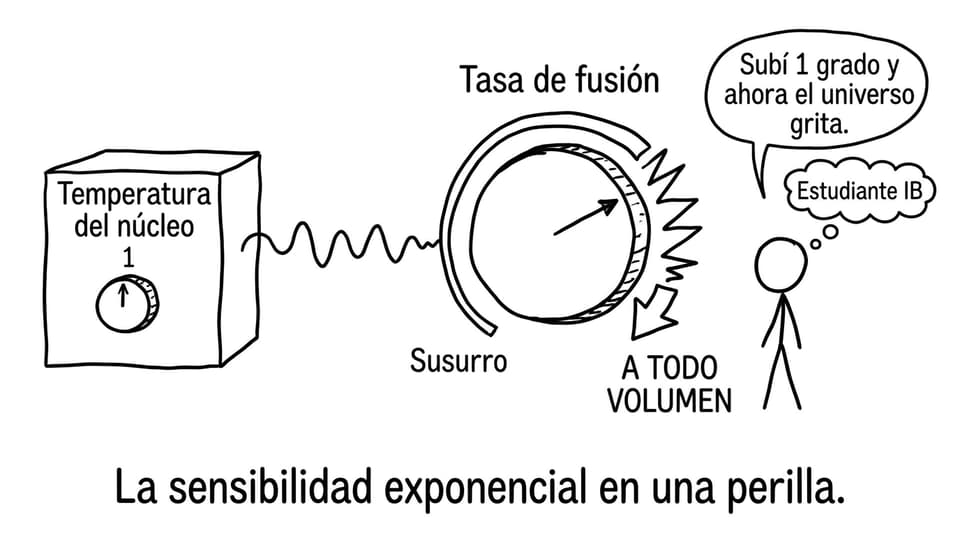
A small increase in core temperature increases average kinetic energy, yes. But the bigger story in IB Physics is that tunneling probability is extremely sensitive to conditions. As temperature rises, nuclei approach faster and get closer on average, making the effective barrier “thinner” in quantum terms. The tunneling probability increases dramatically.
That sensitivity is one reason stars self-regulate: a slightly hotter core leads to a higher fusion rate, which leads to higher outward pressure, expansion and cooling, and a return toward equilibrium.
Bring it home with RevisionDojo (IB Physics)
If quantum tunneling feels like a “one paragraph concept,” that’s usually a sign you haven’t practiced applying it the way IB Physics markschemes reward: clear barrier language, wavefunction probability, and stellar-rate reasoning.
RevisionDojo helps you turn that understanding into marks with syllabus-aligned Study Notes, Flashcards, AI Chat, and the Questionbank for targeted drilling. When you’re ready to simulate pressure, build timed sets with Mock Exams and check your mistakes with Grading tools. And if you want high-yield practice before exams, use Predicted Papers (without relying on luck). Start from the hub: IB Physics resources and keep your formulas tight with the Physics Data Booklet.
Quantum tunneling is the star’s quiet loophole. Master it in IB Physics, and you’re not just memorizing a fact; you’re learning how the universe negotiates the impossible.