


Half the class walks into the exam thinking half-life is a countdown timer. The other half thinks it’s a “magic number” you plug into a formula. In IB Physics, half-life is neither. It’s a quiet lesson about how the universe can be random in the small, yet astonishingly regular in the large.
Radioactive decay is the classic example: you cannot predict which nucleus will decay next, but you can predict the fraction that will decay over time. Half-life is the bridge between those two truths.
The IB Physics definition that actually matters
In IB Physics, the half-life is the time taken for the number of undecayed nuclei (or the activity) to fall to half its initial value. The key word is half: it’s a constant proportion, not a fixed number of atoms.
That proportional thinking is exactly what makes half-life express the statistical nature of decay.
Quick checklist (exam-ready)
-
A single nucleus decays randomly (unpredictable timing).
-
Each nucleus has a constant probability per unit time (the decay constant, (\lambda)).
-
Large numbers of nuclei behave predictably (law of large numbers).
-
This produces an exponential decrease: (N = N_0 e^{-\lambda t}).
-
Half-life is linked by (t_{1/2} = \ln 2 / \lambda).
For the syllabus-aligned formulas and phrasing, use IB Physics Topic E - Nuclear and Quantum Physics.
Why half-life is a probability story, not a schedule
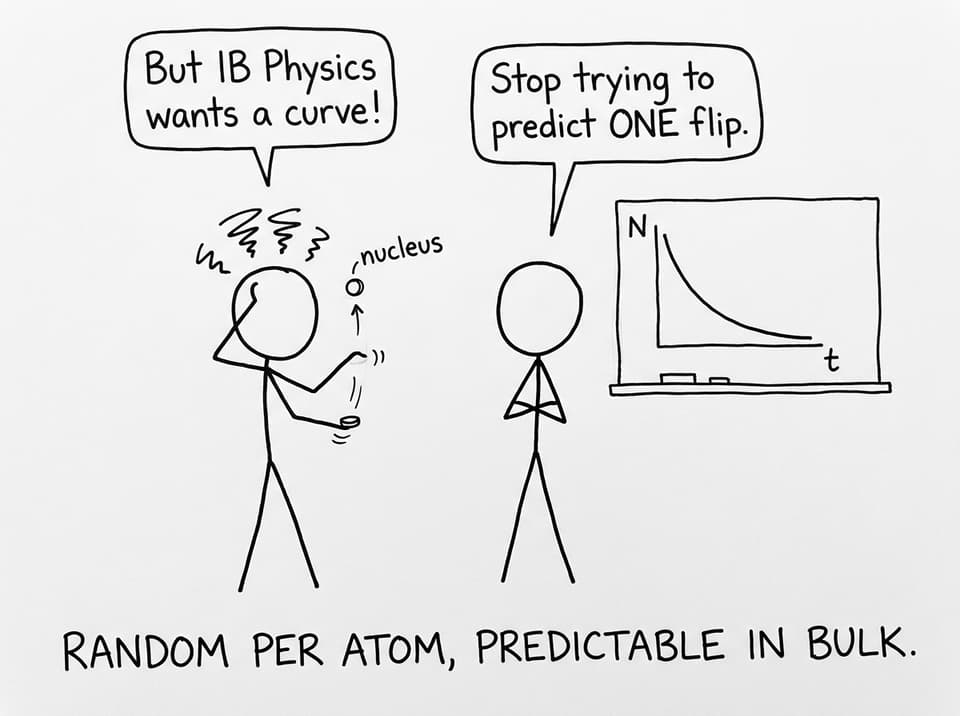
Imagine a stadium full of identical coins, each flipping itself once every second. No coin is “due” for heads. Yet after many flips, you expect about half to show heads.
Decay works similarly. In IB Physics, we say each nucleus has the same chance of decaying in any tiny time interval, regardless of its age. Old nuclei are not “more tired” than new ones. There is no built-in timer.
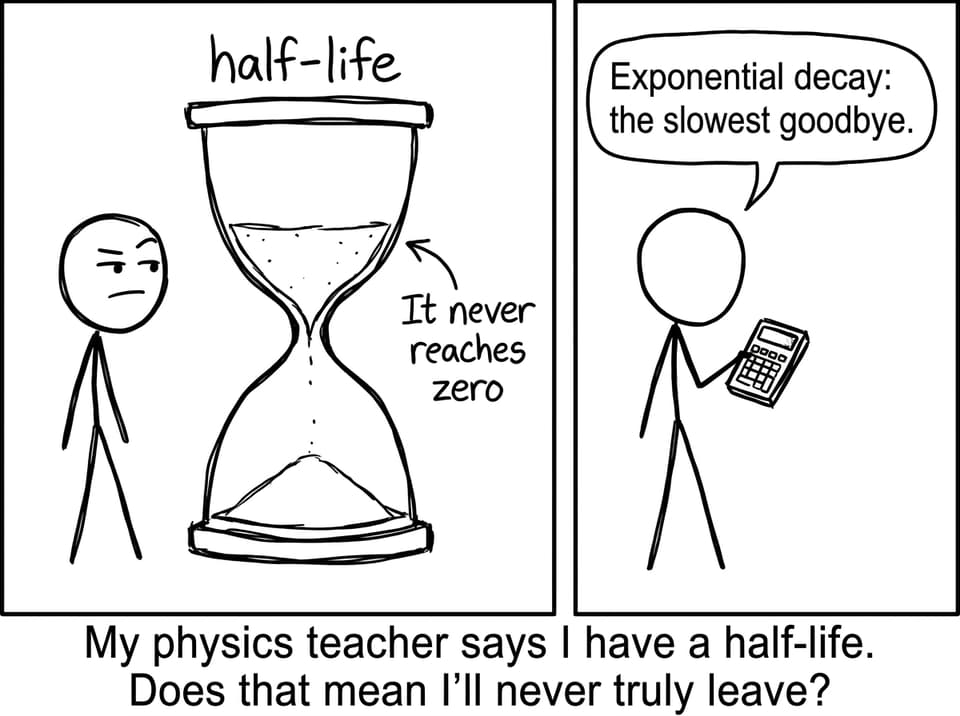
That constant probability creates a curve where the same fraction disappears over equal time intervals. One half-life later: half remain. Another half-life: half of what remains.
To practise how this appears in exam questions, the E.3 Radioactive decay Questionbank is ideal.
The statistical nature of decay: predictable averages from random events
The most important exam insight is this: half-life is not a promise about any individual nucleus. It’s a statistical description of a population.
With a small sample, your counts can jump around. With millions or billions of nuclei, the fluctuations become a small percentage, and the average behaviour becomes steady. This is why measured activity is reliable enough for real applications, and why IB examiners expect you to treat half-life as stable.
If you want the clean explanation of decay law and the meaning of (\lambda), see E.3.3 Quantitative Analysis of Decay Notes.
Independence: why heating it won’t change the half-life
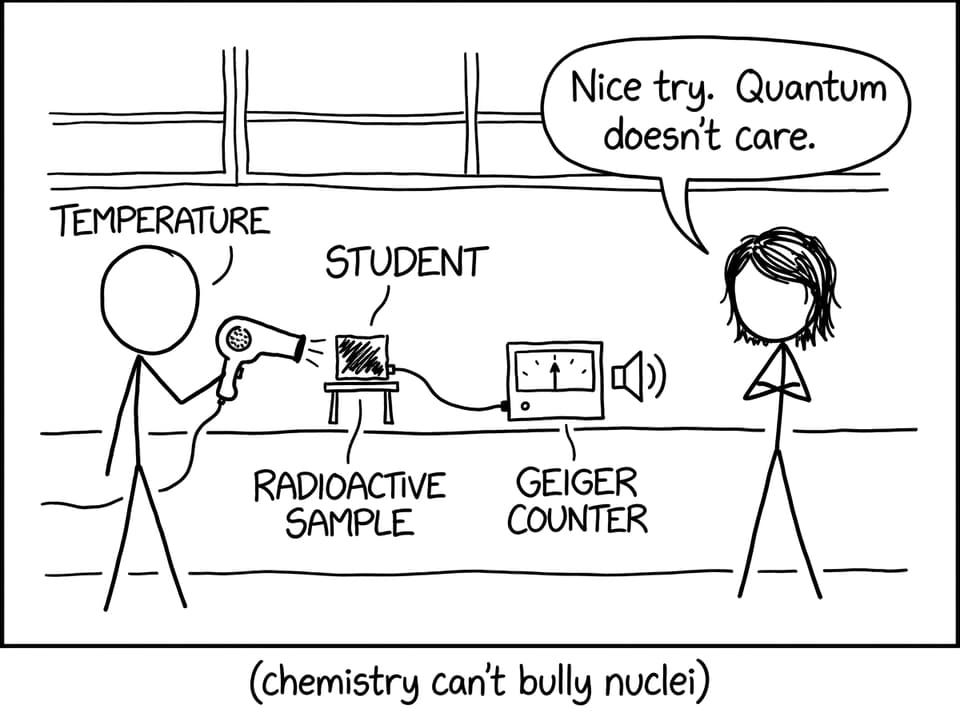
Another way half-life expresses the statistical nature of decay is through independence. Each nucleus decays without “checking” what its neighbours are doing. Under normal conditions, decay is also unaffected by temperature, pressure, or chemical bonding.
That’s not just trivia. It’s a statement that the mechanism is quantum and probabilistic, not mechanical.
For a broader, student-friendly overview that links these ideas together, read Radioactivity Explained Simply.
How to turn this into marks (what IB Physics questions reward)
Examiners usually want you to connect words to the model:
-
Use “random” to mean unpredictable for an individual nucleus.
-
Use “spontaneous” to mean independent of external conditions.
-
Use half-life to show constant fractional decrease.
-
Mention exponential form, or describe the “half of the remainder” pattern.
Then practise until it’s automatic. RevisionDojo helps because you can move from concept to application quickly: build targeted drills in the E.3 Radioactive decay topic hub, and test yourself using the Topic E questionbank. The AI Chat can also walk you through why an exponential model fits better than a linear one, while Flashcards lock in definitions like activity, decay constant, and half-life.
Bringing it home: make randomness work for you in IB Physics
Half-life is how IB Physics teaches you to respect randomness without fearing it. One nucleus is a mystery. A trillion nuclei form a pattern you can calculate, graph, and use to answer exam questions calmly.
If you want that calm in your revision, use RevisionDojo to combine Study Notes, a targeted Questionbank, quick Flashcards, and Mock Exams that force the statistical language to become natural. When the exam asks how half-life expresses the statistical nature of decay, you’ll be ready to explain: individual events are unpredictable, but the population obeys a stable exponential law, and that’s exactly what half-life measures.