



A tiny mystery hiding in a rainbow (IB Physics)
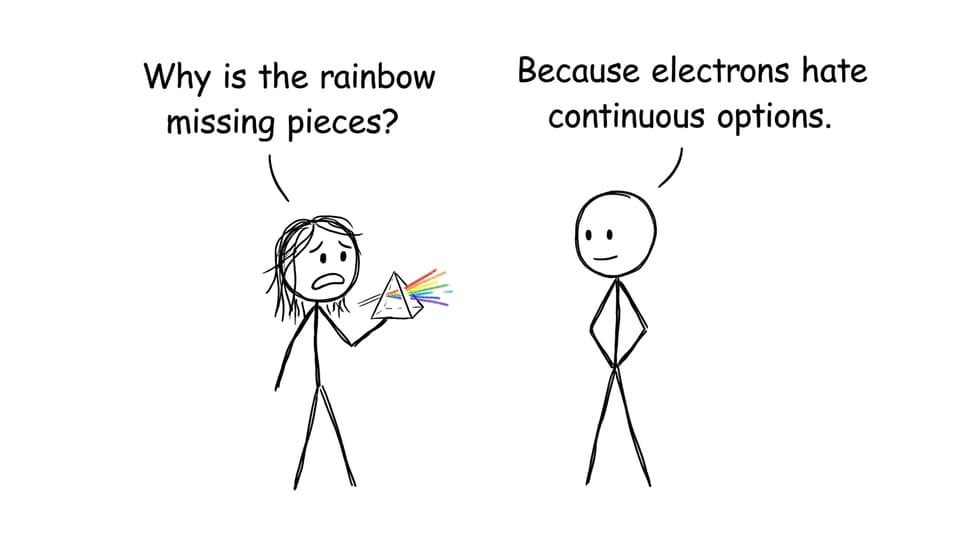
You look at a spectrum and expect a smooth rainbow. Instead, you get bright, razor-thin colored lines, or worse, dark gaps that look like someone erased parts of the light. In IB Physics, that “missing pieces” feeling is the clue. Nature is telling you electrons do not negotiate. They only accept certain energies, and that stubbornness is exactly what creates spectral lines.
Quick exam checklist: what you must say
If the prompt asks how quantized energy levels explain spectral lines, hit these points:
-
Electrons in atoms occupy discrete (quantized) energy levels, not a continuum.
-
A transition between two levels requires an energy change ΔE.
-
A photon is emitted or absorbed with E = hf.
-
Therefore only certain frequencies (and wavelengths) occur, observed as spectral lines.
-
Emission: bright lines (photons released). Absorption: dark lines (photons removed).
For the syllabus framing, keep Topic E close by: Topic E: Nuclear and quantum physics.
Why quantized energy levels create lines, not a smear
In classical thinking, an electron could orbit with any energy. If that were true, atoms would radiate every possible photon energy as electrons spiraled around, the spectrum would blur into a continuous band.
But IB Physics leans on the quantum picture: electrons behave like standing waves bound to the atom. Only wave patterns that “fit” are allowed, so only certain energies exist. That means energy changes come in fixed steps.
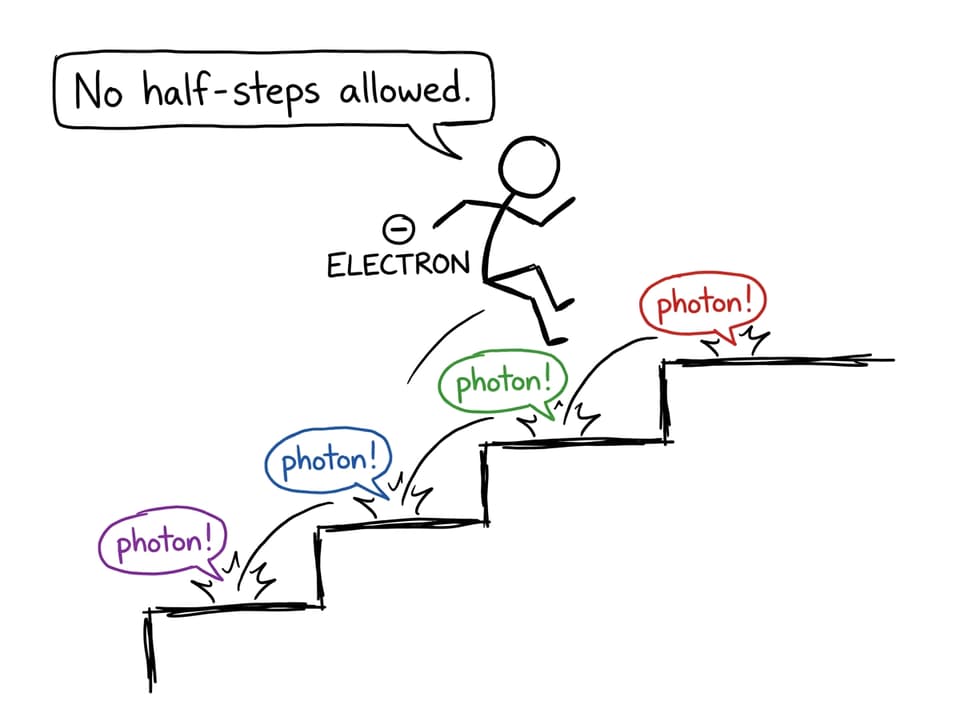
When an electron drops from a higher energy level to a lower one, it cannot release “almost” the right energy. It must release exactly:
-
ΔE = E_high − E_low
-
Photon energy: E = hf = hc/λ
So each allowed transition corresponds to a specific photon frequency f (and wavelength λ). A set of allowed transitions becomes a set of sharp spectral lines.
If you want the clean IB wording (and the hydrogen formula), RevisionDojo’s notes are excellent here: Bohr model and quantized energy levels (HL).
Emission vs absorption: same staircase, opposite direction
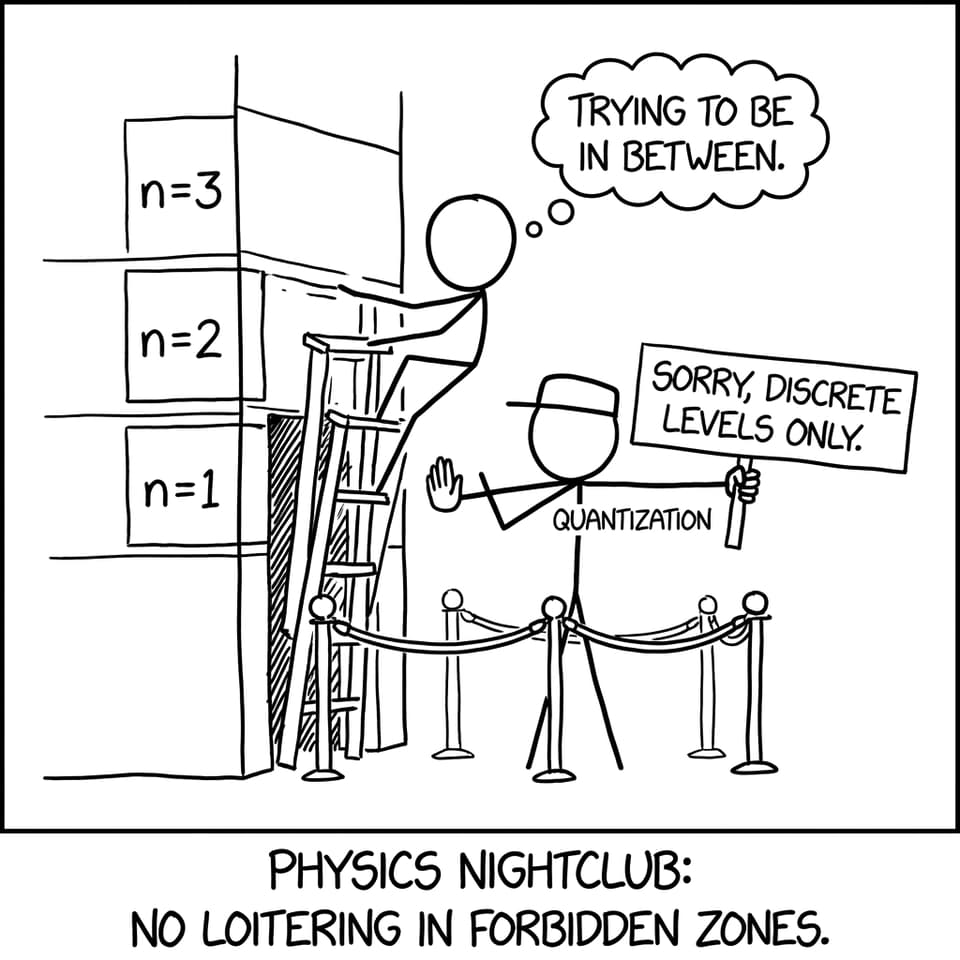
A helpful way to stay calm in exams: emission and absorption are the same story read in opposite directions.
Emission spectra (bright lines)
Give the atom energy (heat, electric discharge, light) and electrons jump up to excited states. Those states are unstable, so electrons fall back down. Each drop releases a photon whose energy equals the gap between the two levels. Because the gaps are fixed, the photons are fixed, bright lines on a dark background.
Absorption spectra (dark lines)
Send white light through a cooler gas. Electrons only absorb photons that match allowed upward transitions. Those specific wavelengths are removed from the spectrum, showing up as dark lines on a continuous background.
To connect this to a broader scientific use case (and a great memory anchor), see: What stellar spectra tell us about composition and movement.
How to turn this into marks on exam day (IB Physics)
Knowing the idea is one thing; scoring is another. Here’s a RevisionDojo-friendly workflow many IB Physics students use:
-
Learn the model with IB Physics resources hub.
-
Drill definitions and equations with the Bohr model flashcards.
-
Practice transitions and spectroscopy questions in the E.1 Structure of the atom Questionbank and the full Topic E Questionbank.
-
When you start mixing up constants or units under pressure, keep a tab open to the IB Physics Data Booklet.
-
Closer to exams, simulate time pressure using IB Paper 1 mock exam strategies and finish with IB Physics predicted papers.
That ecosystem matters: RevisionDojo’s Study Notes, Flashcards, Questionbank, AI Chat, Grading tools, Predicted Papers, and Mock Exams turn the “spectral lines” idea into repeatable exam performance.
Bringing it home
Spectral lines are not random decorations in a data booklet diagram. They are the visible consequence of quantized energy levels: electrons can only stand on certain rungs, so light can only be emitted or absorbed in certain packets. If you can say that clearly, use ΔE = hf, and distinguish emission from absorption, you will score well in IB Physics.
To lock it in, use RevisionDojo’s Questionbank for repetition, Flashcards for recall, AI Chat when the concept feels slippery, and Mock Exams plus Predicted Papers when you want that calm, timed-exam confidence.