



A tiny jar, a huge idea (IB Physics)
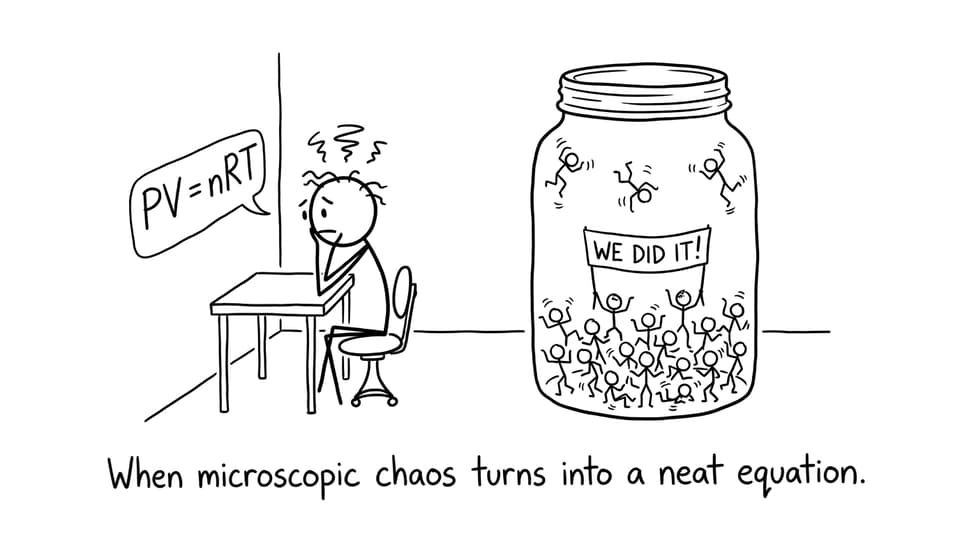
Open a perfume bottle for one second and the whole room eventually knows. No single molecule has a map. Yet the outcome is oddly reliable. That’s the quiet magic at the heart of IB Physics gas laws: microscopic randomness turning into macroscopic certainty.
When you revise Boyle’s law or the ideal gas law, it can feel like memorising rules. But the deeper exam skill is seeing them as emergent patterns, the statistics of countless particles moving, colliding, and swapping momentum.
Quick checklist: what to remember for IB Physics gas laws
-
Pressure comes from particle collisions with container walls (momentum change per time).
-
Temperature measures average kinetic energy (use Kelvin in calculations).
-
Volume controls collision rate with walls (more space, fewer hits).
-
Number of particles scales pressure (more particles, more collisions).
-
Mixtures add pressures because collisions are additive (partial pressures).
For syllabus-aligned practice, start with IB Physics Topic B.3 Gas Laws and then lock in details with IB Physics B.3 Gas Laws Notes.
How pressure emerges from collisions (IB Physics)
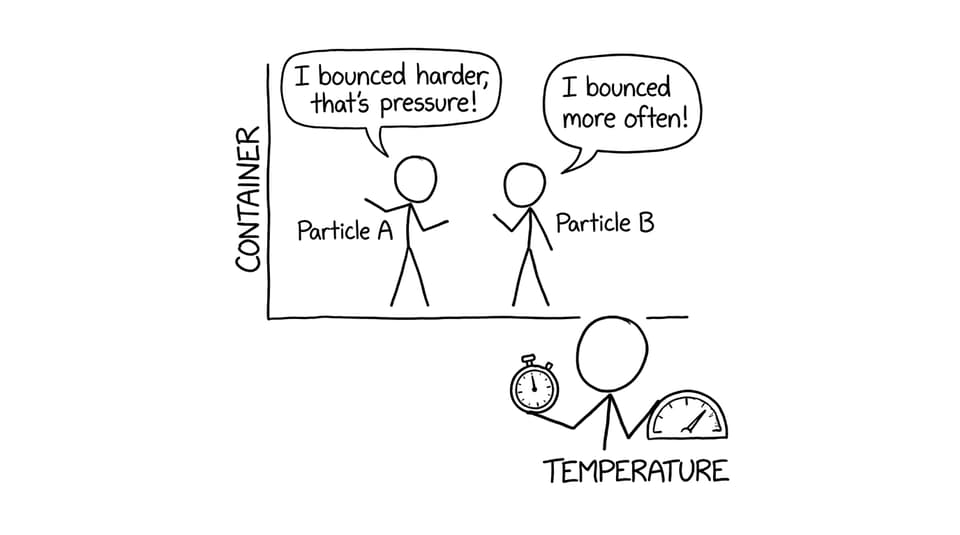
Imagine the container wall as a very patient referee. Each time a particle hits it and bounces back, the particle’s momentum changes. Newton’s second law says force is the rate of change of momentum, so those tiny momentum changes add up to a measurable force on the wall. Divide by area and you get pressure.
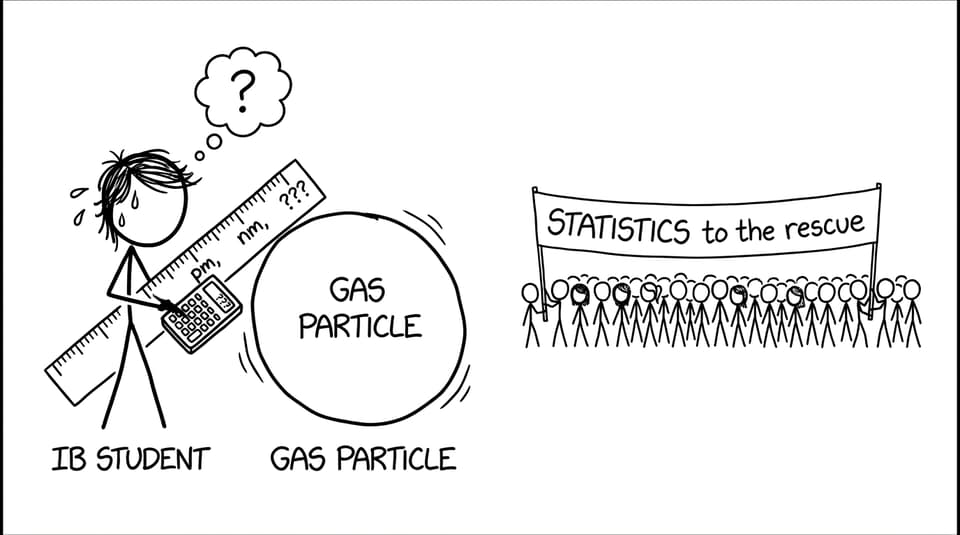
In IB Physics, you don’t need to track any one particle. You need the average behaviour of a huge crowd. That’s why models like the kinetic theory are so powerful: individual motion is unpredictable, but the distribution is stable.
Want the exam-style link between micro and macro? RevisionDojo’s Notes for 3.2: Modelling a gas connect collisions to equations like (PV=nRT) and to quantities like RMS speed.
Why temperature raises pressure (and what “temperature” really means)
A common IB mistake is treating temperature like a “heat amount.” In kinetic theory, temperature is tied to average kinetic energy. Higher (T) means particles move faster on average, so:
-
collisions happen more often, and
-
each collision transfers more momentum.
So if volume is fixed, heating a gas makes pressure rise. That’s not a rule imposed from outside; it’s just the wall getting hit harder and more frequently.
If you’re mixing up heat, internal energy, and temperature, pair your gas-law revision with IB Physics 3.1: Thermal Concepts Notes and then extend into processes using B.2: Thermodynamics Notes.
Volume changes: the simplest way to “see” Boyle’s law
Picture the same set of particles, same average speed, but a bigger box. Now the particles travel further between wall collisions. Collision frequency drops, so the average force on the wall drops, so pressure drops.
That’s Boyle’s law in a sentence: at constant temperature, (P) is inversely related to (V) because the wall gets hit less often when the particles have more room.
To drill this with real markscheme-style steps, use the IB Physics Topic B.3 Gas Laws Questionbank (SL/HL). It’s built for timed practice, and RevisionDojo’s Grading tools help you spot where your reasoning jumps too quickly.
Gas mixtures and “additive chaos”
In a mixture, particles of different types still collide with the same walls. Each species contributes its own momentum transfers. Since forces add, the pressures add too. That’s why partial pressures work so cleanly in the ideal model.
This is also why IB Physics treats ideal gases as universal: the large-scale behaviour depends far more on motion and collision statistics than on chemical identity (until real-gas effects matter).
How to revise this fast with RevisionDojo
When students struggle with gas laws, it’s rarely algebra. It’s translation: micro story (\rightarrow) macro equation.
A good workflow:
-
Read the core explanation in IB Physics B.3 Gas Laws Notes.
-
Memorise definitions and relationships with Flashcards for Topic B: The particulate nature of matter.
-
Practise under pressure using the Thermal Physics Questionbank.
-
When you freeze on a step, use RevisionDojo’s AI Chat to ask, “What microscopic change causes this macroscopic change?” and then retry.
Closing: turn “rules” back into a story (IB Physics)
Gas laws aren’t commandments to memorise; they’re what you get when billions of tiny collisions repeat long enough to become predictable. If you can tell that microscopic story clearly, IB Physics questions on (P), (V), and (T) stop feeling like tricks.
Build that instinct with RevisionDojo’s Notes, Flashcards, Questionbank, AI Chat, and Mock Exams, and use the Grading tools to turn every mistake into a cleaner explanation next time.