



A tiny shift that changes your entire universe
You know that feeling in IB Physics when a question looks innocent, then one symbol changes and everything suddenly means something else? Astronomers live in that world.
Out in space, you can’t attach a speedometer to a galaxy. But you can read the light it sends you. When the wavelength of that light arrives slightly stretched or squeezed, it’s like the universe leaving a note in the margin: this object is moving.
In exam terms, this is the Doppler effect applied to light. In human terms, it’s how we turn faint starlight into a story about motion.
The core idea (quick checklist for exams)
For IB Physics, keep these points tight and ready:
-
Approaching source: observed wavelength decreases becomes blueshift.
-
Receding source: observed wavelength increases becomes redshift.
-
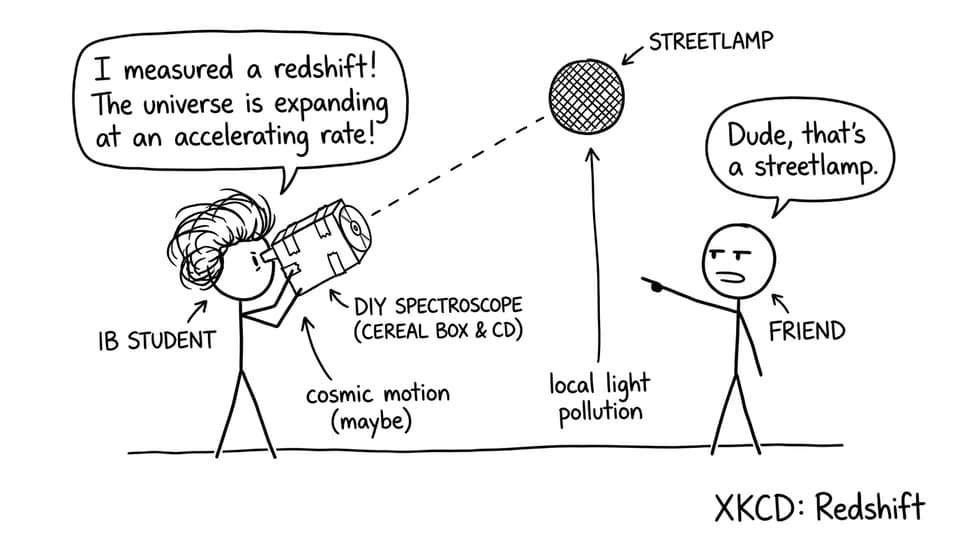
What you measure in practice: spectral lines shift as a whole pattern.
-
For small speeds (non-relativistic): (\Delta\lambda/\lambda \approx v/c).
-
What you’re really finding: radial velocity (motion along the line of sight).
If you want a clean syllabus-aligned refresher, the Doppler effect notes and the newer C.5 Doppler effect notes are built for exactly this.
Why wavelength changes are such powerful evidence
In IB Physics, it’s easy to say “wavelength changes because Doppler.” The deeper scoring move is explaining how we know it’s real.
Astronomical light is not a smooth rainbow. It contains spectral lines\ for specific wavelengths produced by atomic transitions. Think of them like barcodes. In a lab, those lines sit at known “rest” wavelengths. In a telescope, you see the same barcode… just shifted.
That is the key: the entire pattern moves together. This is why astronomers trust wavelength changes to reveal cosmic motion. If you’re hazy on why atoms produce lines at all, this explainer on quantized energy levels and spectral lines ties the physics to what you actually see in spectra.
From galaxies to Big Bang: redshift as a cosmic clue
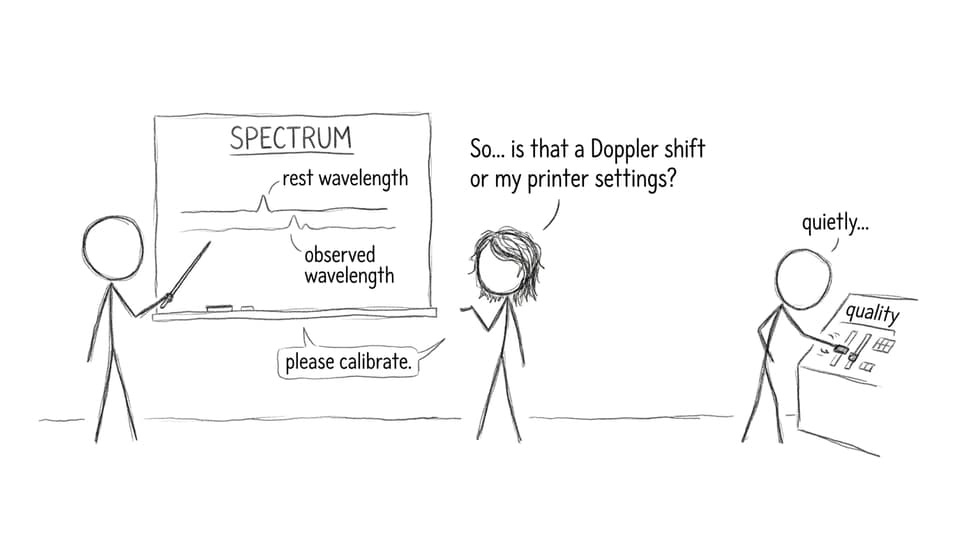
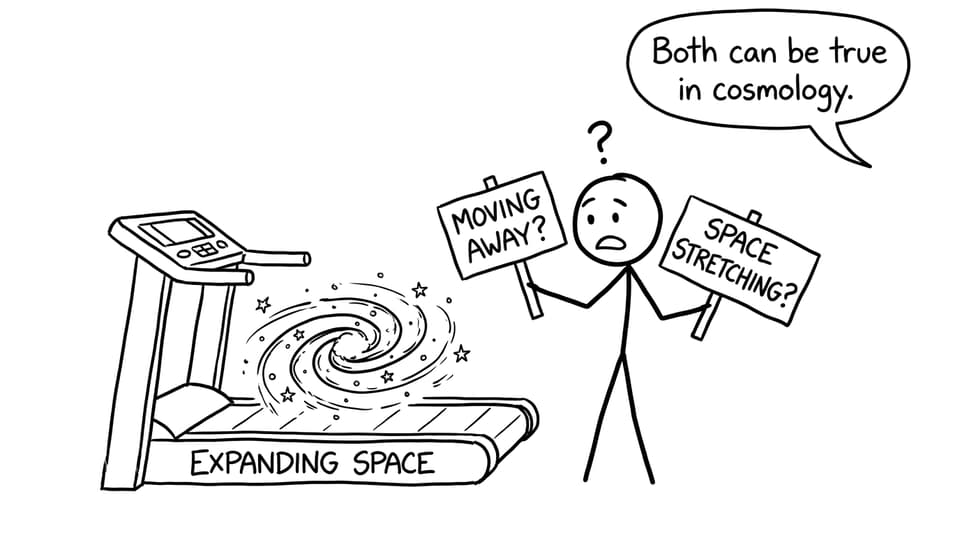
One of the most testable narratives in IB Physics is that distant galaxies tend to show redshift. The farther they are, the larger the shift, which supports the idea of an expanding universe (often discussed with Hubble’s law).
If you want a quick supporting reference to connect redshift to expansion, the Big Bang theory notes are surprisingly useful for keeping the storyline straight, even if you’re studying at DP level.
And if you prefer a compact blog-style recap, what Doppler shifting reveals about relative motion keeps the “direction + speed + line of sight” logic clear.
Local cosmic motion: binaries, exoplanets, and rotation
Wavelength changes don’t just tell grand universe stories. They also reveal “nearby” motion patterns:
-
Binary stars: spectral lines oscillate between redshift and blueshift as stars orbit a shared center of mass. That periodic shift can be used to infer orbital speed and mass.
-
Exoplanet detection: a planet makes its star wobble slightly. The Doppler shift is tiny, but measurable with careful spectroscopy.
-
Galaxy rotation: one edge moves toward us (blueshift) while the opposite edge moves away (redshift), spreading the observed wavelengths and revealing rotational speed.
This complements the broader wave foundations you already know from IB Physics. If you need to rebuild wave intuition quickly, the Wave characteristics notes help you anchor wavelength and frequency before applying Doppler.
Bring it home: make Doppler questions feel predictable
The best part about this topic is that it rewards calm thinking: find the rest wavelength, compare to observed wavelength, decide redshift or blueshift, then link it to radial velocity. That’s the whole spine of many IB Physics questions.
To make it stick, use RevisionDojo the way high scorers actually revise: practice with the C.5 Doppler effect Questionbank, tighten your understanding with C.5 lessons, and reinforce definitions with Wave phenomena flashcards. When you’re ready, use RevisionDojo’s AI Chat to sanity-check your reasoning steps, and the Grading tools to see what an examiner-style explanation looks like.
In IB Physics, wavelength changes aren’t just a detail. They’re the universe’s way of showing its motion, and your chance to pick up reliable marks.