



In IB Physics, standing waves can feel like a magic trick: the wave looks frozen in space, yet everything is still moving. The first time you see it on a string or in a pipe, it’s easy to think, “Wait… where did the wave go?” But the trick is not disappearance; it’s interference. Two traveling waves keep moving, and your eyes just catch the stable pattern they add up to.
The exam-ready idea (quick checklist)
To explain standing waves in IB Physics, you usually need these points:
-
Two traveling waves move in opposite directions in the same medium.
-
They have the same frequency and same amplitude (or very similar).
-
They overlap and combine via the principle of superposition.
-
The result is a stationary pattern of nodes (always zero displacement) and antinodes (maximum displacement).
-
Boundary conditions (fixed ends, open/closed pipe ends) decide which wavelengths “fit.”
If you want syllabus-aligned support, start with C.4 Standing waves and resonance and then drill questions in the C.4 Questionbank.
How two traveling waves combine to form a standing wave
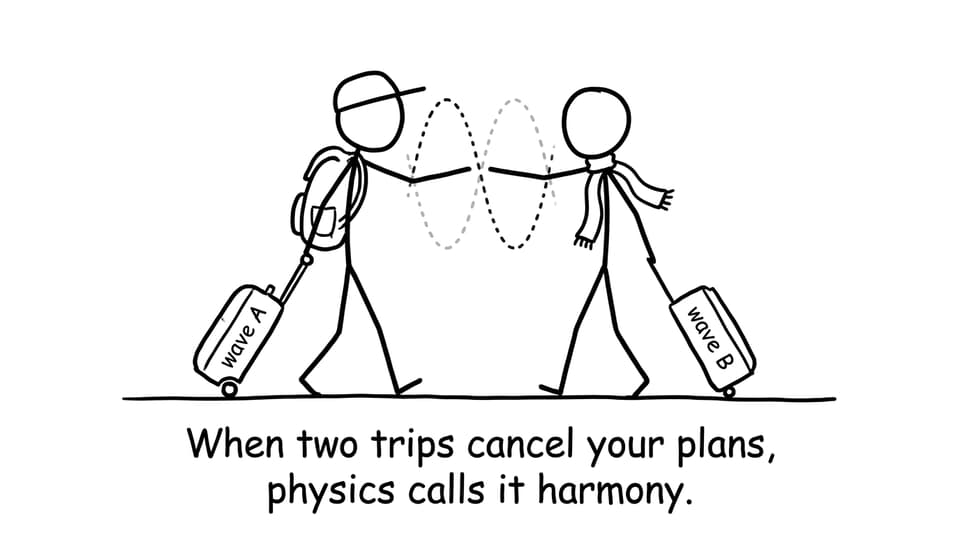
A standing wave forms when two identical waves travel through each other in opposite directions. In IB Physics, you phrase this as: two waves of equal frequency and amplitude moving oppositely superpose to create a stationary interference pattern.
Here’s the key: at every position along the string/air column, the displacement is the sum of the two displacements (superposition). Because one wave is essentially the mirror-travel version of the other, some points are always out of phase (cancel forever), while others are always in phase (reinforce forever). That “forever” is what makes the pattern look pinned down.
For the official wording and the properties examiners expect, revise C.4.1 Formation and properties of standing waves.
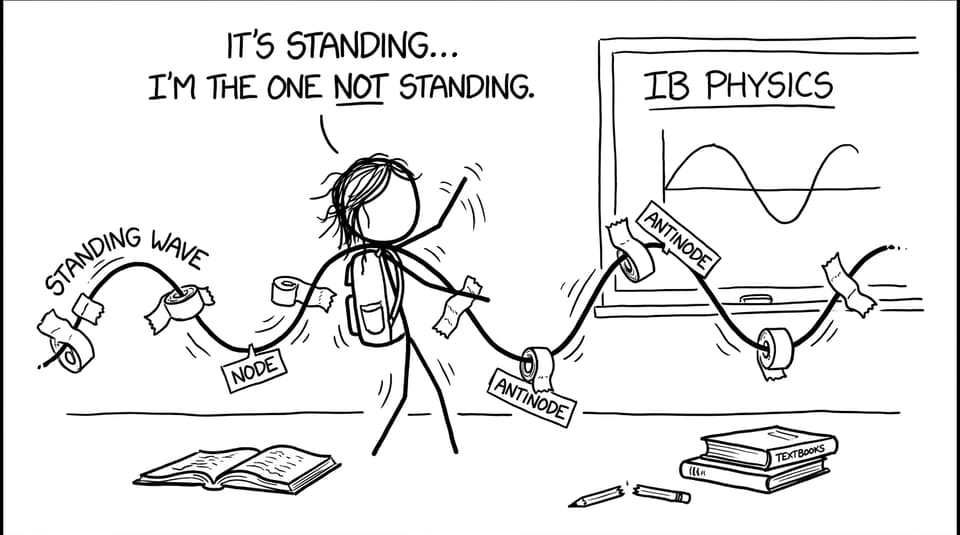
Nodes, antinodes, and the “doesn’t move” illusion
In IB Physics, the easiest scoring definitions are:
-
Node: a point of zero displacement at all times (permanent destructive interference).
-
Antinode: a point of maximum displacement (permanent constructive interference).
What confuses students is that particles still oscillate up and down (or back and forth for sound), but the locations of nodes and antinodes do not slide along the medium. The pattern is stationary because the phase relationship between the two traveling waves is consistent.
A fast fact that often appears in questions: the distance between adjacent nodes (or adjacent antinodes) is (\lambda/2), and nodes and antinodes alternate.
If you want a clean system view (strings, pipes, harmonics), use C.4.2 Standing wave patterns in systems plus quick recall in the C.4 Flashcards.
Why reflection matters (strings and air columns)
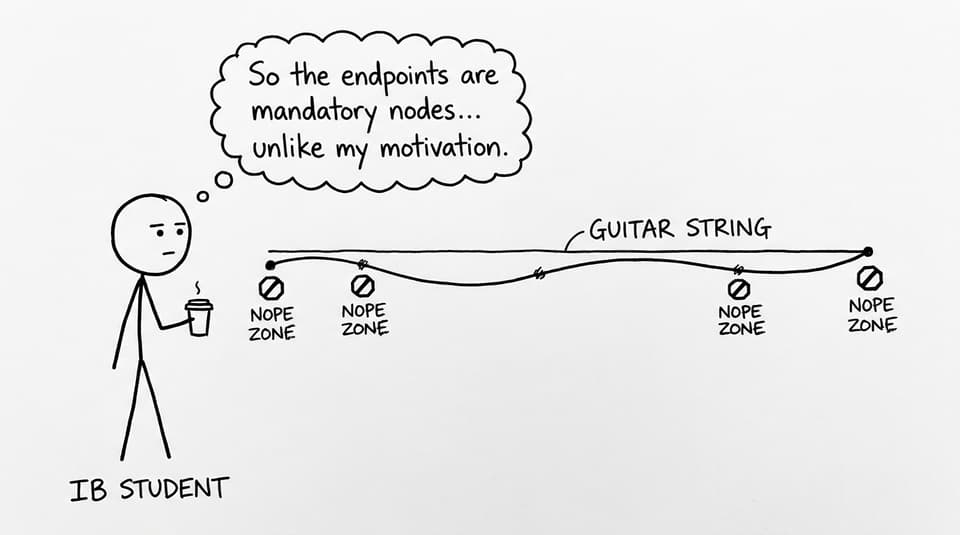
Most real standing waves you meet in IB Physics happen because a wave reflects.
-
On a string fixed at both ends, a wave hits an end, reflects, and travels back. The original and reflected waves then overlap.
-
The ends can’t move, so they must be nodes. That boundary condition filters out all wavelengths except the ones that “fit” the length.
This is why resonance feels picky: only certain frequencies create stable standing wave patterns.
To connect this directly to broader wave skills (superposition, interference, phase), practise in Topic C Wave behaviour Questionbank and reinforce with Oscillations and Waves.
Bring it home: turn the concept into marks
Standing waves in IB Physics are really a story of two travelers passing each other forever: same rhythm, opposite directions, and a perfectly consistent interference pattern. Once you can say “superposition creates permanent nodes and antinodes under boundary conditions,” you’re already writing what examiners want.
If you want to convert that understanding into exam performance, RevisionDojo is built for it: use the Study Notes to clarify the model, the Flashcards for fast definitions, the Questionbank for exam-style practice, and the AI Chat to debug misconceptions. When you’re ready to simulate the real thing, use Predicted Papers, Mock Exams, and Grading tools to train timing and accuracy, and if you want human feedback, RevisionDojo Tutors can help you tighten your explanations.
Keep IB Physics simple: two waves in, one stable pattern out. Then practise until that sentence becomes automatic.