Rotational motion feels like the moment physics stops speaking your language.
One day you are comfortable with displacement, velocity, and acceleration. The next day the exam paper swaps in Greek letters and suddenly your intuition goes quiet. The good news (and the core idea in IB Physics) is that rotational motion is not a new universe; it is linear motion, rewritten around a circle.
The one checklist that makes IB Physics rotation feel familiar
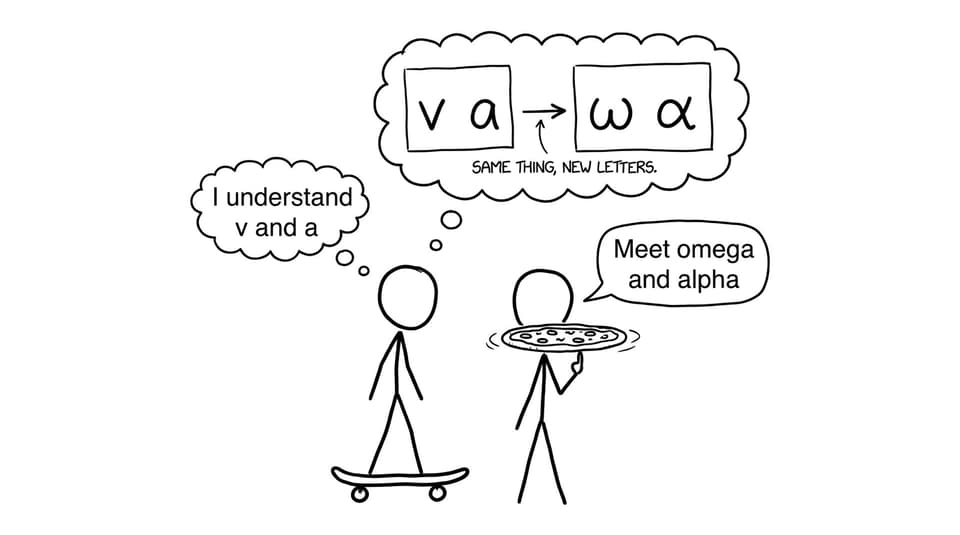
If you remember nothing else, remember this mapping. In IB Physics, rotation becomes manageable when you translate it back into the linear ideas you already trust.
-
Linear displacement (s) (\to) Angular displacement (\theta)
-
Linear velocity (v) (\to) Angular velocity (\omega)
-
Linear acceleration (a) (\to) Angular acceleration (\alpha)
-
Force (F) (\to) Torque (\tau)
-
Mass (m) (\to) Moment of inertia (I)
-
Momentum (p) (\to) Angular momentum (L)
That’s the whole “extension” idea: same relationships, new labels, circular geometry.
IB Physics: the kinematics analogy (why the formulas rhyme)
In straight-line motion, kinematics tracks how position changes with time. In rotational motion, you track how angle changes with time. That’s why (\theta), (\omega), and (\alpha) mirror (s), (v), and (a).
The bridge between the two is the radius (r). For a point on a rotating object:
-
(s = r\theta)
-
(v = r\omega)
-
(a_t = r\alpha) (tangential acceleration)
This is also why circular motion shows up as the “meeting point” of translation and rotation in IB Physics. If you want a tight refresher on the geometry and the core relationships, use IB Physics A.2.4 Circular Motion Notes.
IB Physics: torque is force with leverage (and that’s the point)
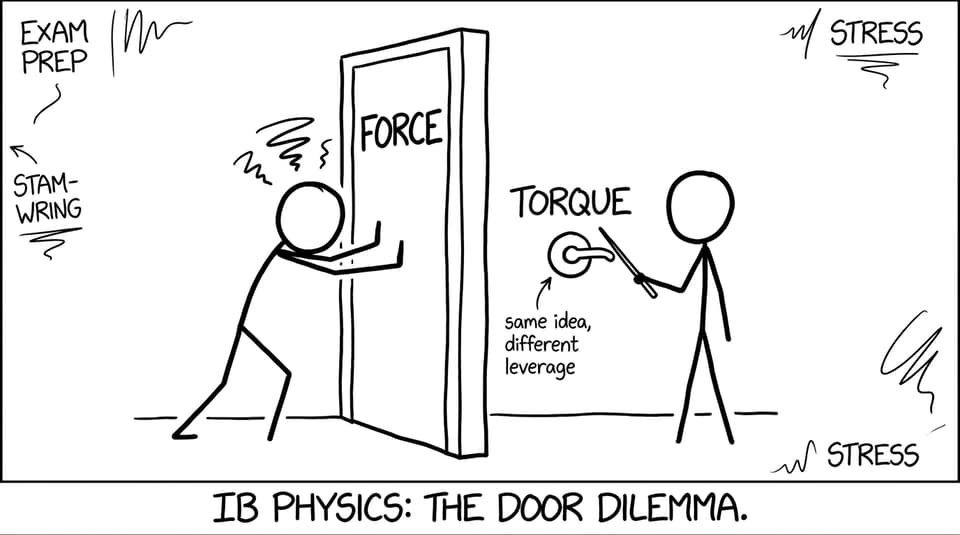
Students often hear “torque is rotational force” and move on. But the deeper exam-ready idea is leverage: the same force can cause very different rotational effects depending on where it acts.
- (\tau = rF\sin\theta)
That equation is basically physics admitting a human truth: pushing near the hinge of a door feels useless; pushing at the handle feels powerful. In IB Physics, torque is how you quantify that difference.
For a focused syllabus-aligned explanation, see A.4.1 Torque and rotational motion notes and then drill the pattern with A.4 Rigid body mechanics Questionbank.
IB Physics: moment of inertia is “mass, but distributed”
Mass tells you how stubborn an object is about changing its linear motion. Moment of inertia tells you how stubborn it is about changing its rotation.
The catch (and the reason test questions feel tricky) is that (I) depends on where the mass sits relative to the axis.
- (I = \sum m_ir_i^2)
So two objects with the same mass can behave very differently if one has more mass far from the axis. If you want the intuition plus the exam language, use A.4.2 Moment of inertia notes and the short, memorable explanation in Why Does Mass Distribution Affect Rotation?.
IB Physics: Newton’s second law doesn’t change: it rotates
This is the “extension of linear motion” in one line:
-
Linear: (F = ma)
-
Rotational: (\tau = I\alpha)
It’s not a new rule. It’s the same cause-and-response structure, but expressed around an axis.
RevisionDojo groups these ideas cleanly in IB Physics A.4 Rigid Body Mechanics and B.1 Rigid bodies and rotational dynamics.
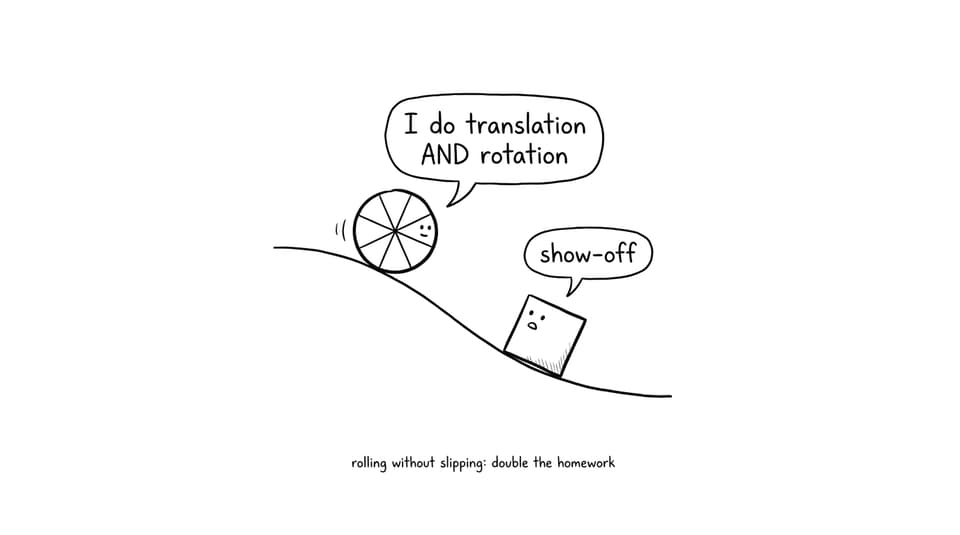
Quick exam move: connect rotation back to translation (rolling and beyond)
Many IB Physics questions reward you for noticing that real systems often do both: translate and rotate.
A rolling wheel is the classic example: the center of mass moves forward while the wheel spins. If you keep the linear-rotational dictionary in your head, these problems stop feeling like magic and start feeling like bookkeeping.
To practice efficiently, combine RevisionDojo’s Mechanics Questionbank with targeted review decks like Flashcards for A.4.1 Torque and rotational motion.
Bring it home with RevisionDojo (and make IB Physics feel consistent)
Rotational motion is an extension of linear motion because the logic never changes: causes produce acceleration, inertia resists change, and geometry connects the quantities. Once you see the dictionary between linear and angular variables, IB Physics becomes more unified, and far less stressful.
To lock it in, use RevisionDojo’s Study Notes for clarity, Flashcards for formulas, the Questionbank for exam-style repetition, and AI Chat plus Grading tools to diagnose what you keep missing. Then build confidence with Mock Exams, Predicted Papers, and targeted support from Tutors when you want feedback that feels personal. Rotation stops being “the hard chapter” when your practice system is steady.