



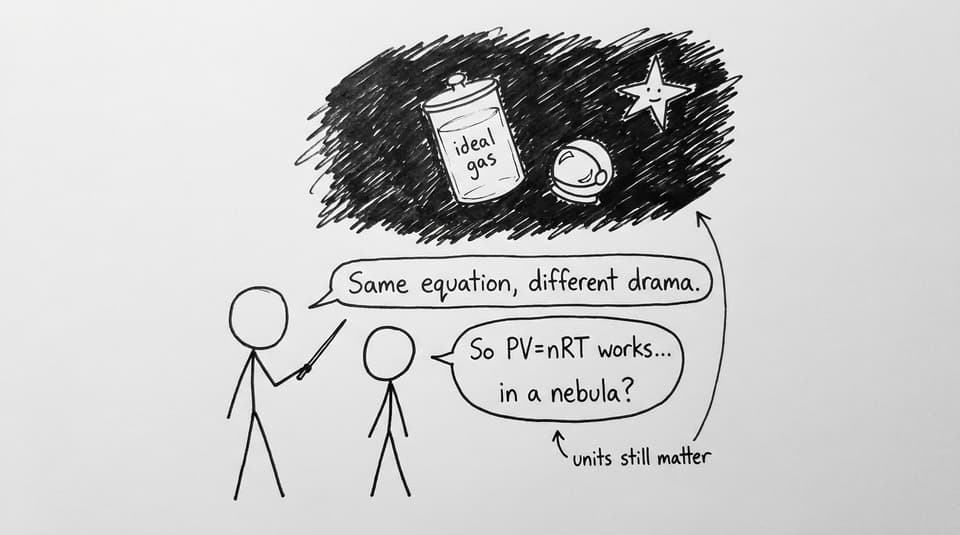
In IB Physics, it is easy to treat gases like a classroom topic: a sealed syringe, a neat PV graph, a tidy formula sheet. Then you look up at the night sky and realize the universe is mostly gas doing untidy things at extreme temperatures.
That is the quiet power of gas behavior: it lets astronomers measure what they cannot touch. With only light arriving from far away, gas behavior becomes a translator, turning spectra and shifts into temperature, composition, pressure, and motion. If you are revising IB Physics for exams, this is one of those connections that makes multiple syllabus areas suddenly feel like one story.
The quick checklist: what gas behavior can tell you
-
Temperature from how a gas radiates and which wavelengths dominate
-
Composition from absorption and emission line patterns
-
Motion from Doppler shift (redshift and blueshift)
-
Internal conditions from pressure, density, and equilibrium ideas
For the gas law core, revise B.3 Gas laws and the supporting B.3 Gas laws notes.
IB Physics and temperature: particles write a spectrum
Temperature in IB Physics is not “how hot something feels” but a measure tied to microscopic kinetic energy. In a hot gas, particles collide more energetically and atoms are excited more often. When electrons drop between energy levels, they emit photons at specific wavelengths. Those line patterns can also appear as absorption lines when cooler gas sits in front of a hotter source.
This is why stellar and nebula spectra are such a big deal: a spectrum is basically a fingerprint plus a thermometer. To tighten this up for exam wording, connect gas behavior to quantized transitions and definitions like emission spectrum and absorption spectrum in the IB Physics glossary and extend with the explanation in How Do Quantized Energy Levels Explain Spectral Lines?.
If you want the thermal-radiation side of the story, revisit 8.2 Thermal energy transfer notes and keep the IB Physics Data Booklet close for constants.
IB Physics and pressure: the invisible force holding stars up
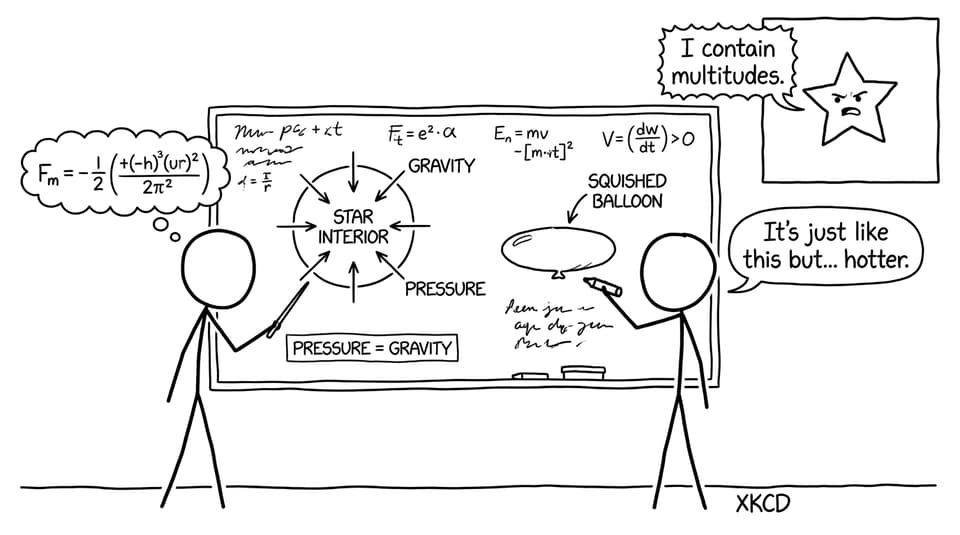
Pressure is just collisions and momentum transfer scaled up. In IB Physics language, pressure is macroscopic but caused by microscopic motion. In stars, the “container” is gravity: gravity pulls inward, gas pressure pushes outward. That balance is what keeps a stable star from collapsing quickly.
You do not need a full stellar-structure model for exams to appreciate the logic. If you can explain why higher temperature increases particle speeds and therefore pressure (kinetic theory), you can explain why pressure matters in stars. Revision-focused support: 3.2 Modelling a gas notes is where the microscopic-to-macroscopic bridge becomes clean and testable.
IB Physics and motion: Doppler shift turns light into speed data
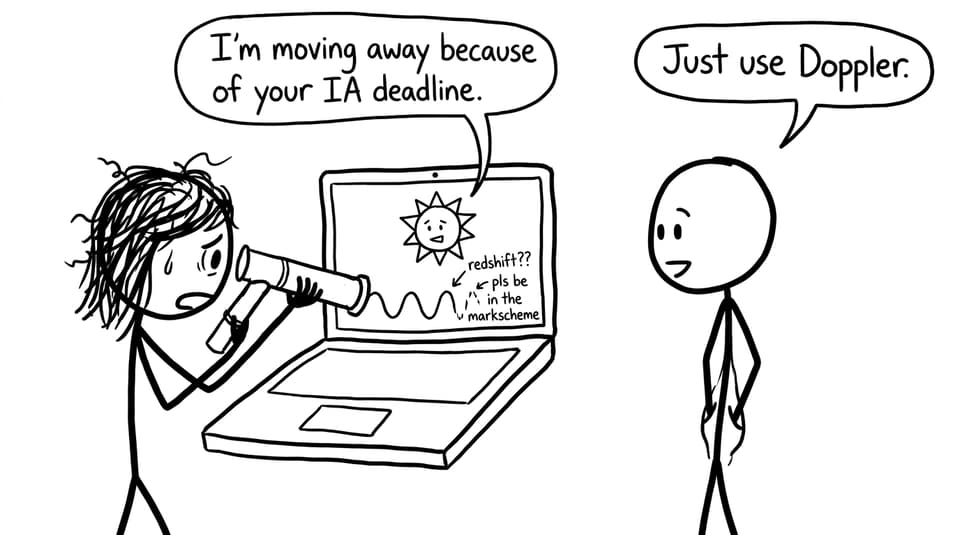
Sometimes the most important property is not what a star is, but what it is doing. If gas is moving toward you, spectral lines shift to shorter wavelengths (blueshift). If it is moving away, they shift to longer wavelengths (redshift). This is the Doppler effect, but in space it becomes a measurement tool for radial velocity.
For targeted revision, use 9.5 Doppler effect notes and the conceptual blog explanation What Does Doppler Shifting Reveal About Relative Motion?. If you want practice that feels like exam marking logic, the C.5 Doppler effect Questionbank is ideal.
How RevisionDojo helps you turn this into exam marks
IB Physics rewards students who can move between models: microscopic particle motion, macroscopic gas laws, and wave behavior in spectra. RevisionDojo is built for that kind of switching.
Use the Study Notes and Flashcards to lock in definitions and key links between temperature, spectra, and pressure. Then shift to the Questionbank to practice writing the short, precise explanations examiners like. When you get stuck, AI Chat helps you debug misconceptions (for example, confusing a frequency change with a wave-speed change in Doppler questions). And if you are building stamina, Mock Exams, Predicted Papers, and Grading tools help you rehearse under time pressure.
For a broader map of what to revise next in IB Physics, start from Physics - IB Resources or browse All #IB Physics Posts.
Closing: one equation, one spectrum, a whole universe
There is something calming about realizing the same IB Physics ideas that explain a gas in a syringe can also explain a star’s stability and a galaxy’s motion. Gas behavior is not just a unit you revise; it is a universal language.
If you want to turn that language into points on the markscheme, use RevisionDojo to connect the pieces: Gas laws, kinetic theory, spectral lines, and the Doppler effect. Start with the notes, drill with the Questionbank, then test yourself with Mock Exams and Predicted Papers. IB Physics gets easier when the universe starts to feel consistent.