
In the last five minutes of an exam, your brain doesn’t forget the syllabus. It forgets structure.
That’s the quiet challenge of IB Psychology SAQs: you often know the study and the theory, but marks disappear when your answer drifts, over-explains, or forgets to link back to the question. The good news is that a strong SAQ is not a creative writing task. It’s a repeatable mini-essay you can train like a routine.
What an IB Psychology SAQ is really testing
An SAQ in IB Psychology is designed to reward three things:
-
Staying laser-focused on the question and command term
-
Accurate use of a relevant theory or concept
-
Evidence from a study, explained briefly but meaningfully
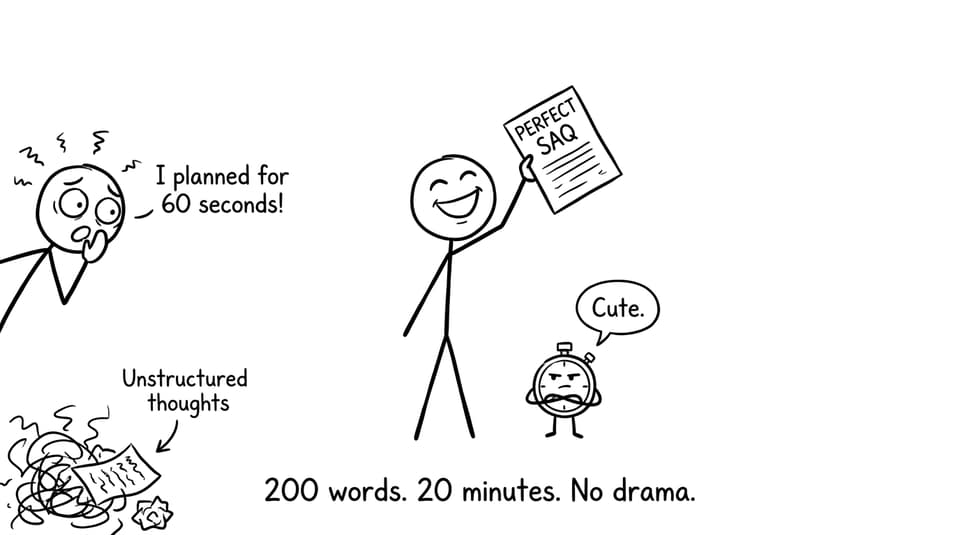
Think of SAQs as “small on words, big on precision.” You’re aiming for about 200-250 words, but every sentence has a job.
If you also write longer responses, keep the difference clear: SAQs are not mini-LAQs. For the LAQ mindset and structure, use How to Write a Psychology LAQ (Long Answer Question).
IB Psychology SAQ checklist (save this)
Before you write, run this fast checklist:
-
Have I identified the command term?
-
Did I define the key concept in 1-2 sentences?
-
Did I choose one study that matches the question?
-
Did I include aim, method, results, conclusion (briefly)?
-
Did I link the study back to the question?
-
Did I finish with a one-sentence wrap-up?
For quick topic refreshers while you practise SAQs, start from the IB Psychology Resources hub.
Step-by-step: How to write an IB Psychology SAQ
Start with the command term (and obey it)
In IB Psychology, the command term is the steering wheel. If you steer wrong, even great content lands “off-task.”
-
Describe: what it is, what happens, key features
-
Explain: describe + why/how using theory and evidence
-
Discuss/Evaluate (less common in SAQs): balanced points, brief critique
A simple habit: rewrite the question in your own words in your head before you write.

Use a 4-part SAQ structure that never panics
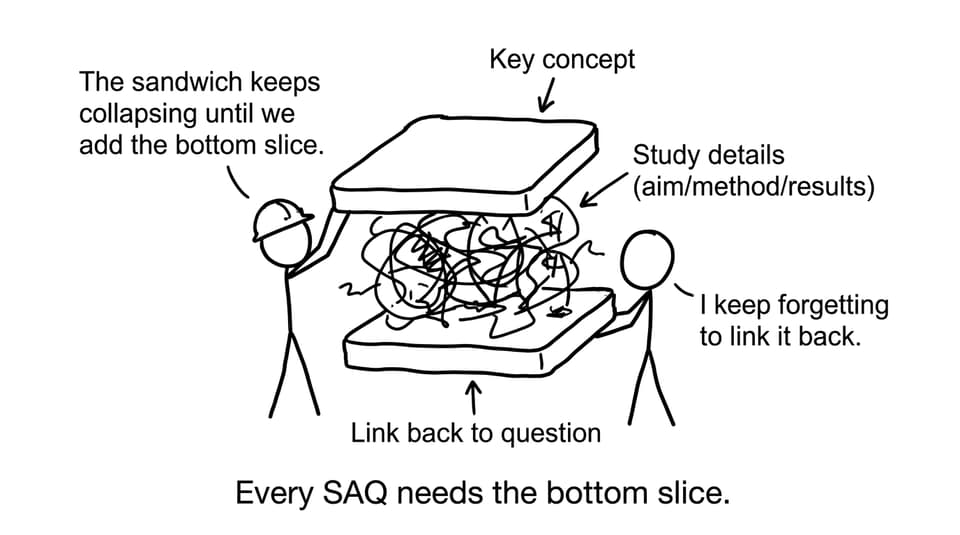
A reliable SAQ structure for IB Psychology looks like this:
-
Point (1-2 sentences): Define the concept and answer the question directly.
-
Study (4-6 sentences): Give the essential study details.
-
Explain (2-3 sentences): Connect the findings to the concept.
-
Link (1 sentence): Tie back to the question explicitly.
That last link sentence is where many marks quietly vanish. Examiners should never have to guess why your study is relevant.
Choose one study and go deep enough
A common trap in IB Psychology SAQs is “two studies, half explained.” One well-chosen study is usually stronger.
Include only what helps the argument:
-
Aim: what the researchers wanted to test
-
Method: key procedure and sample
-
Results: the finding that matters
-
Conclusion: what it suggests about behaviour/cognition/culture
For targeted practice by topic, use RevisionDojo’s question practice, like the Sociocultural Approach Questionbank or the newer syllabus practice area at Psychology (First Exam 2027) Questionbank.
Write like you’re paying for each sentence
In IB Psychology, clarity beats flair. If a sentence doesn’t define, describe, explain, or link, cut it.
A useful rule: pretend you’re texting a smart friend who will only read 10 lines.
If you want a quick way to tighten answers, RevisionDojo’s AI Chat can help you spot where you went vague, and the Grading tools can train you to write in the language of the markscheme rather than the language of stress.
Mini example (template you can copy)
Question: “Describe one study related to the effect of culture on cognition.”
Point: In IB Psychology, culture can shape cognition through schemas, which influence how we interpret and remember information.
Study: Bartlett (1932) investigated how cultural background affects memory using the story “The War of the Ghosts.” British participants repeatedly recalled the story over time (serial reproduction). Many participants changed unfamiliar details to make the story more culturally understandable and often shortened it by omitting elements that did not fit expectations.
Explain: These systematic changes suggest memory is reconstructive, guided by cultural schemas rather than being a perfect recording.
Link: Therefore, this study supports the idea that culture affects cognition by shaping the schemas used in remembering.
To build speed, practise this structure with timed sets using the IB Psychology Predicted Papers and then refine using Flashcards and Study Notes inside RevisionDojo.
Conclusion: make IB Psychology SAQs automatic
A great IB Psychology SAQ isn’t about writing faster. It’s about deciding earlier.
Decide the command term, decide the study, then follow a structure that makes linking back unavoidable. If you want that routine to become automatic, build it with RevisionDojo: practise with the Questionbank, tighten recall with Flashcards and Study Notes, and pressure-test yourself with Mock Exams and Predicted Papers. When exam day arrives, you won’t be searching for inspiration. You’ll be running a system.
For more exam-writing strategy, browse All IB Psychology posts and, if you’re comparing course demands, read Understanding the Differences Between IB Psychology SL and HL.