




If you have ever opened an IB Psychology exam and felt your brain try to sprint out of the room, you are not alone. The Long Answer Question (LAQ) has a special talent: it looks simple, then quietly asks for definitions, research, critical thinking, and a conclusion, all inside one timed response.
The students who score highest are not the ones who “know everything.” They are the ones who can choose what matters, build a clean argument, and evaluate like they mean it. This guide breaks down exactly how to write a strong IB Psychology LAQ with a structure you can repeat under pressure.
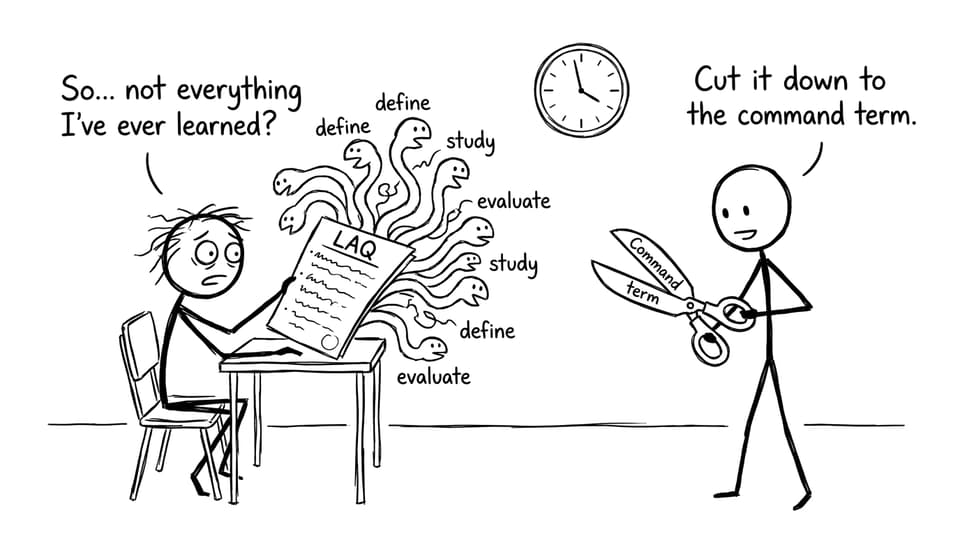
The IB Psychology LAQ checklist (save this)
Before you write a single sentence, run this quick LAQ checklist:
-
Identify the command term (evaluate, discuss, to what extent, contrast, etc.).
-
Underline the topic focus (e.g., cultural factors, memory, ethics, reliability).
-
Decide your 2 core studies (sometimes 3 if they are short) that directly answer the question.
-
Decide your evaluation themes (methodology, bias, ethics, generalisability, credibility, alternative explanations).
-
Write a one-line thesis that answers the question with direction.
If you want a bigger picture of where LAQs sit in the course, the Complete Guide to IB Psychology: Structure, Skills & Assessment is a helpful map.
What an IB Psychology LAQ is really testing
A strong IB Psychology LAQ is not a memory dump. It is a controlled argument.
Examiners reward answers that:
-
Stay focused on the exact wording of the prompt
-
Use research as evidence, not decoration
-
Evaluate the evidence with clear reasoning
-
Keep a logical structure from first line to last
If you are unsure what “top-band” looks like in marking terms, read the IB Psychology Extended Response Question (ERQ) Rubric Explained. Treat it like a scoring blueprint.
How to write an IB Psychology LAQ (structure you can repeat)
Start with a thesis that shows control
Your introduction should do three jobs fast:
-
Define the key terms (only the ones that matter).
-
Answer the question in one clear line (your thesis).
-
Preview your route: what you will argue and what evidence you will use.
Keep it lean. In IB Psychology, long introductions often steal time from evaluation, which is where marks hide.
Build the body in “study blocks”
A reliable LAQ body uses two main paragraphs (or two big sections), each anchored by a study. A simple pattern:
-
Point linked to the question
-
Theory/concept explanation
-
Study description (aim, method, findings, conclusion)
-
Link back to the question
-
Evaluation (strengths, limitations, alternative views)
The key is the link. In IB Psychology, you do not get rewarded for a perfect study summary if it does not prove your point.

Evaluate like a psychologist, not a critic
Evaluation is not “this study is old” or “small sample.” Strong IB Psychology evaluation explains why a limitation matters.
Examples that score well:
-
Validity: Does the method actually measure the process the question asks about?
-
Bias: Could culture, demand characteristics, or researcher expectations shape results?
-
Generalisability: Can you apply the finding beyond that sample and setting?
-
Ethics: Did ethics shape the design, and does that weaken or strengthen conclusions?
-
Alternative explanations: Is there another plausible mechanism for the outcome?
If you want more LAQ-specific paragraph tactics, use How To Structure Answers For IB Psychology LAQs as your template reference.
Finish with a conclusion that actually concludes
A strong conclusion in IB Psychology does not repeat your introduction word-for-word. It should:
-
Summarise your line of argument in 2-3 sentences
-
Make a judgement that matches the command term (especially “evaluate” or “to what extent”)
-
Mention one implication or boundary (when the argument holds, and when it might not)
Mini example plan (so you can see it)
Consider a prompt like: “Evaluate the role of cultural factors in cognitive processes.”
A quick IB Psychology LAQ plan could be:
-
Intro: Define culture and cognitive processes; thesis: culture shapes cognition through schemas and environment, but evidence has limits.
-
Block 1 (Schemas + memory): Bartlett (1932) as evidence of cultural schemas shaping recall; evaluate control and interpretation.
-
Block 2 (Perception): Segall et al. (1966) Muller-Lyer illusion and “carpentered world” exposure; evaluate sampling and scope.
-
Conclusion: Culture plays a meaningful role, but the strength of the claim depends on method quality and which cognitive process you examine.
To practise building plans quickly, RevisionDojo’s IB Psychology Resources hub is a good home base for syllabus-aligned content, and the IB Psychology Sociocultural Approach Questionbank is ideal for drilling prompts that naturally fit LAQs.
How RevisionDojo helps you train LAQs (without guessing)
Most students revise IB Psychology like they are packing for every possible weather forecast. It feels responsible, but it is exhausting.
RevisionDojo is built for the opposite: targeted practice.
-
Use the Questionbank to practise LAQ-style prompts and track weak areas.
-
Use Study Notes and Flashcards to lock down definitions, studies, and evaluation points.
-
Use AI Chat when you are stuck on linking a study back to the question.
-
Use the Grading tools to get feedback on structure, focus, and evaluation depth.
-
Use Mock Exams and Predicted Papers to rehearse timing and stamina with exam-style materials.
For timed exam simulation, the IB Predicted Papers by IB Examiners (Free) page and the dedicated IB Psychology Predicted Papers collection make it easier to practise full responses without improvising prompts.
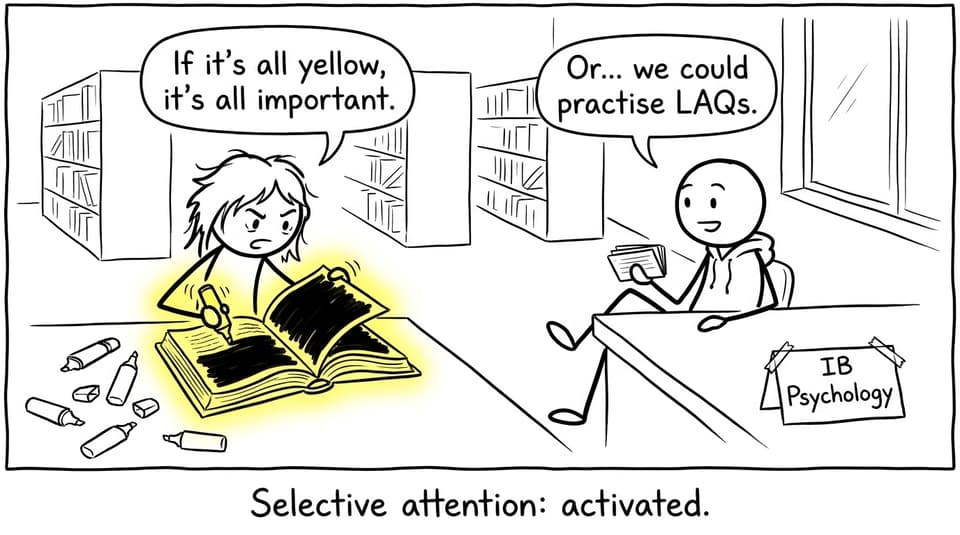
Closing: make IB Psychology LAQs predictable
The best part about IB Psychology LAQs is that they look unpredictable, but they are not. Once you can spot the command term, choose two studies, and evaluate with purpose, the task becomes repeatable. You stop hoping for a “nice” question and start trusting your structure.
If you want to turn that structure into a habit, practise with the How to Write a Psychology SAQ (Short Answer Question) guide alongside LAQs. SAQs train focus, and focus is the backbone of every high-scoring IB Psychology essay. Then build a weekly routine using RevisionDojo’s Questionbank, Flashcards, and Mock Exams so exam day feels like a familiar rehearsal, not a surprise.