
The moment IB grading stops feeling personal
There’s a specific kind of panic that only IB students know: you walk out of a paper thinking, “That was fine,” then someone mentions grade boundaries, moderation, and the mysterious 1-7 scale. Suddenly it feels like your result is being decided in a room you’re not allowed to enter.
But the IB grading system isn’t designed to trick you. It’s designed to standardize you in a good way. Across time zones, languages, and schools with wildly different teaching styles, the IB needs a way to say, “A 6 in this subject means roughly the same thing anywhere.” Once you understand how that standardization works, your revision gets calmer and your strategy gets sharper.
The IB grading system, in one checklist
If you want a fast mental model of IB grading, keep this checklist:
-
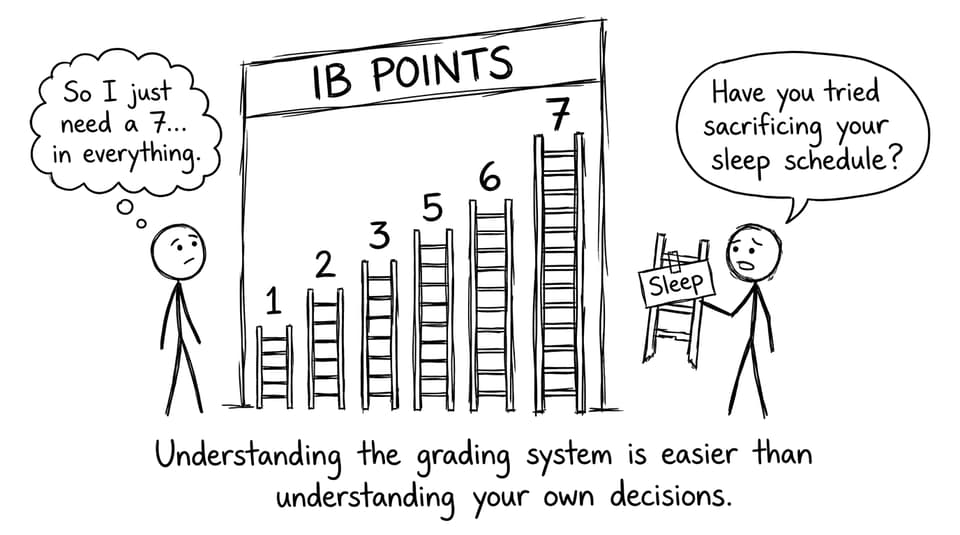
Each IB subject ends with a final grade from 1 to 7.
-
Your subject grade comes from a mix of external exams and internal coursework.
-
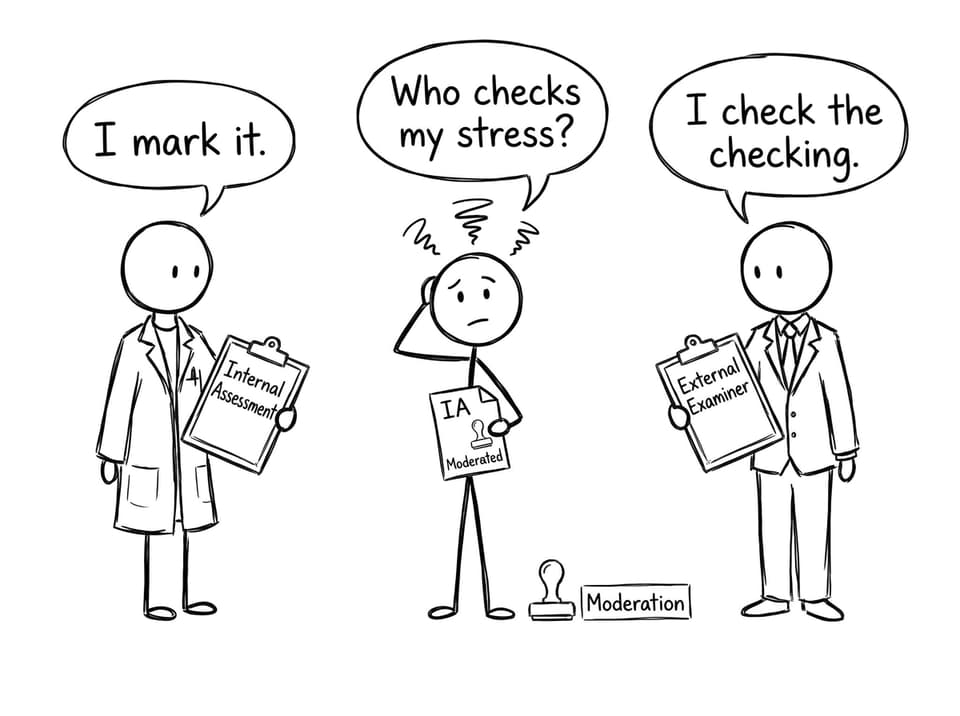
Internal work is marked by teachers but moderated by the IB to keep standards consistent.
-
Boundaries convert your total marks into the final 1-7 grade, and boundaries can change by session.
-
Your Diploma total is up to 45 points: 42 from six subjects + up to 3 core points from TOK and EE.
When you want a quick reality check on where your marks land, RevisionDojo’s IB Grade Calculator helps you translate practice performance into an estimated total.
How IB exams and coursework actually become a grade
The IB basically uses two pipelines that merge at the end.
External assessment: the exam pipeline
External assessment is what most students picture: timed papers in May or November, marked by trained examiners. These exams are built to be comparable across the world, which is why command terms, markschemes, and paper structures matter so much.
A practical way to prepare for this pipeline is to practice in the same rhythm the IB rewards:
-
learn concepts clearly (no fog)
-
practice questions like the papers (no guessing)
-
get feedback that matches markscheme logic (no vibes)
RevisionDojo is designed around that loop: Study Notes for clarity, Flashcards for recall, and the Questionbank feature for exam-style practice with feedback.
Internal assessment (IA): the coursework pipeline
Internal assessment is your coursework: investigations, portfolios, presentations, oral work, or written tasks depending on the subject. Your teacher marks it, but the IB doesn’t just “trust and hope.” It uses moderation.
Moderation means the IB requests a sample of work from a school and checks whether the teacher’s marking matches global standards. If the sample suggests the marks are too harsh or too generous, the final marks can shift for the whole group. That’s not meant to punish you. It’s meant to keep an IB 6 in one school comparable to an IB 6 in another.
If you want to take control of this early, use a rubric-first workflow: draft, compare to criteria, fix weak strands, then draft again. RevisionDojo’s IB Coursework Grader exists for that exact loop, and the Coursework Exemplars Library helps you see what “good” looks like in real student work.
TOK + EE: the quiet 3 points that change everything
Your IB Diploma total isn’t just “six subjects and done.” TOK (Theory of Knowledge) and the Extended Essay (EE) combine to add up to 3 extra points. Those points can be the difference between “close” and “made it.”
What matters strategically is that TOK and EE are graded with their own criteria and scaled into the core points matrix. That means you should treat them like scoreable skills, not abstract reflections you do when you have time.
If you’re trying to strengthen your TOK thinking quickly, the TOK Essay Planning Templates are a clean starting point. And if your EE feels like it’s drifting into description, How to Use TOK to Enhance Your Extended Essay shows how to build evaluation without forcing it.
Grade boundaries and scaling: why a “hard exam” can help you
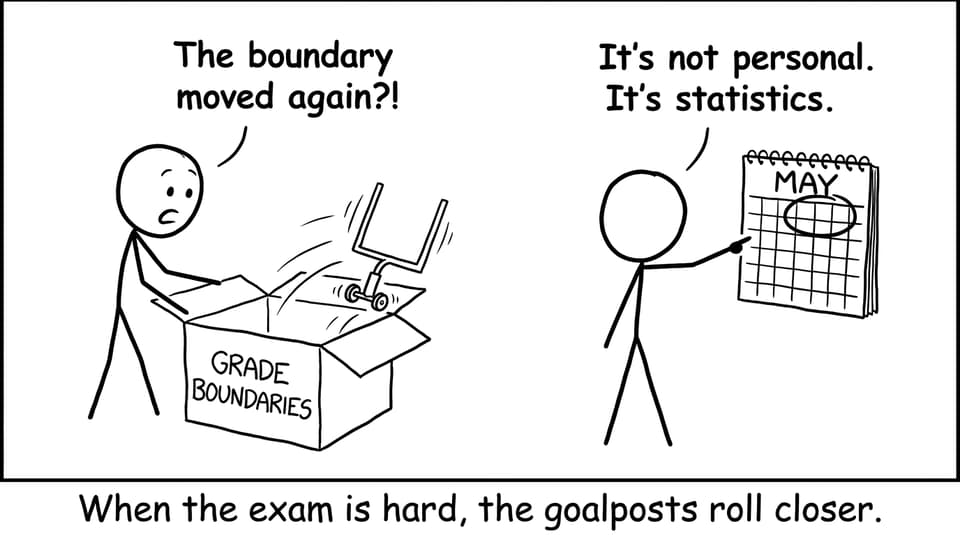
Grade boundaries are the conversion layer between raw marks and the final IB grade 1-7. After marking is complete, the IB sets boundaries for each subject and session. This is why the same percentage doesn’t always equal the same grade year to year.
A boundary system does two important things:
-
It acknowledges that some papers are harder than others.
-
It keeps standards consistent across sessions.
So if an exam was unusually difficult, boundaries often shift so that students aren’t unfairly penalized. This is not a guarantee, and it’s not something you can “game.” But it’s a reminder that your grade is ultimately based on how your performance maps to global standards, not just how painful the paper felt.
If you want more context around how boundaries behave, the RevisionDojo Grading tag hub collects related explanations and strategy posts.
A practical IB strategy: turn grading knowledge into weekly actions
Knowing the IB grading system only matters if it changes what you do on Tuesday.
Here’s a simple weekly system that matches how IB marks are earned:
Use the criteria as your map
For essays, IAs, and structured responses, marks come from criteria. Treat criteria like a checklist you can train. When you write, ask: “Which strand am I scoring here?” If you can’t answer, you’re probably writing beautiful sentences that don’t collect points.
Practice like marks are counted (because they are)
Use targeted sets in the RevisionDojo Questionbank to isolate weak topics and command terms. If you need a process, IB Question Bank | How to Use It Effectively breaks down a practical routine.
Add pressure in small doses
Once per week, simulate exam constraints. That’s where Mock Exams and Predicted Papers become useful: they teach pacing, decision-making, and stamina. If you want a deeper explanation of how to use them responsibly, IB Predicted vs Specimen Papers: What They Mean is a helpful guide, and you can browse IB Predicted Papers by subject.
Get feedback faster than your stress can grow
When you’re stuck, speed matters. RevisionDojo’s AI Chat can clarify concepts, re-explain markscheme logic, or help you turn vague weaknesses into a concrete plan. And if you need human diagnosis, Tutors can help you identify the one pattern that keeps costing marks.
For the broader platform workflow, RevisionDojo App: The Smarter Way to Prep for IB Exams connects the pieces into one repeatable system.
Closing: Make the IB grading system work for you
The IB grading system feels intimidating when it’s invisible. Once it’s visible, it becomes surprisingly practical: criteria lead to marks, marks map to boundaries, and boundaries become grades. Your job isn’t to predict every boundary or decode every rumor. Your job is to build evidence that you can perform under the conditions the IB actually uses.
If you want that process in one place, RevisionDojo gives you the full toolkit: Questionbank, Study Notes, Flashcards, AI Chat, Grading tools, Predicted Papers, Mock Exams, a Coursework Library, and Tutors when you need a human eye. Start by checking your current baseline with the IB Grade Calculator, then build a weekly loop you can repeat until exam day. The calm that comes from a system is its own kind of advantage in the IB.