


If you have ever stared at a report and thought, “I did well… but what does this number actually mean?” you are already living the MYP experience. The MYP grading scale is designed to describe learning, not rank students. That sounds comforting until you try to compare your MYP results with friends, with percentages, or with the IB Diploma Programme.
This guide breaks down what MYP grades mean, how they are calculated, and how the MYP compares to IB DP grading--so you can translate your progress into an exam-ready plan.
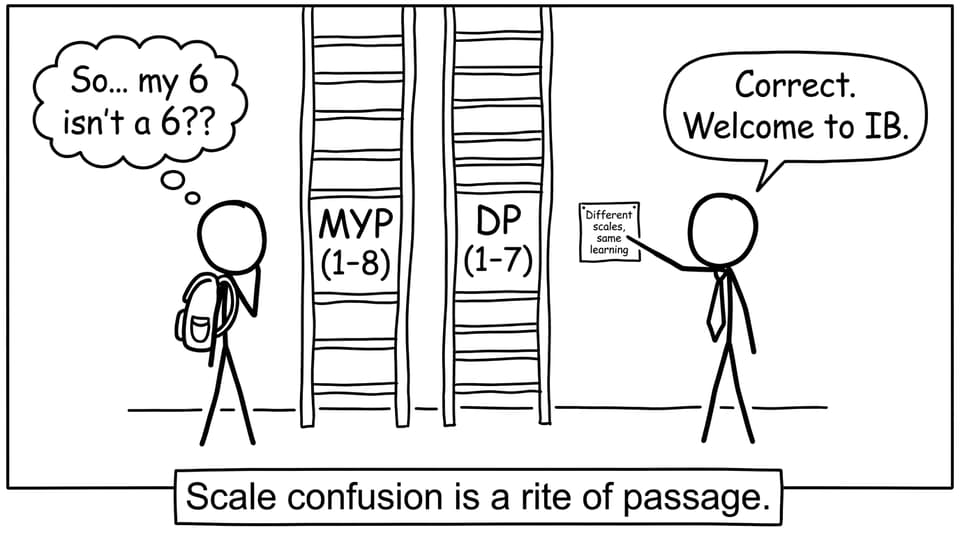
MYP grading scale: the quick translation checklist
Use this as your fast mental model of MYP grading:
-
The MYP is criterion-related (you are graded against standards, not classmates).
-
Most tasks give achievement levels out of 8 for each criterion.
-
Each subject uses four criteria (A, B, C, D).
-
The four criteria add up to 32.
-
That total converts to a final MYP grade using grade boundaries.
If you want the fuller context, keep these two tabs open while you study: How Are MYP Students Graded? Criteria Explained and IB MYP Grade Boundaries: Understanding the 1--7 Scale.
What MYP grades mean (and what they do not mean)
A MYP grade is a summary statement: it describes how consistently you met the programme’s objectives for that subject. It is not meant to be a percentage, and it is not meant to be “the class average with a curve.” In the MYP, you can do everything right and still feel like the number is strangely unfamiliar because the system is describing skills.
In practice, your MYP results usually reflect things like:
-
how well you communicate ideas clearly,
-
how well you apply knowledge in unfamiliar contexts,
-
how well you analyze evidence and justify conclusions,
-
how well you reflect and improve using feedback.
That is why the MYP can feel like it is grading your thinking, not just your memory. For a deeper look at how schools report progress, see Evaluation and Reporting in the MYP: Best Practices.
How MYP grades are calculated (criteria A--D to a final grade)
Here is the process most students need to understand for exams and end-of-unit results in the MYP:
Criterion scores first
Every subject group has four criteria (A--D). Each criterion is scored on a 0--8 achievement level using descriptors. Over a unit, you may receive multiple criterion scores across different tasks.
Then a best-fit decision
Teachers look across the evidence and decide a best-fit level for each criterion. This matters because the MYP is not “add every homework score forever.” It is about the most accurate description of your achievement against the standards.
Total out of 32, then boundaries
The four criteria are totaled (maximum 32) and converted to a final MYP grade using grade boundaries.
If you want to sanity-check what counts as “good,” bookmark What Is a Good MYP Score?.
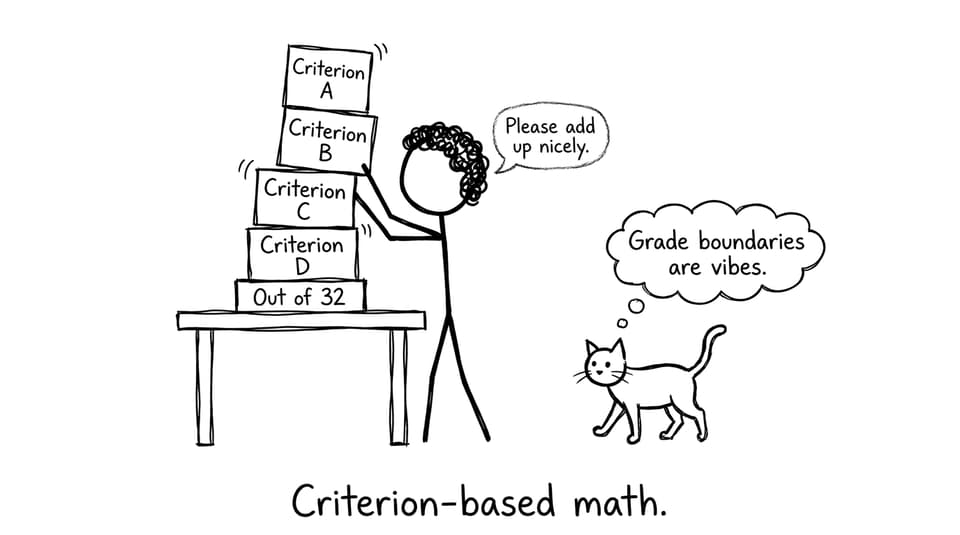
MYP vs IB DP grading: how they compare for exam prep
This is the comparison that matters when you are moving from MYP study habits into DP performance.
The scale looks similar, but the feeling changes
-
The MYP centers on criteria and skills development.
-
IB DP centers on final assessments (exams plus internal work) and grade boundaries.
DP grades are also criterion-referenced, but the pressure shifts because DP results are often tied to university requirements and diploma points. If you want the clearest DP overview, read IB Grading Scale Explained: Complete Marks Breakdown and then use the IB Grade Calculator to map practice performance to likely outcomes.
A practical way to think about it
The MYP teaches you how to get better. DP demands that you prove it on command, on time. If you carry the best parts of the MYP (criteria awareness, reflection, improvement loops), DP becomes less mysterious.
How to turn MYP feedback into DP-ready results
The easiest mistake is to treat MYP criteria as “teacher language.” Instead, treat them like a training plan.
-
Use the RevisionDojo Questionbank to practice skills under exam pressure: Questionbank.
-
Patch knowledge gaps quickly with concise explanations in the RevisionDojo App guide.
-
Build recall with Flashcards, then rehearse timing with Mock Exams and Predicted Papers inside RevisionDojo.
-
If your work is written or rubric-heavy, use the Grading tools and Coursework Library to see what higher bands actually look like.
-
When you are stuck, AI Chat helps you debug misconceptions fast, and Tutors add accountability and strategy.
For a structured routine that feels like exam training, adapt the rhythm from MYP eAssessments: 30-Day Study Plan That Works.
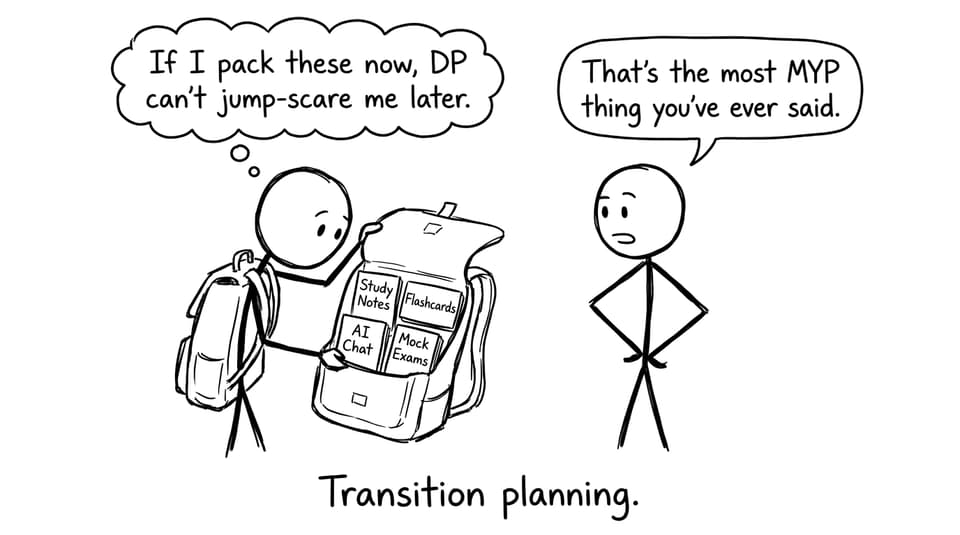
Closing: use MYP as your advantage
The MYP grading scale is not trying to label you; it is trying to coach you. Once you understand how MYP criteria become a final grade, the numbers stop feeling random and start feeling useful. And when you compare MYP to DP, the big takeaway is simple: DP rewards the students who already know how to practice, reflect, and repeat.
If you want one place to turn MYP feedback into exam results, RevisionDojo gives you the full loop: Questionbank practice, Study Notes, Flashcards, AI Chat support, Grading tools, Predicted Papers, Mock Exams, Coursework Library examples, and Tutors when you want a human plan. Start at the RevisionDojo MYP hub, and make your next MYP grade a stepping stone, not a mystery.