
TOK has a funny way of making smart students feel oddly stuck.
You open the document. You type the prescribed title. You stare at it like it’s staring back. And somewhere in the back of your mind you can already hear the examiner’s silent questions: Where’s the knowledge question? Where’s the analysis? Why does this example feel like a Wikipedia detour?
That moment is normal. TOK isn’t asking you to prove you know lots of facts. It’s asking you to show you understand how knowledge is built, trusted, challenged, and limited. That’s a different skill. And once you treat it like a skill, not a vibe, your essay gets easier to plan and much easier to score.
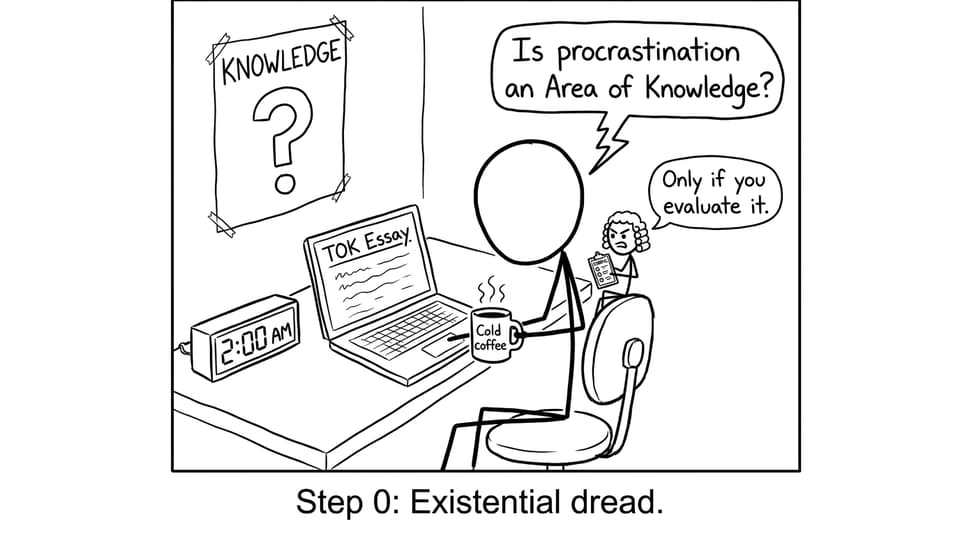
Below is a clear, student-friendly TOK process you can repeat for any title. It’s written for IB students preparing for exams, but it also works when deadlines are close and your brain is tired.
TOK essay quick checklist (save this before you draft)
Before you write full paragraphs, make sure you can answer “yes” to these:
-
You have one focused knowledge question (KQ) that clearly grows from the prescribed title.
-
You will explore two Areas of Knowledge (AOKs) in depth (not four shallowly).
-
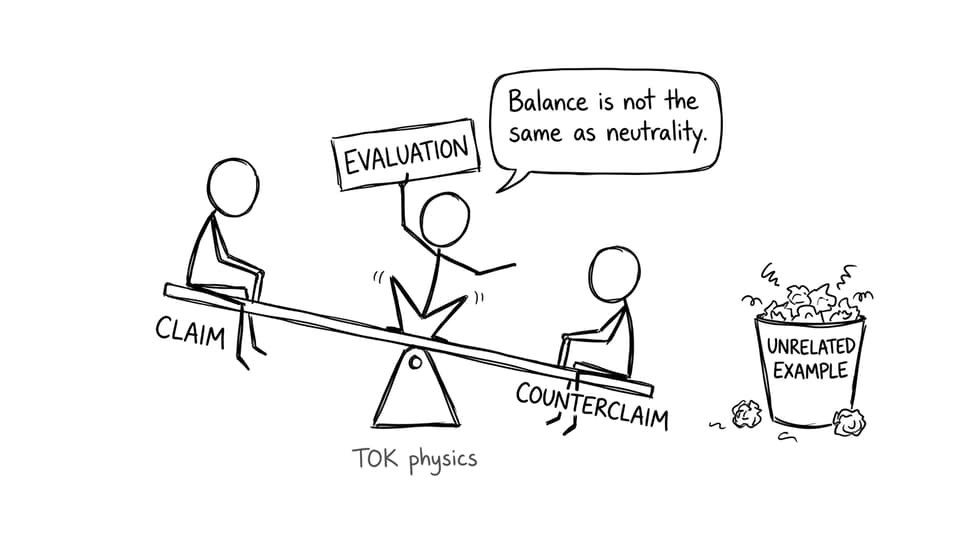
Each body section contains a claim, counterclaim, and evaluation.
-
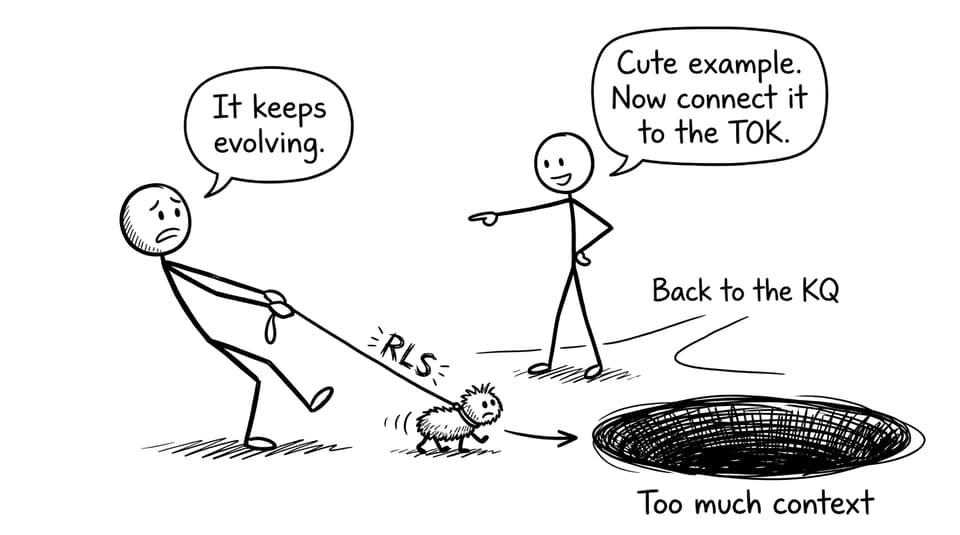
Every real-life example (RLS) is explained, not name-dropped, and is linked back to TOK.
-
Your conclusion doesn’t just summarize; it reflects on what your discussion suggests about knowledge.
If you want a syllabus-aligned breakdown of what the essay is asking for, anchor yourself in IB Theory of Knowledge 4.2 the TOK Essay.
Step 1: Understand what a TOK essay is actually testing
A strong TOK essay isn’t a debate club performance or a history report with fancy words. It’s a controlled exploration of a knowledge question: How do we know? When do we trust knowledge? What shapes it? What limits it?
Think of TOK as a map of uncertainty. In the natural sciences, uncertainty might come from measurement limits, flawed observation, or model assumptions. In history, it might come from bias, selection, and interpretation. TOK rewards you for noticing those differences and explaining why they matter.
When you keep that purpose in front of you, your writing naturally becomes more analytical and less descriptive, which is exactly what the rubric wants.
Step 2: Choose a prescribed title that you can “live inside” for 1,600 words
Not every title is equal for you. The best TOK choice is usually the one where you can quickly imagine:
-
two AOKs you genuinely understand,
-
two or three real-life examples you can explain well,
-
and at least one meaningful counter-perspective.
If you’re unsure how to interpret current titles, browse a structured breakdown like RevisionDojo Ultimate TOK May 2026 Essay Guide or IB TOK Essay Prescribed Titles: November 2026. Even if your session is different, the thinking patterns transfer.
Step 3: Turn the title into a sharp knowledge question (KQ)
Your TOK essay lives or dies by the KQ.
A good KQ is open-ended, contestable, and clearly connected to the title. It’s not a factual question. It’s not “what happened?” It’s “how can we know?” or “to what extent can we trust?”
Try this simple conversion method:
-
Identify key terms in the title (e.g., “observation,” “ethics,” “failure,” “facts,” “ideas”).
-
Ask what the title is really about: reliability, justification, bias, certainty, interpretation, authority, methodology.
-
Draft 2-3 KQs, then pick the one that invites multiple perspectives without becoming vague.
If you want ready-to-use planning frameworks, use TOK Essay Planning Templates for May 2026 Titles. The templates help you build arguments around a KQ instead of wandering.
Step 4: Pick two AOKs that create contrast (not clutter)
TOK rewards depth over breadth. Two AOKs is the sweet spot.
Choose AOKs that naturally behave differently, so your analysis has tension. For example:
-
Natural sciences vs history: replication and data vs interpretation and sources.
-
Mathematics vs arts: proof and certainty vs meaning and subjectivity.
-
Human sciences vs ethics: patterns and models vs value judgments.
The key is not listing differences. It’s using the differences to answer your KQ.
Step 5: Build a lean outline that forces claim, counterclaim, evaluation
Many TOK drafts collapse because the structure is too “essay-ish” and not “TOK-ish.” TOK structure is a thinking structure.
A practical outline looks like this:
-
Introduction: interpret title, state KQ, preview AOKs and your line of argument.
-
Body AOK 1: claim -> example -> counterclaim -> example -> evaluation.
-
Body AOK 2: claim -> example -> counterclaim -> example -> evaluation.
-
Conclusion: answer the KQ with nuance; reflect on implications and limits.
For a deeper structure walkthrough, see Structuring for Success in IB TOK Essays. It’s the kind of resource you check once, then reuse forever.
Step 6: Write claims that are specific enough to test
In TOK, weak claims sound like posters: “Emotion influences knowledge.” True, but not usable.
Strong claims are testable and contextual:
-
In history, historians’ backgrounds can shape which sources are prioritized, changing what is treated as “reliable.”
-
In natural sciences, observation is essential, but instruments and theory-laden interpretation affect what counts as evidence.
Notice what makes these stronger: they hint at mechanisms (source selection, instruments, interpretation). Mechanisms give you something to evaluate.
Step 7: Use counterclaims as real alternatives, not polite opposites
A counterclaim isn’t “on the other hand, some disagree.” A counterclaim is a rival explanation that could also be reasonable.
For instance, if your claim in history is “bias undermines reliability,” your counterclaim could be: bias is unavoidable, but transparent methodology and cross-checking can still produce robust knowledge.
Then comes the most important word in TOK: evaluation.
Evaluation means you decide:
-
When does the claim hold most strongly?
-
When does the counterclaim become more convincing?
-
What assumptions are doing the work?
That decision-making is what examiners recognize as TOK thinking.
Step 8: Choose real-life examples that you can actually explain
Examples are where TOK becomes real, and where many students accidentally lose focus.
Pick examples you can do three things with:
-
Explain clearly in 3-5 sentences.
-
Use to show a knowledge process (how knowledge was produced/validated/disputed).
-
Link back to the KQ with an explicit sentence.
Examples can come from:
-
scientific controversies, model revisions, limitations of measurement,
-
disputes over historical narratives,
-
ethical disagreements across cultures,
-
personal experiences where language or emotion shaped what felt “true.”
Your example should be a tool, not a story you fall in love with.
Step 9: Add personal engagement without turning it into a diary
TOK wants your voice, but your voice should advance the analysis.
Personal engagement can be as small as:
-
noticing a bias you used to have,
-
explaining why a method feels convincing to you,
-
reflecting on how learning in one AOK changed how you trust knowledge in another.
A good test: if you removed the personal sentence, would the argument get weaker? If yes, keep it. If it’s just “I think this is interesting,” upgrade it into a reasoned insight.
Step 10: Edit for clarity, rubric alignment, and academic integrity
TOK essays are often lost in the final mile: unclear phrasing, missing evaluation, or examples that don’t link back.
Use a three-pass edit:
-
Pass 1 (Structure): does every paragraph serve the KQ? Do you have claim/counterclaim/evaluation in each AOK?
-
Pass 2 (Language): cut filler. Replace vague words (“stuff,” “many,” “a lot”) with precise ones.
-
Pass 3 (Rubric realism): would an examiner see sustained analysis, or mostly description?
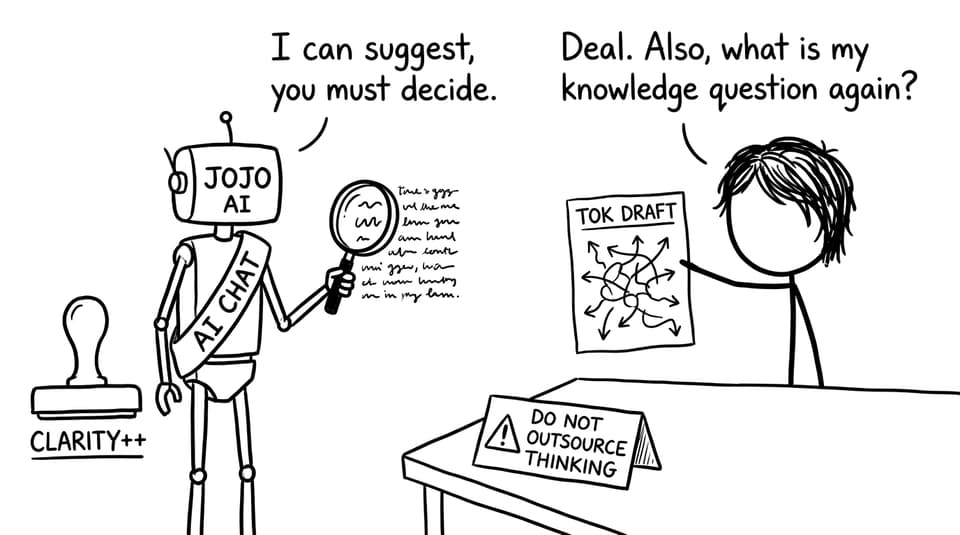
For fast, criterion-aligned feedback, use the IB TOK Essay Grader. Pair it with Jojo AI to ask targeted questions like: “Where is my evaluation thin?” or “Which sentence actually links the example to the KQ?” That combination keeps your TOK thinking yours, while speeding up the revision loop.
If you want to compare your structure to strong models, the IB Theory of Knowledge (TOK) Examples page is a calm way to calibrate what “good” looks like.
How RevisionDojo helps you write a better TOK essay (without guessing)
TOK can feel isolated because it’s philosophical, and feedback is often slow. RevisionDojo is built to reduce that isolation.
Here’s a simple workflow many IB students use:
-
Use Study Notes to clarify TOK terms, AOK differences, and what the essay rubric rewards.
-
Create quick recall prompts with Flashcards so your key definitions and frameworks stay available under pressure.
-
Use Jojo AI as AI Chat to diagnose weak evaluation, unclear KQs, or messy paragraph logic.
-
Use the TOK grader as a grading tool to test whether your draft actually matches the rubric.
-
Reduce uncertainty by studying high-quality samples in the Coursework Library (the TOK exemplars above).
-
When you want a human to point out your blind spots, get focused feedback via Tutors.
For a broader look at how the platform fits IB prep, see RevisionDojo App: The Smarter Way to Prep for IB Exams. Even though TOK is coursework, the same loop applies: understand, practice, get feedback, iterate.
Conclusion: write TOK like you’re building a case, not filling a page
A good TOK essay isn’t magic. It’s a chain of choices: a focused KQ, two contrasting AOKs, claims that can be tested, counterclaims that genuinely compete, examples that do real work, and evaluation that shows mature judgment.
If you want the fastest path from “blank page” to “examiner-ready,” build your draft in RevisionDojo, check your structure with the TOK grader, tighten logic with Jojo AI Chat, and calibrate your standards using the Coursework Library exemplars.
When you’re ready, Join RevisionDojo and turn your TOK essay into something calmer: a repeatable process you can trust.