

If you have one week left, you don’t need a miracle. You need a map.
IB Biology feels huge because it is huge: molecules to ecosystems, details to big-picture themes, and exam questions that love to mix everything together. But one week is still enough time to create momentum, patch the biggest holes, and convert panic into points -- if you study like an athlete with a short season, not a librarian with infinite time.
This guide gives you a one-week cram plan for the IB Biology 2025 onward syllabus, built around the four themes and the “levels of organisation” structure. It also shows exactly how to use RevisionDojo to make each day count.
The one-week IB Biology checklist (do this first)
Before the schedule, set up your system. Good cramming is mostly logistics.
-
Pick one “home base” for content: IB Biology resources hub
-
Decide your daily loop: Study Notes -- Flashcards -- Questionbank -- review mistakes
-
Build a weak-topics list (max 10 items) using quick diagnostic questions from the Cell Biology Questionbank
-
Use active recall every session: short questions, closed-book blurting, mini diagrams
-
Reserve the final 60–90 minutes of each day for exam-style practice
If you do nothing else, do this: treat IB Biology like a skill, not a reading assignment.
How the IB Biology 2025 onward syllabus is organised
The 2025 onward IB Biology course is built around four conceptual themes:
-
Unity and diversity
-
Form and function
-
Interaction and interdependence
-
Continuity and change
Each theme appears across molecules, cells, organisms, and ecosystems. That structure matters because IB Biology questions often test connections (for example, enzymes + respiration + ecosystems) rather than isolated facts.
For a quick overview of what changed and what exam questions now reward, keep this open: What to expect from the new IB Biology syllabus 2025.
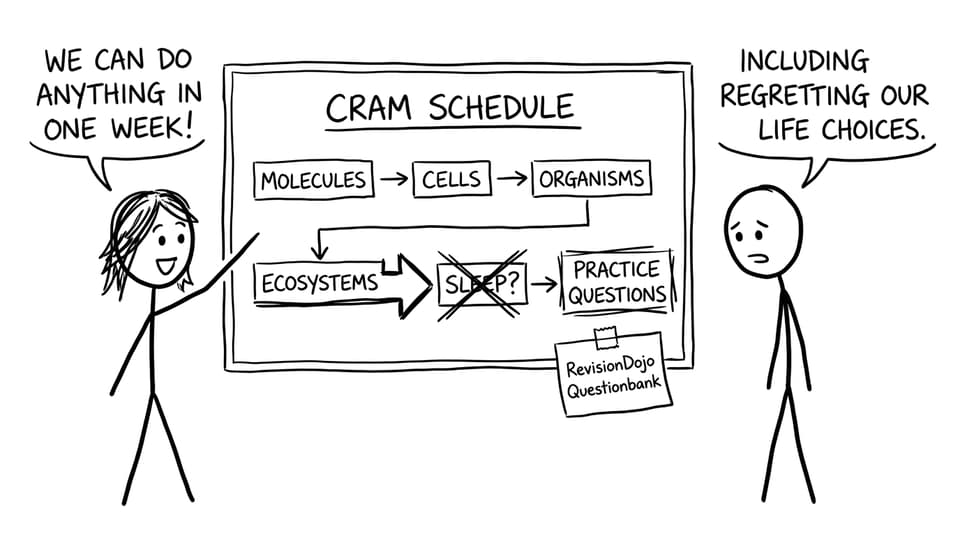
Your day-by-day one-week cram plan for IB Biology
This schedule is aggressive, but realistic. Each day has one main theme, then a short “stitching” session that links ideas across levels of organisation.
Day 1: Unity and diversity
Focus: water, nucleic acids, cell structure, classification, and the logic of cladistics (HL).
-
Learn from Study Notes (fast, not perfect)
-
Drill key definitions with Flashcards
-
Do 30–50 mixed questions, then log your errors
If you need more structured notes coverage, use: IB Biology 2025 onward notes guide.
Day 2: Unity and diversity (ecosystems layer) + review
Focus: evolution/speciation + conservation/biodiversity, then a full theme recap.
Make IB Biology stick by forcing recall:
-
10-minute blurting: “What is speciation?” “How do we measure biodiversity?”
-
20-minute “teach it” out loud
-
30-minute Questionbank sprint
Day 3: Form and function
Focus: biomolecules (carbs, lipids, proteins), membranes, transport, organelles, specialization, gas exchange and transport.
High-yield move: do protein questions early. They show up everywhere.
Use: B1.2 Proteins Questionbank.
Day 4: Form and function (ecosystems + adaptation) + review
Focus: adaptation to environment, ecological niches, and the “structure fits function” mindset.
End the day with one mixed mini-mock using RevisionDojo’s Mock Exams and Grading tools to see what you lose marks for (usually wording and missing steps).
Day 5: Interaction and interdependence
Focus: enzymes/metabolism, respiration, photosynthesis, neural signaling, defense against disease.
This is where IB Biology rewards understanding over memorising.
Use RevisionDojo’s AI Chat to interrogate confusion: “Explain chemiosmosis like I’m five, then like I’m sitting Paper 2.”
Day 6: Interaction and interdependence (ecology) + review
Focus: populations/communities, energy and matter transfers.
Practice here pays off fast because data-based ecology questions are predictable in style.
Use: C4.1 Populations and Communities Questionbank.
Day 7: Continuity and change + final consolidation
Focus: DNA replication, protein synthesis, mutations/gene editing, cell division, inheritance, homeostasis, natural selection, climate change.
Final 2 hours:
-
Build a one-page “connections sheet” linking genes -- proteins -- traits -- selection -- ecosystems.
-
Do a mixed set from the Questionbank.
-
Use Predicted Papers and Mock Exams (not endless sets, just enough to calibrate timing and command terms).
The three rules that make IB Biology cramming actually work
Use active recall, not passive rereading
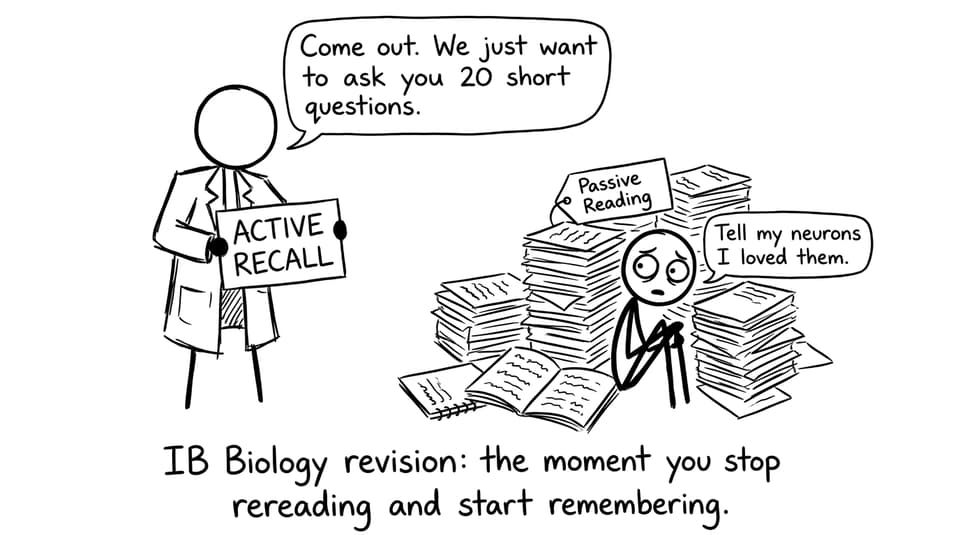
IB Biology is too dense for highlighting marathons. Flashcards, short-answer practice, and closed-book blurting outperform rereading because they train retrieval -- the exact thing exams demand. Use How to use flashcards for IB Biology revision and keep sessions short but frequent. When you miss a question, write the mistake as a new flashcard. That’s how panic becomes a personalised syllabus.
Practice exam phrasing every day
Most students “know” IB Biology but lose marks on command terms and precision. RevisionDojo’s Grading tools and explanations help you see what the examiner wanted, not what you meant. Treat every wrong question as a clue about wording, not intelligence.
Protect sleep like it’s part of the syllabus
One week means your brain is the bottleneck. A tired brain memorises badly and reads slowly. Aim for a consistent sleep window and one short walk daily. Cramming works when you’re sharp enough to do active recall.
One week left? Make it count with RevisionDojo
IB Biology doesn’t reward the student who reads the most. It rewards the student who can retrieve, apply, and explain under time pressure.
If you’re cramming the IB Biology 2025 onward syllabus in one week, build your routine around RevisionDojo: Study Notes for clarity, Flashcards for active recall, AI Chat for stuck moments, Questionbank for exam practice, and Mock Exams, Predicted Papers, and Grading tools to make your answers examiner-ready. Then, if you want extra accountability, add Tutors for a final-week polish.
Open the IB Biology hub, pick Day 1, and start now. Your future self will feel the difference in the first ten minutes of the exam.