


In Year 1, most IB students don’t choose an IB Math course. They choose a story.
A story about “keeping doors open.” A story about “not being a math person.” A story about “economics needs calculus.” And sometimes, a story that starts with a friend saying, “AA is the smart one, AI is the easy one,” and ends with months of stress that never needed to happen.
If you’re aiming for business or economics, your IB Math choice matters because it shapes what you practice every week: whether you learn to model the messy world (markets, data, uncertainty), or to master the clean world (proof, algebraic structure, calculus technique). Both worlds are valuable. But they help different futures.
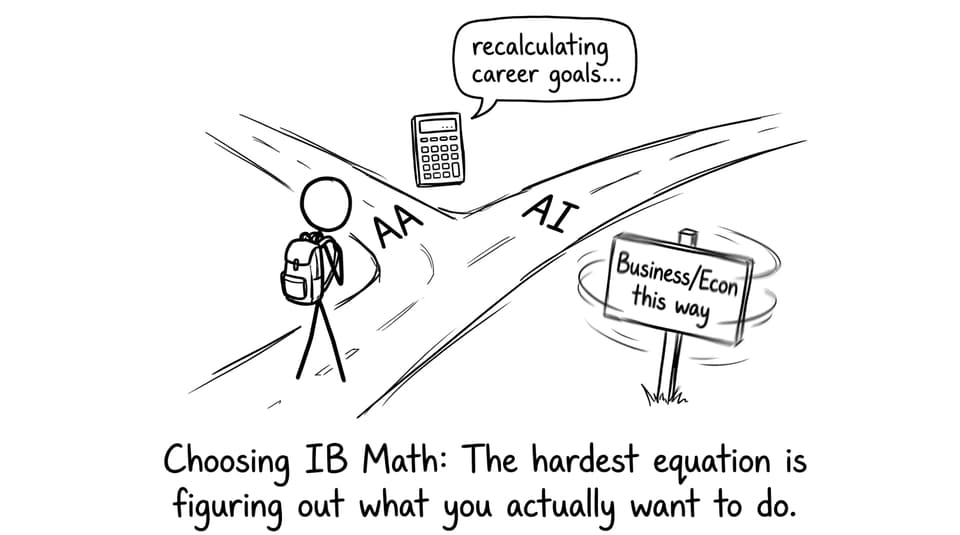
Quick checklist: pick the right IB Math in 3 minutes
Use this fast filter before you overthink it:
-
If your dream involves data, business decisions, real-world modeling, finance contexts, lean AI.
-
If your dream involves econometrics, mathematical economics, STEM-heavy options, or calculus-first admissions, lean AA.
-
If your target universities are competitive and quantitative, HL becomes a strategic advantage.
-
If your schedule is already heavy (HL Econ + HL Business + languages), SL can be the difference between consistent practice and burnout.
For a broader breakdown of the four routes, keep this guide open: AA vs AI, SL vs HL, and How to Choose the Right Course.
The IB Math pathways: AA vs AI (what the labels really mean)
The IB didn’t split IB Math to confuse you. They split it because students need different kinds of mathematical thinking.
IB Math AI (Applications and Interpretation)
AI is where math behaves like it does in business: imperfect information, noisy data, and models you defend with interpretation.
You’ll spend more time on:
-
statistics and probability
-
technology-driven analysis
-
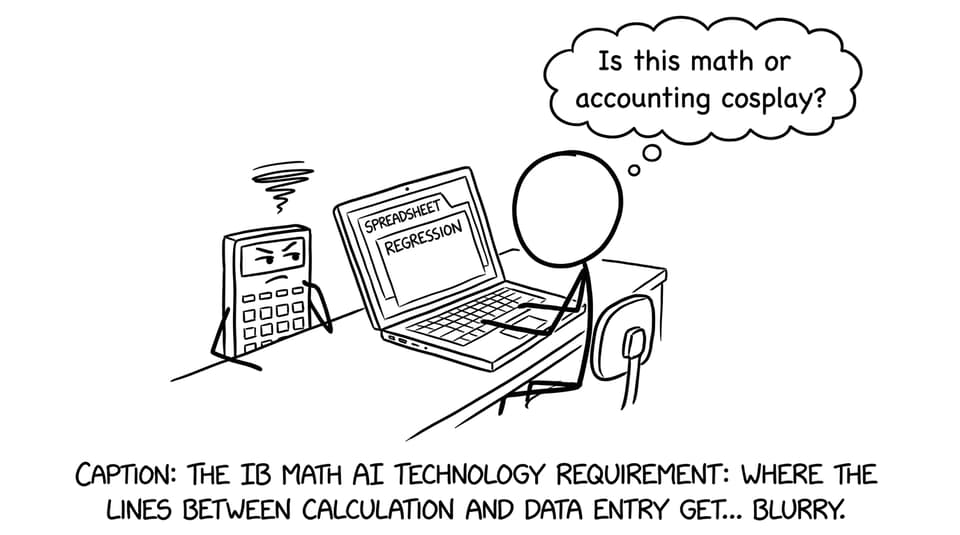
regression and modeling
-
interpreting graphs and outputs
If you want a feel for how AI leans into statistics, explore RevisionDojo’s AI resources like Statistics and Probability for IB Math AI and the workflow-heavy How to Interpret Data in IB Math AI Using Technology.
IB Math AA (Analysis and Approaches)
AA is where math behaves like it does in theoretical economics and quantitative degrees: abstraction first, interpretation second.
You’ll spend more time on:
-
algebraic manipulation and structure
-
calculus techniques
-
proof-style reasoning (especially at HL)
If you’re curious what AA includes, RevisionDojo’s IB Math AA hub shows the topic map clearly.
SL vs HL: the workload isn’t just “more content”
Students often describe SL vs HL as a volume difference. In IB Math, it’s also a pressure difference.
SL usually rewards consistency: learn a method, practice it, and get fluent.
HL often rewards transfer: take a method, twist it, combine it with another topic, and explain why it still works.
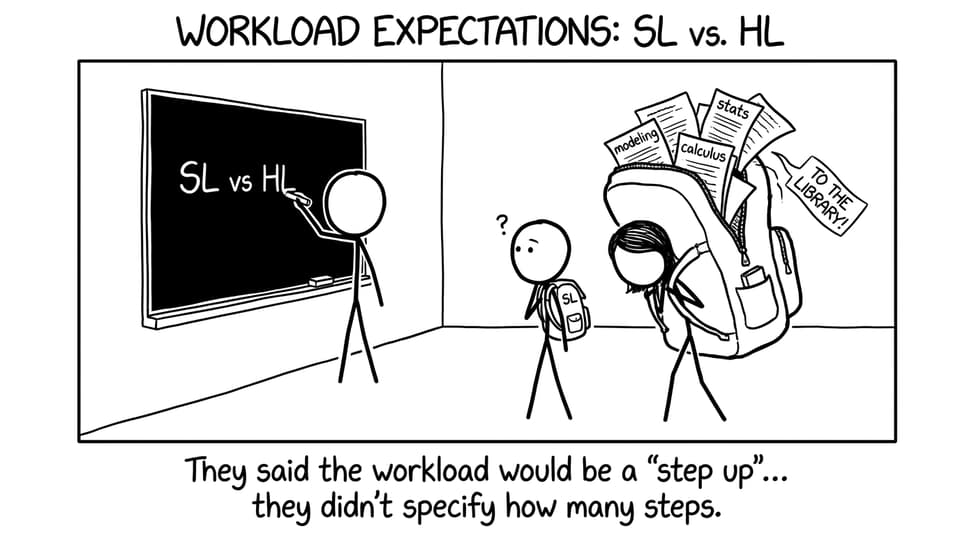
This matters for business and economics because your other subjects often demand written evaluation (Econ essays, Business case study logic, IAs). HL math can be brilliant preparation, but only if it doesn’t eat the time you need to score everywhere else.
Best IB Math for business: why AI is usually the clean fit
For most students heading to business or mainstream economics, IB Math AI matches the skills you’ll actually use:
-
reading data quickly (tables, charts, distributions)
-
building models (growth, decay, cost curves, forecasting)
-
reasoning with uncertainty (probability, risk)
-
using technology properly (because real analysts don’t do everything by hand)
This is also why AI often supports your IB workflow beyond exams. Your math internal assessment becomes less about forcing a “cool calculus trick” and more about investigating something real.
If you’re doing an IA that involves graphs and results (common in business-style investigations), this guide is gold: How to Analyze Graphs and Results in the IB Math IA.
AI SL vs AI HL for economics and business: how to choose
Here’s the most honest way to choose IB Math level: pick the one you can practice consistently for 18 months.
Choose IB Math AI SL if...
-
You want a strong quantitative foundation without your week collapsing.
-
Your target programs are standard business, management, marketing, or broad social sciences.
-
Your strengths are writing, evaluation, or qualitative analysis, and you need math to be stable.
AI SL can still be rigorous when you do it properly. The difference is that it’s easier to keep your practice rhythm steady.
Choose IB Math AI HL if...
-
You’re aiming for competitive economics/business programs with heavier quantitative expectations.
-
You enjoy statistics, modeling, and problem-solving with technology.
-
You want more headroom for quantitative uni modules later.
If you want a reality check on difficulty (without the drama), read: Which IB Math Is Harder? A Detailed Comparison and Should I Take IB Math AA or AI? A Realistic Breakdown.
When IB Math AA is the better choice for economics
There’s a version of economics that looks like business news and policy debates. And there’s a version of economics that looks like a math department.
If you’re targeting:
-
econometrics-heavy degrees
-
mathematical economics
-
quantitative finance paths
-
double majors that involve math or CS
...then IB Math AA, especially AA HL, can be the right signal and the right training.
It’s not that AI is “inferior.” It’s that AA trains a different muscle: abstract reasoning under constraints.
To see what AA HL demands, the topic hub helps: IB Math AA. And if you want to understand why people call it difficult, this comparison is useful: How Difficult Is IB Math HL Compared to Other IB Subjects?.
How IB Math shows up inside IB Economics (SL and HL)
Economics is not “mathy” in the way AA HL is mathy. But IB Math skills change how calmly you handle Econ, especially at HL.
You’ll use math when you:
-
interpret elasticities and percentage changes
-
read and annotate diagrams accurately
-
compare trends in data response questions
-
justify decisions with quantitative evidence
If you’re studying Economics and want your resources organized in one place, start here: IB Economics resources.
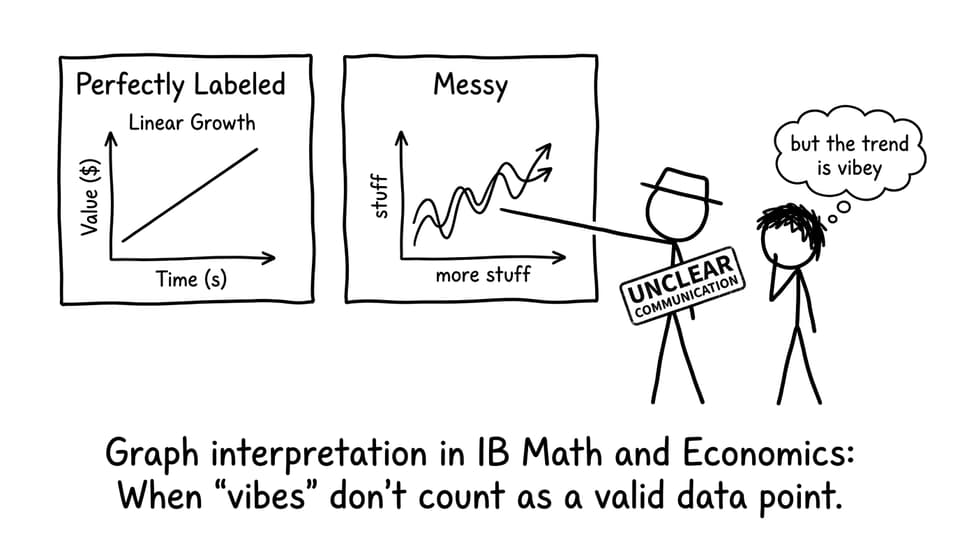
And if you ever find yourself thinking, “My diagram makes sense, but my explanation feels weak,” it’s usually a communication issue, not a knowledge issue.
How to study IB Math for business and economics (without wasting effort)
Most students don’t fail IB Math because they never worked hard. They fail because they worked hard in the wrong direction.
Here’s a strategy that stays aligned with business/econ needs:
Build your “decision-making toolkit”
-
Create a formula sheet you can explain, not just copy.
-
Train graph interpretation daily (axes, units, intercepts, meaning).
-
Practice choosing a model, not just computing.
Practice like the exam, but with feedback
RevisionDojo is built for this exact loop: learn, drill, diagnose, repeat.
-
Use the Questionbank to target weak strands fast.
-
Use Study Notes to rebuild methods you keep forgetting.
-
Use Flashcards for definitions, conditions, and calculator steps.
-
Use AI Chat when you’re stuck and need a second explanation.
-
Use Grading tools to get markscheme-aligned feedback on written reasoning.
-
Use Predicted Papers and Mock Exams to rehearse timing and stress.
-
Use the Coursework Library if your math investigation overlaps with business/econ contexts.
-
Use Tutors when the issue is foundational and time is short.
If you want to see how targeted practice is structured, this overview helps: Comprehensive IB Question Bank: Thousands of Practice Questions.
Common myths that push students into the wrong IB Math
“AA is always better for economics.”
Only for the most quantitative economics tracks. For many business and broad economics degrees, AI is closer to the day-to-day work: interpreting data, modeling change, and explaining results.
“AI is easy, so universities don’t respect it.”
AI HL is not a soft option. It’s demanding in a different way: you’re constantly interpreting context, choosing tools, and defending outputs. That’s exactly what business analysts do.
“If I choose AI, I won’t be ready for uni.”
Readiness comes from depth, not labels. A student who practices AI consistently, understands statistics, and communicates clearly is often more prepared than someone who survived AA by memorizing templates.
Closing: choose the IB Math that matches the life you want to live
The best IB Math course for business and economics is usually Math AI, because it trains the habit that business rewards: turning messy information into clear decisions.
-
Choose AI SL if you want stability, time, and a strong practical foundation.
-
Choose AI HL if you’re aiming for competitive programs or want deeper quantitative confidence.
-
Choose AA HL when your economics path is genuinely mathematical and admissions expect calculus-heavy readiness.
Once you choose, don’t leave your outcome to luck. Build your routine on RevisionDojo: Questionbank practice, Study Notes when you forget, Flashcards for retention, AI Chat when you’re stuck, and Mock Exams plus Predicted Papers when it’s time to perform.
Your course choice sets the direction. Your practice decides the result, and RevisionDojo is built to make that practice count.