RevisionDojo logoRevisionDojo logo
FeaturesSubjectsPricingSchools
Back to all posts
  1. Home
  2. /Blog
  3. /IB Program Explained: 2025 Student Success Guide

IB Program Explained: 2025 Student Success Guide

IB
RevisionDojo Team
•Last updated: 19 Jul 2026•7 min read
ShareShare on XShare on WhatsAppShare on LinkedInShare on Facebook
Add as a preferred source on Google
IB Program Explained: 2025 Student Success Guide

Join 650k+ students breezing through the IBReady to breeze through the IB?

Footer

General

  • Download apps
  • For parents
  • For schools
  • Pricing
  • Gift RevisionDojo
  • Tutoring
  • IB syllabus
  • MYP syllabus
  • Blog
  • Student Questions

Features

  • Question Bank
  • Test Builder & Exam Mode
  • Predicted Papers
  • Past Papers
  • Study Notes
  • Interactive Lessons
  • Flashcards
  • Jojo AI Tutor
  • Coursework Studio
  • View all features

Research

  • All research
  • Jojo AI vs leading AI study tools
  • 2026 State of Learning Survey
  • 2025 State of Learning Survey
  • IB Moderation Analysis
  • Jojo AI vs ChatGPT
  • Jojo AI vs Gemini
  • Jojo AI vs Perplexity
  • Jojo AI vs Claude
  • Jojo AI vs Poe

Platform

  • About RevisionDojo
  • RevisionDojo vs Others
  • Content philosophy
  • Trustpilot
  • Join usWe're hiring
  • Student Ambassador
  • Help center
  • Contact us
  • Terms of Service
  • Data & privacy
  • Privacy policy
  • Cookie policy
  • Trust Center

IB Subjects

  • Arabic A
  • Arabic A Lit
  • Arabic ab initio
  • Arabic B
  • Biology
  • Business Management
  • Chemistry
  • Chinese A Lang & Lit
  • Chinese B
  • Computer Science (CS)
  • Computer Science (First Exam 2027)
  • Design Technology (DT)
  • Design Technology (First Exam 2027)
  • Digital Society (DS)
  • Economics
  • English A Lang & Lit
  • English A Lit
  • English B
  • Environmental systems and societies (ESS)
  • French A
  • French A Lit
  • French ab initio
  • French B
  • Geography
  • German A
  • German A Lit
  • German ab initio
  • German B
  • Global Politics
  • History
  • History (First Exam 2028)
  • Mathematics Analysis and Approaches (AA)
  • Mathematics Applications & Interpretation (AI)
  • Philosophy
  • Physics
  • Psychology
  • Psychology (First Exam 2027)
  • Spanish A
  • Spanish A Lit
  • Spanish ab initio
  • Spanish B
  • Sports, exercise and health science (SEHS)
  • Theory of Knowledge (TOK)
  • World Religions

MYP Subjects

  • MYP Biology
  • MYP Chemistry
  • MYP Design
  • MYP English Lang & Lit
  • MYP Extended Mathematics
  • MYP History
  • MYP Individuals & Societies
  • MYP Integrated Sciences
  • MYP Physics
  • MYP Standard Mathematics
  • MYP Biology
  • MYP Chemistry
  • MYP Design
  • MYP English Lang & Lit
  • MYP Extended Mathematics
  • MYP History
  • MYP Individuals & Societies
  • MYP Integrated Sciences
  • MYP Physics
  • MYP Standard Mathematics
RevisionDojo logo

© 2022 - 2026 RevisionDojo (MyDojo Inc)

RevisionDojo was developed independently of the IBO and as such is not endorsed by it in any way.

Download on the App StoreGet it on Google Play
GDPR compliant

If you have ever watched an IB calendar fill up and wondered, “Is this actually helping me, or just making me busy?” you are not alone. The IB can feel like a storm of acronyms, deadlines, and expectations. But underneath the noise, it is built around a simple idea: a student becomes stronger when learning is broad, deep, and repeatedly tested in real conditions.

That is why the IB often rewards students who learn how to study, not just what to study.
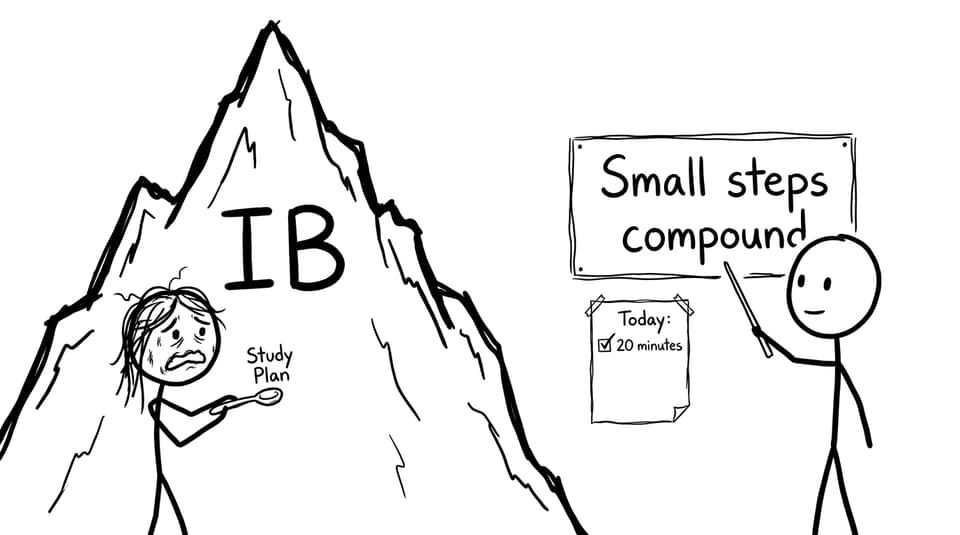
A student faces an IB mountain with a tiny study plan spoon

What is the IB Program?

The International Baccalaureate (IB) is a globally recognized education system founded in 1968 in Geneva, Switzerland. It offers four programs, but most exam-focused students are thinking about the IB Diploma Programme (DP), designed for ages 16-19.

The key thing to know is that the IB is not meant to be a collection of “hard classes.” It is meant to be a training ground for university-style thinking: analysis, writing, research, and performance under timed assessment.

If you want the fastest overview of what RevisionDojo supports across your IB journey, start here: RevisionDojo for IB and the general hub: International Baccalaureate (IB).

Quick checklist: how the IB Diploma is structured

Use this as your mental map before you revise anything:

  • Six subject groups (Languages, Individuals and Societies, Sciences, Mathematics, The Arts)

  • Three subjects at Higher Level (HL) and three at Standard Level (SL)

  • Three core requirements:

    • Theory of Knowledge (TOK)

    • Extended Essay (EE)

    • Creativity, Activity, Service (CAS)

When exam season hits, the point is not to “cover” everything. The point is to build repeatable proof that you can score marks under IB conditions.

The parts of IB that actually help you later

The IB teaches you to think in criteria, not vibes

A quiet advantage of the IB is that it pushes you toward clear standards. You stop asking, “Is this good?” and start asking, “Does this meet the markband?”

This is exactly why exam practice matters so much. With RevisionDojo, students turn that criteria mindset into a loop: Questionbank practice, feedback, then targeted fixes. If you want a practical entry point, explore the free Questionbank feature and the deeper strategy guide: IB Question Bank: Thousands of Practice Questions.

The IB is broad on purpose (and that protects you)

The IB is famously broad: languages, math, science, humanities. At first it feels like too much. Later, it becomes a kind of insurance.

Many students discover they are stronger than they expected because they trained in multiple modes: essays, lab thinking, problem solving, oral communication. That flexibility shows up in university courses where you are constantly switching task types.

To make the breadth manageable, lean on structured materials instead of rewriting everything from scratch: Study Notes and the companion guide: IB Subject Note Collections.
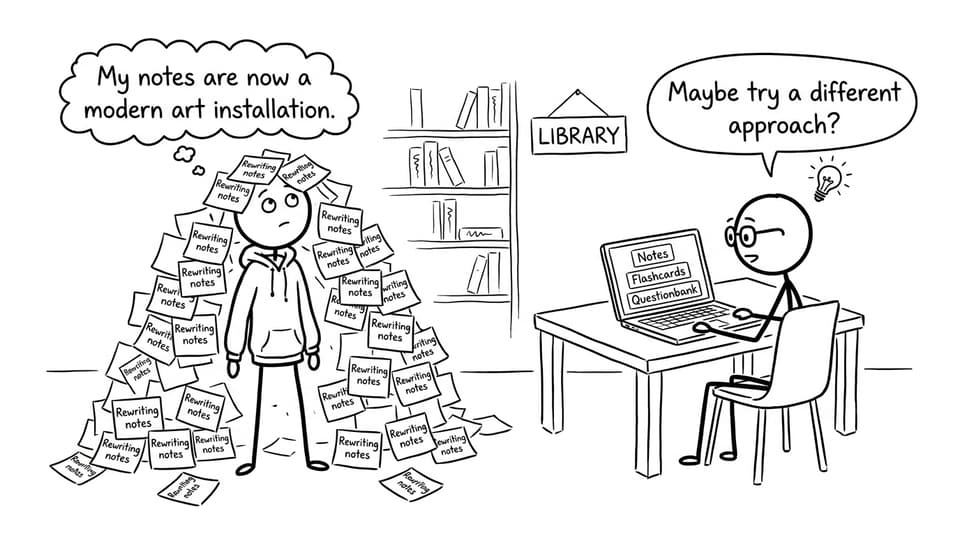
Two students: one drowning in rewritten notes, one using Notes/Flashcards/Questionbank

How the IB benefits you during exams (the part you care about)

The IB rewards active recall more than rereading

By the time you reach IB exams, “understanding” is not enough. You need retrieval: the ability to produce an answer on demand, in the correct style, under time.

That is why short daily recall wins. A few minutes of spaced repetition can outperform a long session of passive reading. Build that habit using IB Flashcards with Spaced Repetition (SRS) and the strategy breakdown: IB Flashcard System.

The IB rewards timing and stamina (which you can train)

Students often say, “I know the content, I just run out of time.” In the IB, time is a skill.

You train it by sitting realistic timed sets, then reviewing like an analyst: where did marks leak: content, command terms, structure, or pacing? RevisionDojo supports this with Mock Exams, Predicted Papers, and feedback loops via AI Chat and Grading tools.

For a strong workflow, read How 45-Point IB Students Prepare for Exams and the simulation guide: IB Predicted vs Specimen Papers: What They Mean.
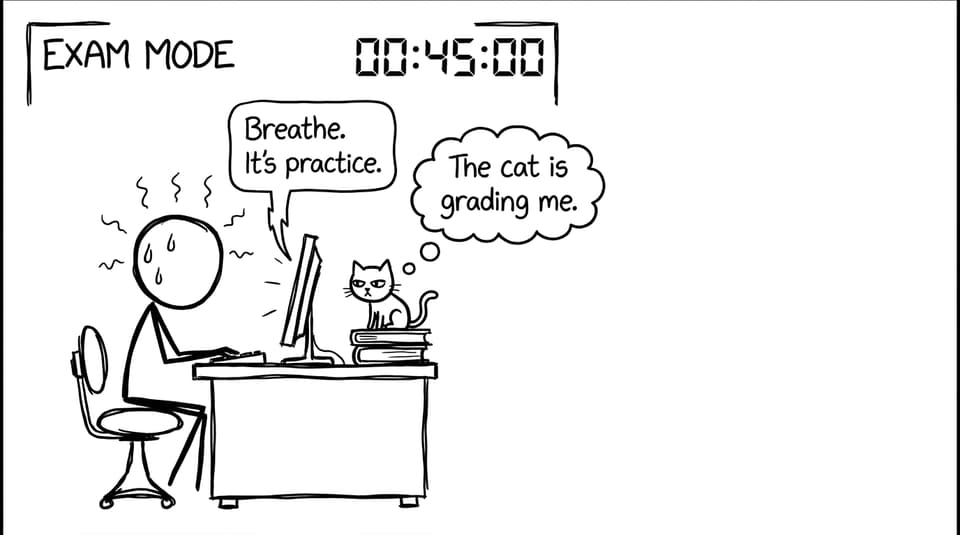
Student in EXAM MODE with timer, computer says breathe, cat judges

A simple RevisionDojo plan that fits real IB life

Here is a realistic weekly structure many IB students can sustain:

  • 3-5 sessions: targeted Questionbank sets (one topic, one skill)

  • Daily 7-10 minutes: Flashcards (spaced repetition)

  • 2 sessions: patch gaps using Study Notes (short, focused)

  • 1 session: a timed Mock Exam or Predicted Paper, then deep review

  • As needed: AI Chat for fast clarification, and Tutors when you want a human to help you restructure how you answer

If coursework is also pressuring you, RevisionDojo’s Coursework Library and Grading tools help you improve drafts faster and understand rubrics without guessing. For a bigger picture of how the ecosystem works, see: RevisionDojo App: The Smarter Way to Prep for IB Exams.

Closing: why IB pays you back

The IB is demanding, but it is not demanding by accident. It is trying to turn you into someone who can handle complexity without panicking, someone who can write, reason, and perform on a deadline.

If you want to feel that benefit before results day, build your routine now: revise with Study Notes, drill with the Questionbank, stay sharp with Flashcards, and rehearse the real thing using Mock Exams and Predicted Papers inside RevisionDojo.

Because the goal is not to survive the IB. The goal is to walk into your exams feeling like you have done this before, and to have the data to prove it.

How helpful was this article?
Add as a preferred source on Google

Continue studying with RevisionDojo

  • IB Coursework GraderCheck an IA, EE, or TOK draft against IB assessment criteria.
  • IB Coursework ExamplesLearn from high-scoring coursework across IB subjects.
  • IB Grade CalculatorEstimate an IB grade using session-specific boundaries.
  • IB Grade BoundariesExplore historical grade boundaries by subject and session.

Frequently Asked Questions

Related Articles

DP1 Reassurance & Mindset · Oct 21, 2026 · 11 min read

What I Wish I Knew: IB DP1 Lessons That Matter

What I wish I knew IB students understood sooner: a reassuring DP1 guide to study systems, deadlines, feedback, CAS, rest, and starting this week.

DP1 Reassurance & Mindset · Oct 21, 2026 · 11 min read

Switch From IB Diploma to Courses: Is It Failure?

Switch from IB Diploma to courses without shame. Compare credentials, university implications, warning signs, and practical next steps for DP1 students.

DP1 Reassurance & Mindset · Oct 21, 2026 · 11

Straight-A Student Struggling in IB? A DP1 Reset

Straight-A student struggling in IB? Learn why DP1 feels different, reset your study system, and take practical steps to regain confidence this week.

DP1 Reassurance & Mindset · Oct 21, 2026 · 12

Why IB Teachers Grade Harsh in DP1, and What to Do

IB teachers grade harsh in DP1 for several reasons. Learn how marking works, check whether feedback is fair, and build a practical study plan this week.

DP1 Reassurance & Mindset · Oct 21, 2026 · 12

IB October Burnout: Why DP1 Feels the Worst

IB October burnout can make DP1 feel unmanageable. Learn why the dip happens and use a realistic one-week reset to regain energy, focus, and control.

DP1 Reassurance & Mindset · Oct 21, 2026 · 10

Good First Semester IB: What Progress Looks Like

Good first semester IB progress is not perfection. Learn what DP1 students should understand, organize, practise, and improve during their first term.

min read
min read
min read
min read