

The week you realize your IB workload has two layers is the week everything starts to make sense.
There’s the visible layer: classes, deadlines, revision plans. Then there’s the invisible layer: the shape of the programme you’re actually enrolled in. Are you doing the full IB Diploma, or taking individual IB courses for certificates?
That difference matters, especially when you’re planning exams and deciding where to spend your limited energy.
What is an IB Course Certificate?
An IB Course Certificate is awarded when you complete one or more individual IB Diploma Programme courses (at SL or HL) without meeting the requirements for the full IB Diploma.
The key point for exam prep: your certificate course is not a “lite” syllabus. You still sit the same style of assessments as Diploma candidates in that subject, and your grade is still reported on the familiar IB 1–7 scale.
If you want a broader comparison of pathways, see Full IB Diploma vs Individual IB Courses.
IB Course Certificate vs the full IB Diploma
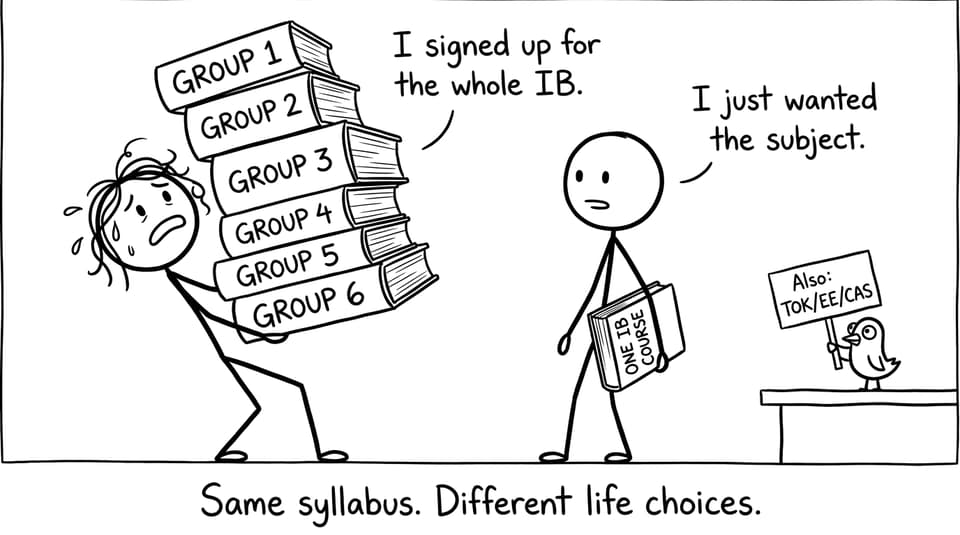
The full IB Diploma is a package: six subjects across groups plus three core components. The Course Certificate route is modular: you take the subjects you want, and you stop there.
The biggest differences (fast checklist)
-
Subject load: Full IB Diploma = six subjects; Certificate = one or more.
-
Core components: Full IB Diploma includes TOK, EE, and CAS; Certificate does not.
-
University signaling: Full IB Diploma is generally broader and carries more weight overall, while strong certificate grades can still help when they match your intended course.
-
Student experience: Diploma rewards balance and long-term organization; certificates reward focus and depth in fewer areas.
When your goal is exam performance, the practical takeaway is this: certificate students can often revise more intensely per subject, while Diploma students must distribute attention across a wider map.
Who should consider an IB Course Certificate?
An IB Course Certificate can be a smart fit if you:
-
Want IB recognition in a specific subject (for example, to support a university pathway)
-
Are following another curriculum and want a rigorous add-on
-
Need a more sustainable workload than the full Diploma
-
Started the Diploma but can’t complete all requirements, yet still want official IB course results
It’s not “less serious.” It’s a different strategy.
How to prep for IB exams in either pathway (without wasting time)
Whether you’re a full IB Diploma candidate or taking IB certificates, your revision system should be brutally simple: learn, test, fix, repeat.
A reliable loop using RevisionDojo:
-
Patch knowledge quickly with RevisionDojo for IB
-
Train marks using the Questionbank and exam-style sets (then review mistakes)
-
Lock in memory with IB Flashcards
-
Get unstuck fast using AI Chat
-
Build realism with IB Predicted Papers and timed Mock Exams
-
Reduce coursework stress using IB Coursework Guides and Grading tools
If you’re behind and need a calm plan, use How to Study for IB Exams When You Feel Behind. If you want the full structure, follow How to Study for IB Exams: Step-by-Step Guide.
The bottom line
An IB Course Certificate is a focused way to earn official IB recognition in one or more subjects, without the full Diploma core. The full IB Diploma is broader and more holistic, but also heavier.
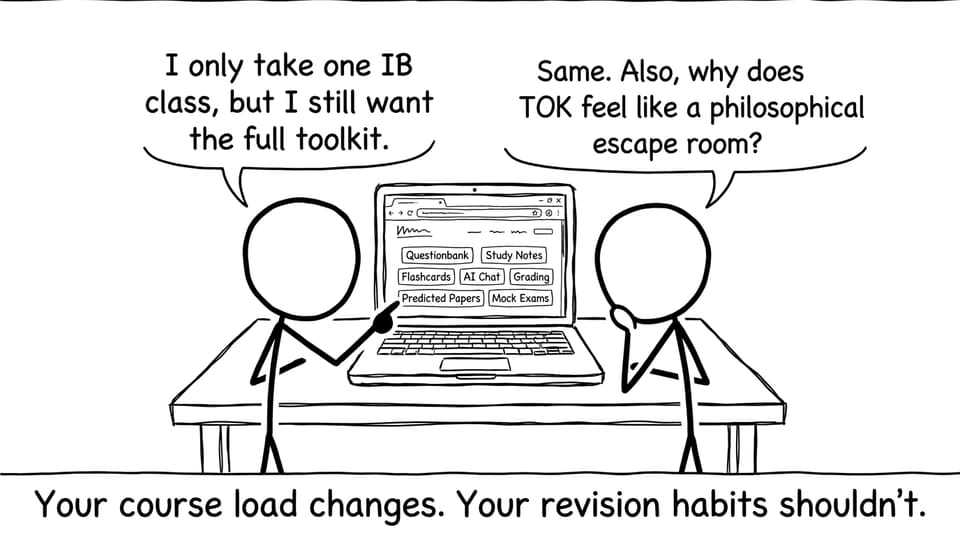
Whichever route you’re on, exams reward the same thing: clear understanding plus repeated practice under pressure. Build that with RevisionDojo’s Questionbank, Study Notes, Flashcards, AI Chat, Predicted Papers, Mock Exams, Coursework Library, Grading tools, and Tutors, and your IB plan starts feeling less like chaos and more like a system.
Explore your subject hub and start a tighter revision loop at RevisionDojo.