
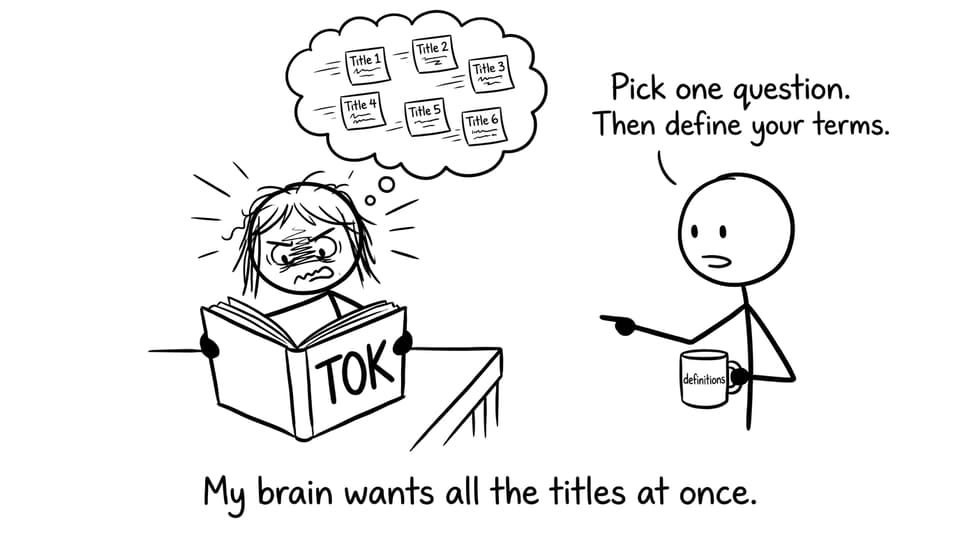
TOK feels calm right up until the moment you open the prescribed titles and realize each one is a trapdoor into a bigger question: How do we decide what counts as knowledge? That’s the real test of the TOK essay. The good news is that the November 2025 set is predictable in one comforting way: if you define terms, choose workable Areas of Knowledge (AOKs), and build balanced claims and counterclaims, you can make any title feel manageable.
Below is a practical TOK guide to the November 2025 TOK essay titles, how to choose the right one, and writing strategies that turn a vague idea into a focused argument.
November 2025 TOK essay titles (official prescribed titles)
Here are the prescribed titles for the November 2025 session:
-
1. For historians and artists, do conventions limit or expand their ability to produce knowledge? (History and the arts)
-
2. What is the relationship between knowing and understanding? (Two AOKs)
-
3. Should knowledge in an area of knowledge be pursued for its own sake rather than for its potential application? (Mathematics and one other AOK)
-
4. To what extent do you agree that however the methods of an area of knowledge change, the scope remains the same? (Two AOKs)
-
5. In the pursuit of knowledge, is it possible or even desirable to set aside temporarily what we already know? (Natural sciences and one other AOK)
-
6. Is empathy an attribute that is equally important for a historian and a human scientist? (History and the human sciences)
If you want a quick refresher on how the TOK course and assessment fit together, keep the official-style overview open while you plan: IB Theory of Knowledge resources.
A quick TOK planning checklist (use this before you draft)
-
Pick one title and rewrite it in your own words.
-
Define 2-4 key terms in a way you can actually use (not dictionary padding).
-
Choose two AOKs that will genuinely create tension.
-
Decide your main claim and the best counterclaim.
-
Attach one precise real-world example per AOK.
-
Add the Core Theme angle (often Knowledge and the Knower) so the essay stays unmistakably TOK.
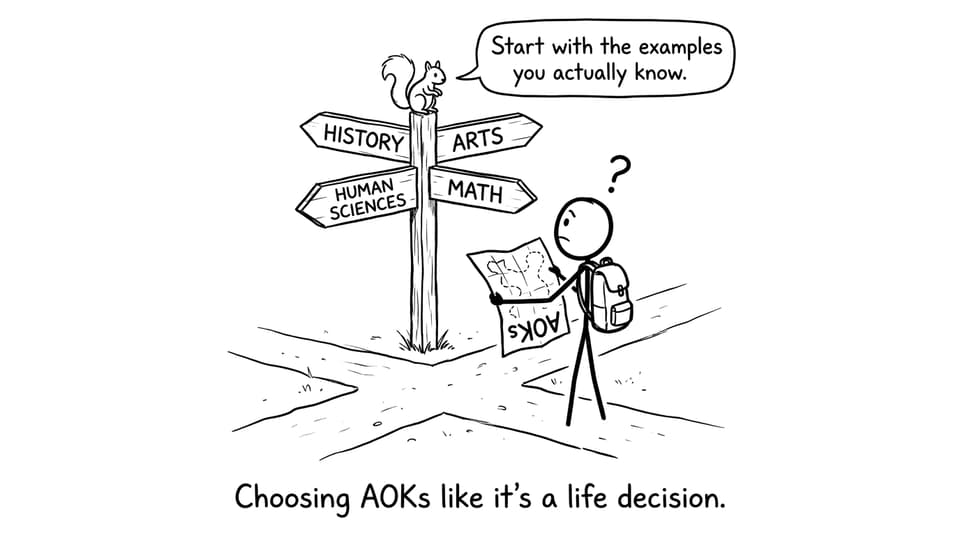
For deeper AOK selection help, this is worth reading early: Connecting TOK essay ideas to Areas of Knowledge.
How to choose the best TOK essay title for you
A strong TOK choice is less about which title sounds impressive and more about which title you can prove something about.
Choose the title that gives you controllable definitions
Some titles hinge on terms you can define cleanly. For example, Title 3 becomes much easier once you define “for its own sake” vs “application” using mathematics as a case where usefulness is complicated.
Title 1 can also be great, but only if you can define “conventions” in both the arts and history without drifting into vague commentary.
Choose the title that matches your example bank
Your examples are your steering wheel. If you already know a strong scientific shift (e.g., model change, measurement limits, paradigm change), Title 5 is a natural fit. If you have strong historical interpretation cases, Title 6 can become powerful.
If you need quick AOK clarity, use: Overview of the five Areas of Knowledge in TOK.
TOK essay structure that stays focused (and examiner-friendly)
Most TOK essays fall apart for one quiet reason: paragraphs stop answering the title.
A simple structure that prevents that:
Introduction (tight, not dramatic)
-
Define the key terms.
-
State your AOKs.
-
Present the knowledge question you think the title is really asking.
-
Preview your line of argument.
For a syllabus-aligned breakdown of the essay itself, use: TOK 4.2 The TOK Essay notes.
Body AOK 1: claim then counterclaim
-
Claim about how knowledge works in AOK 1.
-
Example (specific enough to verify).
-
Counterclaim that limits the claim.
-
Evaluation: when does each side hold?
Body AOK 2: repeat, but make the contrast real
Don’t “repeat with different content.” Make the second AOK challenge the first: different methods, different standards, different stakes.
Conclusion: weigh, don’t summarize
A TOK conclusion should feel like a judgement call with humility. You’re not finishing the debate. You’re showing you understand what makes it hard.
To keep the Core Theme present instead of tacked on, see: How to use the Core Theme in your TOK essay.
Writing strategies that reliably lift TOK marks
Define terms like you plan to use them
Pick definitions that create criteria. If “empathy” matters (Title 6), specify what kind: emotional resonance, perspective-taking, or methodological sensitivity to context.
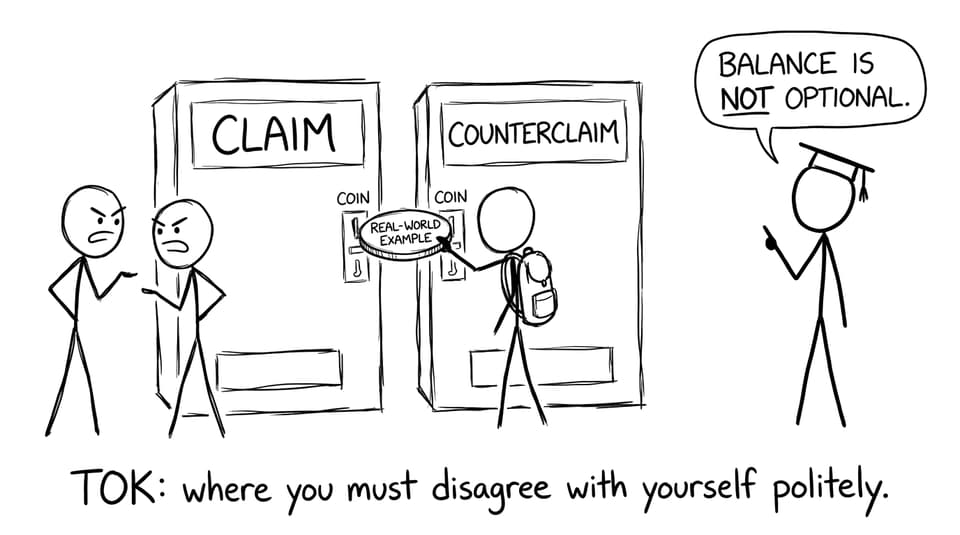
Make counterclaims do real work
A counterclaim isn’t “some people disagree.” In TOK, it’s the boundary of your first claim. This is where the best evaluation lives.
Use RevisionDojo to build the feedback loop
The fastest improvement comes from iteration: write, get feedback, revise, repeat.
RevisionDojo helps you run that loop without guessing:
-
Use Study Notes to clarify concepts fast.
-
Turn key definitions into Flashcards so they stay sharp.
-
Practise argument moves with the Questionbank mindset (target one weakness at a time).
-
Ask AI Chat (Jojo) to challenge your claim with alternative perspectives.
-
Use Grading tools to check alignment with the TOK rubric.
-
Pull inspiration from the Coursework Library to see what strong structure looks like.
-
Build realism with Mock Exams and Predicted Papers for timed writing stamina.
-
Get strategic help from Tutors when you need a human second brain.
Start here if you want a central hub for TOK materials: All TOK posts.
Closing: write the TOK essay you can defend
The best TOK essays don’t try to sound philosophical. They sound careful. They define terms, they choose AOKs that genuinely disagree, and they use examples to test ideas instead of decorating them.
If you want to turn your November 2025 TOK title into a draft you can actually defend under pressure, build your workflow in RevisionDojo: Study Notes for clarity, Flashcards for definitions, AI Chat for challenge, Grading tools for alignment, and the Coursework Library for models of strong reasoning. Your TOK essay doesn’t need to be perfect on the first try. It needs to get better on purpose.