


If you have ever walked out of a tough IB Math HL lesson thinking, “I understood it… until I didn’t,” the final exams can feel like that moment, except timed, silent, and worth everything.
The good news is that IB Math HL exams are demanding in a predictable way. Once you understand the format, what examiners reward, and how each paper “wants” you to think, the pressure becomes something you can train for.
IB Math HL exam format (quick overview)
Use this checklist to anchor your IB revision:
-
Confirm the official structure and weightings on the IB Mathematics Analysis and Approaches Resources.
-
Paper 1 trains exact algebra and clean reasoning (no calculator).
-
Paper 2 trains calculator efficiency plus interpretation (calculator allowed).
-
Paper 3 (HL only) trains unfamiliar contexts and connected problem-solving.
-
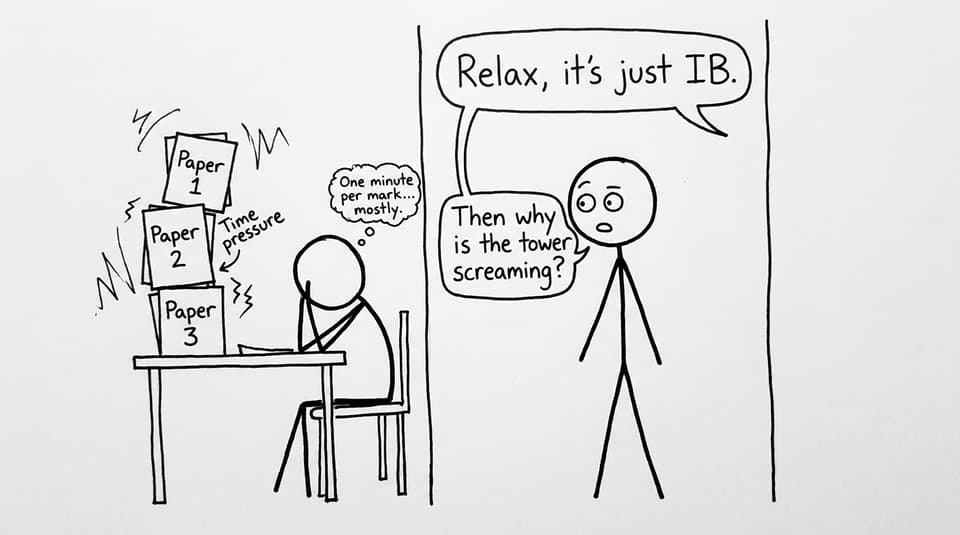
Method marks matter across every paper.
-
Your Internal Assessment (exploration) also contributes 20% of the course grade.
If you want one home base while you revise, keep the IB Math AA hub open and work topic-by-topic from there.
Paper 1: Non-calculator fluency (HL)
Paper 1 is where the IB tests whether your mathematics stands on its own.
What to expect:
-
Duration: 120 minutes (HL)
-
Calculator: not permitted
-
Heavy emphasis on algebraic control, exact values, calculus techniques, functions, trigonometry, and proof-style reasoning.
Why it feels hard: you cannot “numerically escape” a messy line of working. A small algebra slip early can multiply into a wrong method later.
Training strategy: build symbolic stamina.
-
Use concise notes to patch gaps, especially in calculus and algebra (RevisionDojo’s AA Calculus topic page is a strong place to tighten methods).
-
Drill targeted sets until your first attempt is clean, not just eventually correct.
Paper 2: Calculator allowed, but thinking required
Paper 2 is where many IB students overestimate the calculator and underestimate the examiner.
What to expect:
-
Duration: 120 minutes (HL)
-
Calculator: required/allowed
-
Longer applications of core topics plus statistics, numerical methods, modeling, and multi-step questions.
The common trap: copying calculator output without explaining what it means.
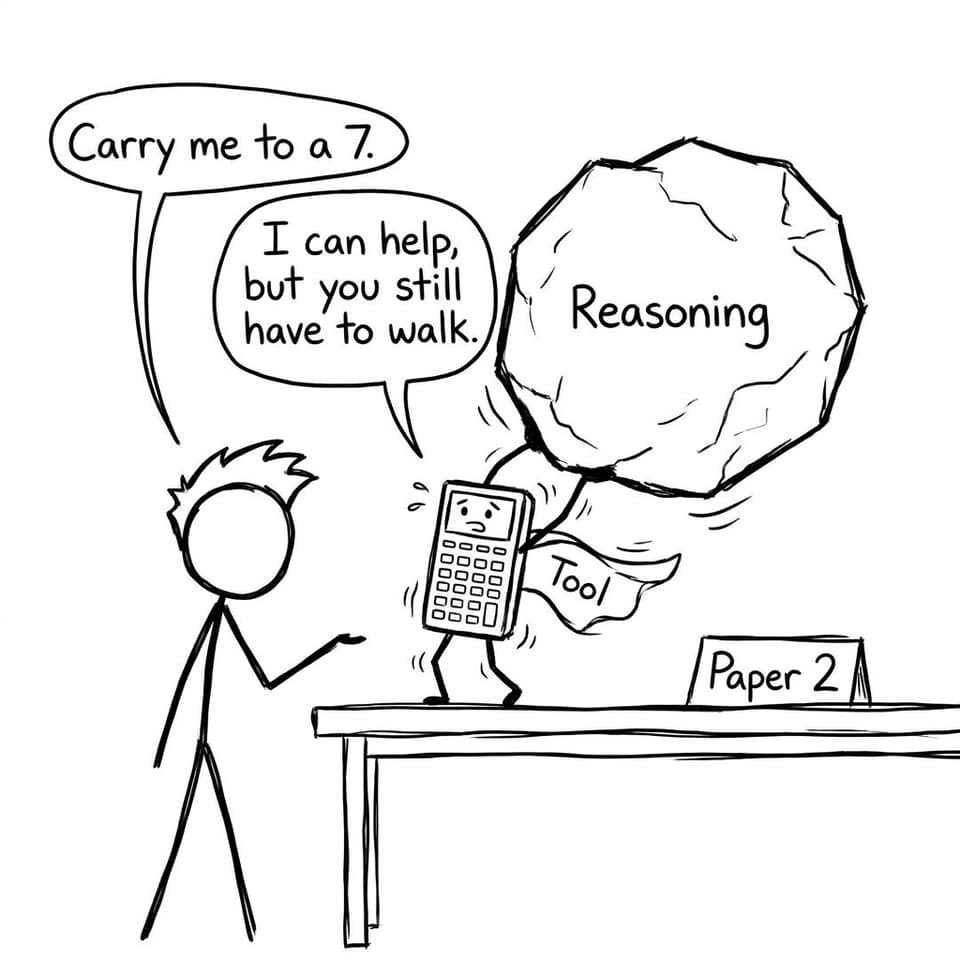
Training strategy: practice “calculator plus commentary.”
-
Treat every calculator step as a claim you must justify.
-
Know where formulas live and how to apply them under time pressure using the IB Mathematics Analysis and Approaches Data Booklet.
-
For stats confidence, rotate regular practice from the Statistics and Probability topic so your interpretations become automatic.
Paper 3: HL only, extended response under uncertainty
Paper 3 is the most “honest” IB paper. It rewards adaptable thinking over memorised routines.
What to expect:
-
Duration: 60 minutes (HL)
-
Extended-response problems, often in unfamiliar settings.
-
Connected parts where later marks depend on earlier structure and interpretation.
What examiners reward: sensible assumptions, clear reasoning, and communication. Even when your final answer is off, method marks can keep your score alive.
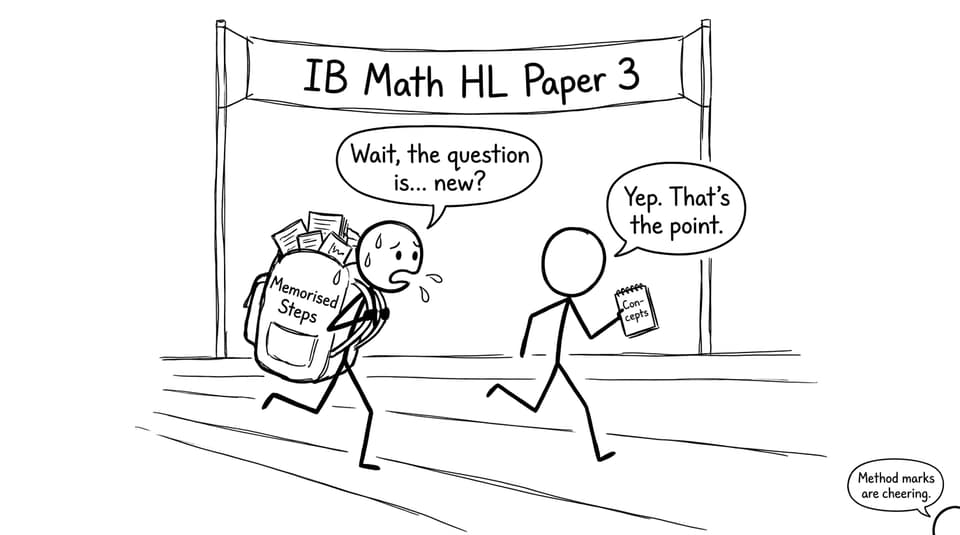
Training strategy: rehearse discomfort.
-
Sit full-paper practice that feels new, not just question drills.
-
Then do a post-mortem: where did you freeze, and what would a calmer first line have been?
A useful companion read is How to Master IB Math AA HL Topics Efficiently because it breaks revision into repeatable loops.
IB marking: how to earn marks even when you are not perfect
The IB is not only marking answers. It is marking thinking.
Here is what that means in practice:
-
Show structure: define variables, state constraints, and write the method.
-
Treat command terms seriously (state vs find vs explain vs verify).
-
Write in a way an examiner can follow at speed.
If you want to train this deliberately, RevisionDojo helps you close the loop: Study Notes to learn the method, Flashcards to retain it, Questionbank to apply it, AI Chat when stuck, and Grading tools to see how exam-style responses score.
A practical IB strategy: time, feedback, and repetition
Most IB students do not fail because they never studied. They fail because they studied without a tight feedback loop.
Use this simple system:
Time by marks
A reliable rule is roughly one minute per mark. It is not perfect, but it stops you from spending 18 minutes “rescuing” a 6-mark problem.
Practice by paper type
Train the skill the exam will demand:
-
Paper 1 sets for fluency and exactness
-
Paper 2 sets for calculator technique and interpretation
-
Paper 3 sets for connected reasoning
For question practice that mirrors these demands, use RevisionDojo’s topic practice such as the Functions Questionbank, Calculus Questionbank, and Statistics and Probability Questionbank.
Simulate, then diagnose
Add regular exam rehearsals using RevisionDojo’s Mock Exams and Predicted Papers to build stamina and decision-making.
-
Start from Mathematics Analysis and Approaches Predicted Papers.
-
For the bigger picture, browse IB Predicted Papers.
Pair that with reflection routines from How to Study for IB Exams: Step-by-Step Guide and practical performance tips from IB Mock Exam Tips: Expert Strategies for Better Performance.
FAQ
How should I split revision across Paper 1, Paper 2, and Paper 3 in IB Math HL?
Start by being honest about which paper loses you marks fastest, because IB improvement is usually bottlenecked by one weakness. Paper 1 often punishes algebra and exact reasoning, so students who are “conceptually fine” but messy should prioritize Paper 1 fluency early. Paper 2 is best trained through repetition with your own calculator, because speed comes from familiarity with your buttons and menus, not talent. Paper 3 needs fewer total questions but more reflection per question, because the goal is adaptability and communication. A balanced weekly plan is usually two targeted topic sessions (Paper 1 or 2 style) plus one timed Paper 3 or mixed-paper session. RevisionDojo makes this split easier because you can move from notes to Questionbank sets and then into Mock Exams or Predicted Papers without changing platforms.
What are the highest-impact habits for IB Math HL students aiming for top grades?
The highest-impact habit is keeping an error log that records the reason you lost marks, not just the topic name, because IB mistakes are often patterns (rushing, misreading, weak explanation). The second habit is practicing under time constraints early, even in short blocks, so your brain learns what “good enough and moving on” feels like. The third habit is writing full solutions occasionally, not only final answers, because method marks reward structure and clarity. A fourth habit is using flashcards for definitions, theorems, and standard setups so you do not waste exam time recalling basics. Finally, schedule reattempts: the same question type 48 hours later, then again a week later, until it becomes automatic. RevisionDojo supports this loop naturally with Flashcards, AI Chat for stuck points, and Grading tools that keep your feedback aligned to exam expectations.
How do Predicted Papers and mock-style practice help with IB Math HL, and how should I use them?
Predicted Papers help because they force you to practice pacing, stamina, and paper navigation, the parts of IB performance you cannot train by doing isolated questions. The key is to treat them like rehearsals, not like judgment days. Sit the paper with strict timing, then spend as long as needed reviewing: identify three errors that were content gaps and three that were decision-making gaps. After that, convert each error into targeted practice using the Questionbank, so your next session attacks the real causes. Do another timed paper only after you have closed at least some of those gaps, otherwise you are repeating the same performance. This is where RevisionDojo shines: Predicted Papers, Mock Exams, Questionbank, Study Notes, and AI feedback work as one system. If you need extra structure, RevisionDojo Tutors can help you turn those post-mortems into a weekly plan.
Final thought: turn IB pressure into IB practice
The IB Math HL exams are not a surprise test of intelligence. They are a predictable test of fluency, reasoning, and calm decision-making.
Start by learning the format. Then practice the format. Use RevisionDojo to keep everything in one place: Study Notes for clarity, Flashcards for recall, Questionbank for precision, AI Chat for quick help, Grading tools for feedback, and Predicted Papers plus Mock Exams for full exam rehearsal.
When exam day arrives, you do not want new motivation. You want familiar routines that already work in IB conditions.