
If you have ever stared at your subject selection form and felt your stomach drop at the words IB Math, you are not alone.
Because the choice is not really “AA vs AI.” It is a choice about what kind of thinking you want to practice for two years, what kind of pressure you can handle on exam day, and what doors you want to keep open for university.
In 2025, the smartest students are not trying to pick the “harder” course. They are trying to pick the right course, then build a repeatable system to score well in IB Math.
IB Math AA vs AI: a fast decision checklist
Before you read the full guide, answer these quickly:
-
Do you enjoy algebraic manipulation and abstract problems more than real-world contexts?
-
Do you want (or might want) a STEM-heavy degree that often expects calculus depth?
-
Do you like interpreting data, building models, and using technology strategically?
-
Are you choosing HL because you love the subject, or because your university path needs it?
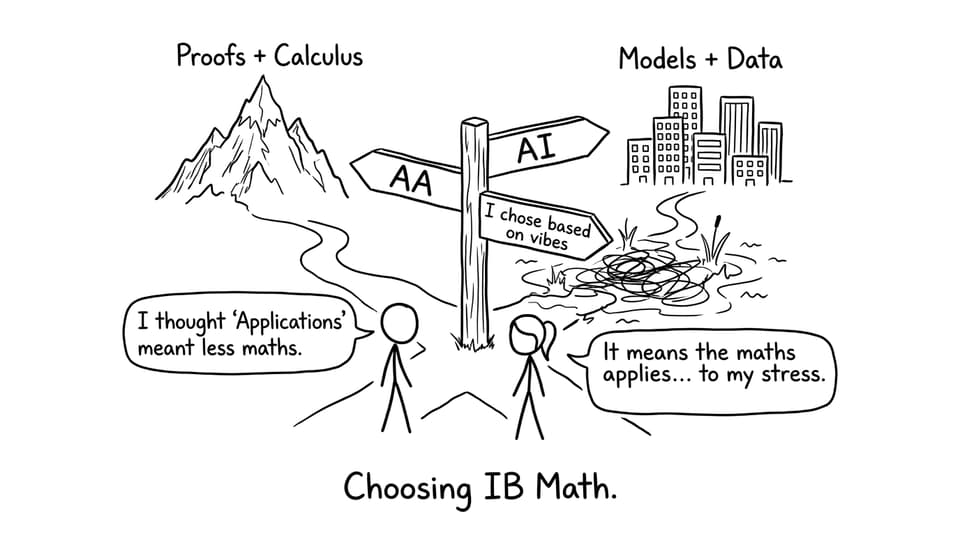
If your answers lean “abstract + calculus,” you will probably fit IB Math AA. If they lean “data + modeling + interpretation,” you will likely fit IB Math AI.
What is IB Math AA (Analysis and Approaches)?
IB Math AA is the course for students who want to understand mathematics as a system of ideas. It leans into:
-
algebra and functions
-
trigonometry and geometric reasoning
-
calculus (especially at HL)
-
proof and formal mathematical communication
In practice, IB Math AA rewards students who can keep their work precise when the question gets abstract. It is not just “harder.” It is more demanding of pure technique.
If you want a syllabus-aligned map of the course, start with IB Mathematics Analysis and Approaches Resources. For many students, the first “aha” moment comes from seeing the course broken down into manageable topics.
What is IB Math AI (Applications and Interpretation)?
IB Math AI is built around applying mathematics to situations that feel closer to the real world: data, models, and interpretation. It emphasizes:
-
statistics and probability
-
modeling and technology-assisted methods
-
interpreting results in context (what your answer means)
This is still IB Math. It is not a shortcut. The difficulty just shows up differently: less time proving identities, more time deciding what model is appropriate and explaining what the output tells you.
To explore the course structure, use IB Mathematics Applications and Interpretation Resources.
IB Math AA vs AI: the real differences that affect grades
The simplest comparison is “AA = pure, AI = applied.” But what matters for exams is how those differences change your study life.
Depth of calculus
In IB Math AA, calculus is central, especially at HL. You will need fluency, not recognition.
If calculus is already a stress point, a targeted hub helps: IB Math AA Calculus.
Technology dependency
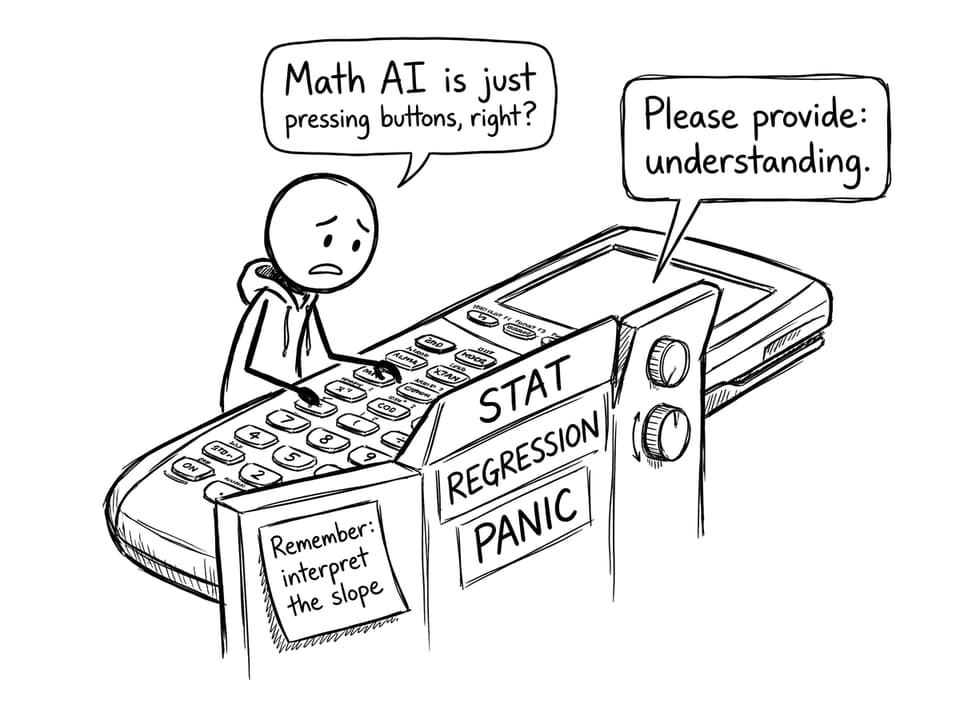
In IB Math AI, technology is more integrated. That does not mean “press buttons.” It means you must understand what the calculator output represents, and how to justify it.
Question style
-
IB Math AA questions often feel like puzzles where the “real task” is algebraic control.
-
IB Math AI questions often feel like decisions: choose a method, model a situation, interpret a parameter.
If you are already revising and want a workflow that matches both courses, follow How to Revise IB Math AA and AI Effectively.
Who should choose IB Math AA?
Choose IB Math AA if most of these sound like you:
-
You enjoy abstract problem-solving, especially algebra and functions.
-
You are considering degrees like engineering, physics, computer science, mathematics, or other calculus-heavy fields.
-
You are willing to train precision (because many AA marks are lost to small slips).
For students aiming for top STEM pathways, IB Math AA HL is often the safer choice because it signals readiness for university-level math.
If you want to build your revision around what actually moves scores, combine topic learning with practice loops using How to Use the Questionbank for Targeted Math Revision.
Who should choose IB Math AI?
Choose IB Math AI if most of these describe you:
-
You like mathematics when it connects to real contexts: business, social sciences, life sciences, psychology, design.
-
You enjoy interpreting graphs, data, and trends.
-
You are comfortable learning calculator techniques and using them thoughtfully.
A good way to test your fit is to open a modeling-heavy area and see whether you find it engaging or draining. For example, browse IB Math AI Functions, then attempt a small set of questions.
HL vs SL: how to choose your level without guessing
The HL vs SL decision is where many students quietly lose time. They commit to a level, then spend months trying to “motivate” themselves into liking it.
A better approach is to decide based on two anchors:
-
University requirements (the non-negotiable part)
-
Your honest tolerance for weekly difficulty (the sustainable part)
In IB Math AA, HL typically adds more depth, especially in calculus and proof-style thinking. In AI, HL increases complexity in modeling and interpretation and can still be very demanding.
If you want a practical overview of the course and assessment expectations, see IB Mathematics: Analysis and Approaches (AA) Complete Guide.
Can you switch between IB Math AA and AI?
Sometimes, yes. Easily, no.
Most schools allow switching within the first months of DP1. But the cost is real: catching up on different topic emphases, re-adjusting problem style, and potentially revisiting your Internal Assessment direction.
If you are unsure, do not wait until you are drowning. Switches are easiest when you still have time to rebuild foundations calmly.
IB Math IA: how AA and AI explorations differ
Both courses require an IA (mathematical exploration), and it is worth 20% of the final grade.
-
In IB Math AA, many strong IAs lean into calculus, proofs, or theoretical patterns.
-
In IB Math AI, strong IAs often revolve around data, statistical testing, regression, or modeling real situations.
RevisionDojo’s advantage here is the ecosystem: you can learn a method in Study Notes, test it in the Questionbank, clarify confusion with AI Chat, and use Grading tools to improve structure and math communication. When you are ready to rehearse under pressure, Mock Exams and Predicted Papers help you practice pacing and coverage.
How RevisionDojo helps you win in IB Math (AA or AI)
The biggest trap in IB Math revision is doing “a lot” without getting clearer.
RevisionDojo is built to reduce that fog:
-
Use the Questionbank to practice by topic and difficulty, with feedback that tells you what actually cost marks: IB Math AA Calculus Questionbank and IB Math AI Number and Algebra Questionbank.
-
Lock in recall with Mathematics Analysis and Approaches Flashcards.
-
Build stamina with realistic rehearsal using IB Predicted Papers.
-
If you need human support, combine all of the above with expert help via Tutoring.
If you want a calm, repeatable schedule that fits both AA and AI, follow How to Create a Personal IB Math Revision Schedule.
FAQ: IB Math AA vs AI
Is IB Math AA harder than IB Math AI?
“Harder” depends on what kind of difficulty drains you. IB Math AA is often harder for students who dislike abstract algebra and need lots of calculus confidence, because the course repeatedly demands precision under pressure. Many AA students find that a single algebra slip can erase otherwise correct thinking, which can feel harsh on timed papers. IB Math AI can feel easier at first because the questions look more contextual, but it becomes difficult if you do not genuinely understand what your calculator is doing. AI also tests interpretation and communication, which can be a different kind of challenge. The best predictor is not your current grade, but which style of thinking you can practice consistently for two years.
Can you study engineering with IB Math AI?
For many engineering programs, IB Math AA HL is strongly preferred or required, because universities expect a deeper calculus foundation. That does not mean AI students cannot do engineering anywhere, but it narrows options and can create extra requirements. The risk is not only admissions; it is also first-year readiness, where calculus and algebra move fast. If engineering is even a “maybe,” choosing AA (often HL) is usually the safer long-term decision. If you are already in AI and worried, speak to your coordinator early while switching is still possible. And regardless of course, build exam readiness through timed practice and error review so your final results match your goals.
Is IB Math AI SL the easiest option to pass?
It is often perceived that way, but “easiest” can be misleading. IB Math AI SL rewards students who can read a scenario carefully, choose a method, use technology appropriately, and interpret results in context. If you dislike writing explanations or you rely on memorizing steps without understanding, AI can still punish you on exam day. Many students lose marks not because the math is impossible, but because they do not explain what their result means. A safer approach is to choose the course that fits your strengths, then revise using active practice loops (notes, questions, feedback, retakes). When you do that, both AA and AI become manageable.
Conclusion: choose the right IB Math, then make it predictable
Picking between AA and AI is a one-time decision. Scoring well in IB Math is a daily system.
Choose IB Math AA if you want depth in calculus and abstract reasoning. Choose IB Math AI if you want mathematics that lives in data, models, and interpretation. Then stop relying on motivation and start building a routine you can repeat.
If you want an all-in-one home base for that routine, RevisionDojo gives you the full stack: Study Notes, Flashcards, AI Chat, Questionbank, Grading tools, Predicted Papers, Mock Exams, a Coursework Library, and Tutors. Start from the hub that matches your course, and make your next practice session small, specific, and timed.