RevisionDojo logoRevisionDojo logo
FeaturesSubjectsPricingSchools
Back to all posts
  1. Home
  2. /Blog
  3. /Can You Reuse IA Ideas as Inspiration?

Can You Reuse IA Ideas as Inspiration?

IA
RevisionDojo Team
•Last updated: 19 Jul 2026•8 min read
ShareShare on XShare on WhatsAppShare on LinkedInShare on Facebook
Add as a preferred source on Google
Can You Reuse IA Ideas as Inspiration?

Join 650k+ students breezing through the IBReady to breeze through the IB?

Footer

General

  • Download apps
  • For parents
  • For schools
  • Pricing
  • Gift RevisionDojo
  • Tutoring
  • IB syllabus
  • MYP syllabus
  • Blog
  • Student Questions

Features

  • Question Bank
  • Test Builder & Exam Mode
  • Predicted Papers
  • Past Papers
  • Study Notes
  • Interactive Lessons
  • Flashcards
  • Jojo AI Tutor
  • Coursework Studio
  • View all features

Research

  • All research
  • Jojo AI vs leading AI study tools
  • 2026 State of Learning Survey
  • 2025 State of Learning Survey
  • IB Moderation Analysis
  • Jojo AI vs ChatGPT
  • Jojo AI vs Gemini
  • Jojo AI vs Perplexity
  • Jojo AI vs Claude
  • Jojo AI vs Poe

Platform

  • About RevisionDojo
  • RevisionDojo vs Others
  • Content philosophy
  • Trustpilot
  • Join usWe're hiring
  • Student Ambassador
  • Help center
  • Contact us
  • Terms of Service
  • Data & privacy
  • Privacy policy
  • Cookie policy
  • Trust Center

IB Subjects

  • Arabic A
  • Arabic A Lit
  • Arabic ab initio
  • Arabic B
  • Biology
  • Business Management
  • Chemistry
  • Chinese A Lang & Lit
  • Chinese B
  • Computer Science (CS)
  • Computer Science (First Exam 2027)
  • Design Technology (DT)
  • Design Technology (First Exam 2027)
  • Digital Society (DS)
  • Economics
  • English A Lang & Lit
  • English A Lit
  • English B
  • Environmental systems and societies (ESS)
  • French A
  • French A Lit
  • French ab initio
  • French B
  • Geography
  • German A
  • German A Lit
  • German ab initio
  • German B
  • Global Politics
  • History
  • History (First Exam 2028)
  • Mathematics Analysis and Approaches (AA)
  • Mathematics Applications & Interpretation (AI)
  • Philosophy
  • Physics
  • Psychology
  • Psychology (First Exam 2027)
  • Spanish A
  • Spanish A Lit
  • Spanish ab initio
  • Spanish B
  • Sports, exercise and health science (SEHS)
  • Theory of Knowledge (TOK)
  • World Religions

MYP Subjects

  • MYP Biology
  • MYP Chemistry
  • MYP Design
  • MYP English Lang & Lit
  • MYP Extended Mathematics
  • MYP History
  • MYP Individuals & Societies
  • MYP Integrated Sciences
  • MYP Physics
  • MYP Standard Mathematics
  • MYP Biology
  • MYP Chemistry
  • MYP Design
  • MYP English Lang & Lit
  • MYP Extended Mathematics
  • MYP History
  • MYP Individuals & Societies
  • MYP Integrated Sciences
  • MYP Physics
  • MYP Standard Mathematics
RevisionDojo logo

© 2022 - 2026 RevisionDojo (MyDojo Inc)

RevisionDojo was developed independently of the IBO and as such is not endorsed by it in any way.

Download on the App StoreGet it on Google Play
GDPR compliant

The moment every IB student has

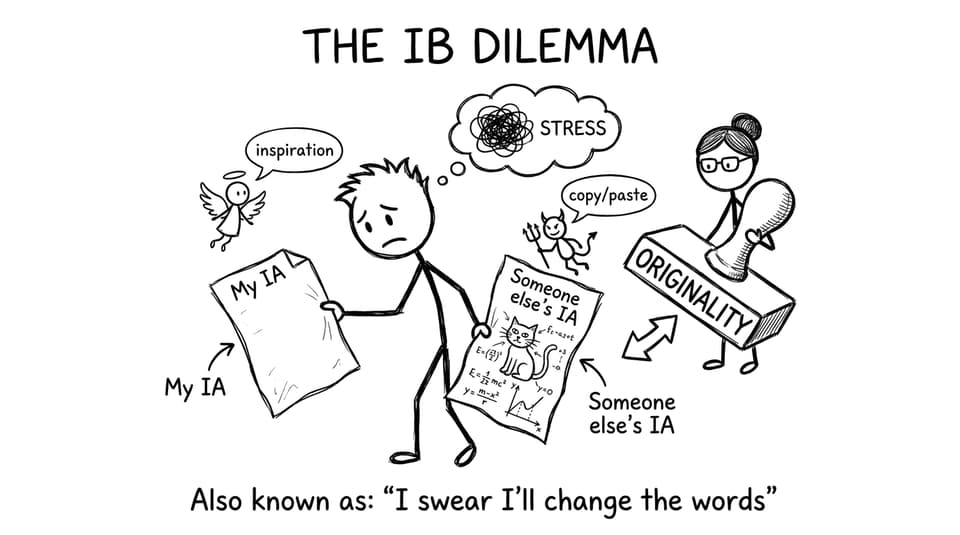
You open a high-scoring IA exemplar and feel two emotions at once: relief (so that’s what “good” looks like) and panic (what if my IA ends up looking too similar?).

That tension is normal. In fact, it’s part of learning. The problem isn’t using someone else’s IA as inspiration. The problem is sliding from “I learned how this works” into “I borrowed what makes it theirs.”

This guide is a calm line in the sand: what you can reuse, what you can’t, and how to turn inspiration into an IA that is unmistakably your own.
Stick-figure angel vs devil arguing over IA inspiration

IA inspiration checklist (safe in 60 seconds)

Use this quick check before you commit to an IA idea:

  • Am I copying structure or copying substance? Structure is fine. Substance is where trouble starts.

  • Could my data only come from my setup or my sources? If not, your IA may be too close.

  • Is my research question meaningfully different in variables, context, or method? One swapped adjective won’t save an unoriginal IA.

  • Can I explain my choices (not just the result)? Examiners reward reasoning.

  • Do I have proof of independent work? Notes, drafts, version history, and raw data.

If you want exemplars that help you learn structure without tempting you into copy-mode, start with RevisionDojo’s IB Internal Assessment Guides and browse the IA tag hub.

What’s acceptable to reuse in an IA (and why it’s actually smart)

Looking at other students’ IA work is like watching game film. You’re not stealing the playbook; you’re learning what “good execution” looks like.

Acceptable inspiration includes:

  • Layout and flow: how the introduction leads into method, then analysis, then evaluation.

  • Presentation habits: clear tables, labeled graphs, consistent units, tidy headings.

  • Evaluation language: how to discuss uncertainty, limitations, reliability, and improvements.

  • General research-question patterns: the shape of a strong question, not the same question.

A practical move: read an exemplar and write down only “moves” you noticed (e.g., “defines variables early,” “links conclusion back to data trend”). Then close it and plan your IA from scratch.

To sharpen the parts students usually rush, keep these nearby: How to Use Data Effectively in Your IA Analysis and How to Write a Compelling IA Evaluation Section.

What’s not acceptable (the similarity traps that sink an IA)

Academic honesty issues usually don’t come from one dramatic act. They come from a series of small, tired decisions.

Unacceptable reuse includes:

  • The same (or nearly identical) research question

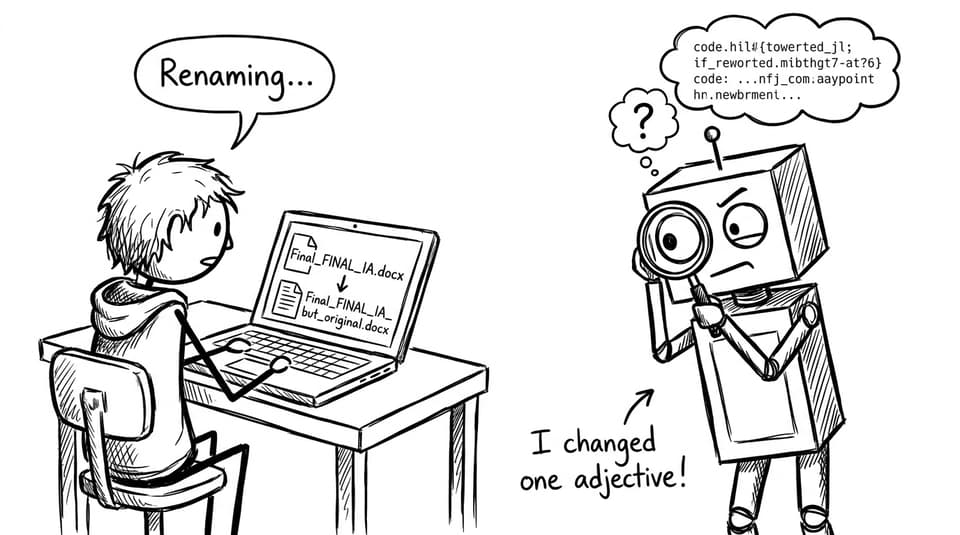
  • A replicated method with only cosmetic tweaks (changing one concentration, one date range, one sample)

  • Reusing data, graphs, results, or conclusions (even if you “redraw” them)

  • Paraphrasing unique reasoning from another IA without clear acknowledgment

A simple test: if an examiner could reasonably say, “This is essentially the same investigation,” your IA is too close.
Student renaming a file while a plagiarism robot squints

How to turn someone else’s IA into your own original work

Here’s the shift that matters: you’re allowed to borrow the frame, but you must supply the thinking.

Extract structure, not substance

When you read an exemplar, focus on decisions that transfer across topics:

  • Where did they justify choices?

  • How did they control variables?

  • How did they connect analysis to the research question?

Then build your IA around your own constraints: your equipment, your dataset, your local context, your chosen model, your participants.

Add a “personal twist” that changes the investigation

If the inspiration is “enzyme activity vs pH,” an original IA twist could be:

  • a different enzyme source,

  • a different independent variable,

  • a different measurement approach,

  • a different context (field conditions vs lab conditions),

  • a different analysis technique.

The goal isn’t to be weird. It’s to be clearly independent.

Write a research question that forces originality

A strong IA question quietly proves you did your own work because it’s specific to your method and data.

Try building it around:

  • your exact variable ranges,

  • your exact population/sample,

  • your exact environment/materials,

  • the exact model or statistical test you will use.

If you’re stuck at the “is this viable?” stage, this helps: How to Choose the Perfect IA Topic for IB Students and Which IA Should You Start First? A Calm IB Strategy.

Acknowledge inspiration when it genuinely shaped your approach

If an exemplar influenced your direction, transparency is safer than pretending it didn’t exist. In reflections, you can briefly note that you reviewed examples and then explain what you changed and why.

That honesty pairs well with process evidence: dated planning notes, pilot trials, rough calculations, and draft iterations.

Why copying is risky (even when you think it’s “different enough”)

The IB expects each IA to represent independent work. Schools also use detection tools and moderation checks that can flag overlap in phrasing, structure, and investigation design.

And the hidden cost is worse than penalties: a copied IA teaches you nothing. Then exams arrive, and you’re trying to think clearly under time pressure without having built the skill.

RevisionDojo is built to reduce that temptation by giving you legitimate support: the Coursework Library for models, Grading tools for rubric alignment, and AI Chat when you’re stuck and need a next step instead of a shortcut. When exams get closer, keep momentum with Study Notes, Flashcards, Questionbank, Mock Exams, and Predicted Papers.

For exam practice that doesn’t eat your whole week, see IB Question Bank | How to Use It Effectively.
Flowchart of idea to authentic IA with silly detours

Final takeaway: learn the approach, not the answer

Using an exemplar to understand how a great IA is built is not only allowed; it’s one of the fastest ways to improve. But your IA must carry your own thinking: your question, your method choices, your data, and your conclusions.

If you want inspiration that stays ethical, use RevisionDojo to study models in the Coursework Library, pressure-test your draft with Grading tools, and ask AI Chat to help you refine an original research question. Then keep your exam prep steady with Flashcards, Study Notes, the Questionbank, and targeted Mock Exams so coursework doesn’t hijack your season.

Further reading that pairs well with this: How IA Moderation Works (and How to Protect Your Grade) and How Many Sources Should an IA Have?.

How helpful was this article?
Add as a preferred source on Google

Continue studying with RevisionDojo

  • IB Coursework GraderCheck an IA, EE, or TOK draft against IB assessment criteria.
  • IB Coursework ExamplesLearn from high-scoring coursework across IB subjects.
  • IB Grade CalculatorEstimate an IB grade using session-specific boundaries.
  • IB Grade BoundariesExplore historical grade boundaries by subject and session.

Frequently Asked Questions

Related Articles

IB en España · Oct 24, 2026 · 11 min read

Evaluación interna de Historia IB: guía completa

Guía de la evaluación interna de Historia IB: pregunta, fuentes, investigación y reflexión, con criterios vigentes e ideas sobre España y Europa.

IB World Religions · Oct 23, 2026 · 11 min read

World Religions IA Mistakes That Cost Marks

World Religions IA mistakes can weaken strong research. Learn how to address all five criteria, manage 1,500-1,800 words, and protect hard-earned marks.

IB en España · Oct 23, 2026 · 10

Psicología IB: inteligencia artificial y uso ético

Aprende a usar IA en Psicología del IB para comprender, practicar y recibir feedback sin vulnerar la integridad académica ni perder autonomía.

IB en España · Oct 22, 2026 · 10

Lengua ab initio del IB e inteligencia artificial

Aprende a usar IA en Lengua ab initio del IB para practicar, recibir orientación y mejorar sin vulnerar la integridad académica del programa.

IB World Religions · Oct 22, 2026 · 11

World Religions IA Checklist Before Submission

World religions IA checklist: verify all five criteria, the 1,500-1,800-word limit, fieldwork ethics, citations, reflection, and final format before submission.

IB en España · Oct 22, 2026 · 9

Cómo estudiar Gestión Empresarial del IB con IA

Aprende a usar IA para estudiar Gestión Empresarial del IB, practicar respuestas y recibir comentarios sin vulnerar la integridad académica.

min read
min read
min read
min read