Let where . Define the scalar triple product by .
This site uses cookie tracking technologies. Learn more in our Cookie Policy.
Let where . Define the scalar triple product by .
The diagram shows a parallelogram with , and .
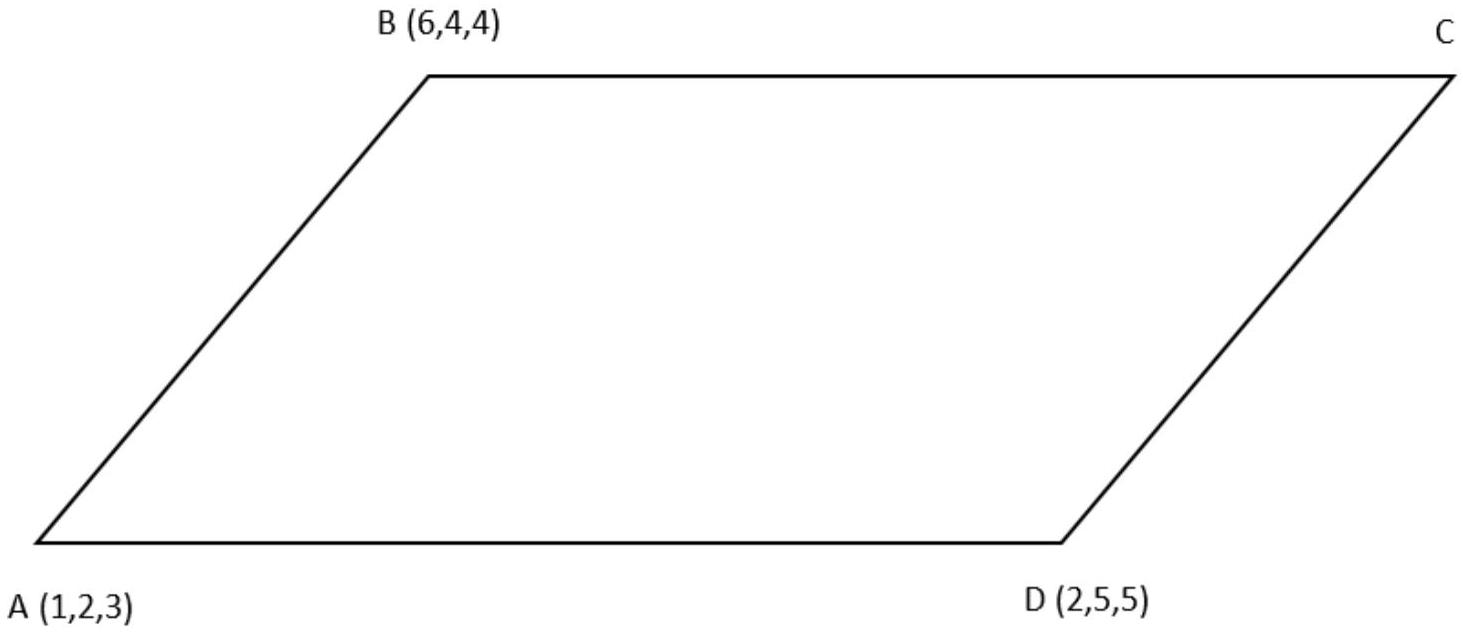
Find the vector from to the point dividing in the ratio (start at ) for and .

In the study of kinematics, the position of a moving particle can be described by a position vector that depends on time. If a particle moves through three-dimensional space with constant velocity, its position at time seconds is given by a vector equation of the form
Line : and plane : .
Practice IB Mathematics Analysis and Approaches (AA) Topic AHL 3.12—vector Definitions with authentic exam-style questions for both SL and HL students. This question bank focuses on the exact syllabus content for AHL 3.12—vector Definitions and mirrors Paper 1, 2, 3 style where relevant.
Get instant solutions, detailed explanations, and build confidence with questions aligned to IB examiner expectations.
For , show that the three vectors are not coplanar.
Find a unit vector perpendicular to both and (for ). Give your answer in exact surd form.

where is the position of the particle at and is its constant velocity vector. Note that while each particle traces out a straight-line path in space (which you are familiar with from the study of vector lines), the key idea here is that the parameter represents time: at each instant , the particle occupies a specific point on the line.
This investigation explores what happens when two particles move simultaneously through 3D space, and in particular, how calculus can be used to determine when they are closest together.
Two particles and move through three-dimensional space. At time seconds (), their position vectors are given by
where distances are measured in metres.
Find the position of each particle at and at .
Show that the displacement vector from to at time is given by
The distance between and at time is denoted .
Since for all , the value of that minimises is the same as the value of that minimises . This is a standard technique in optimization: working with the squared distance avoids the complication of differentiating a square root.
The velocity vectors of and are and respectively. The relative velocity of with respect to is defined as .
Consider now two particles with general position vectors
Hence show that at the time when the particles are closest, the relative velocity is perpendicular to the displacement vector .
Find the point of intersection of the line and the plane .
Show that .
Find .
Find .
where , , , are constant vectors and .
and .
Show that .