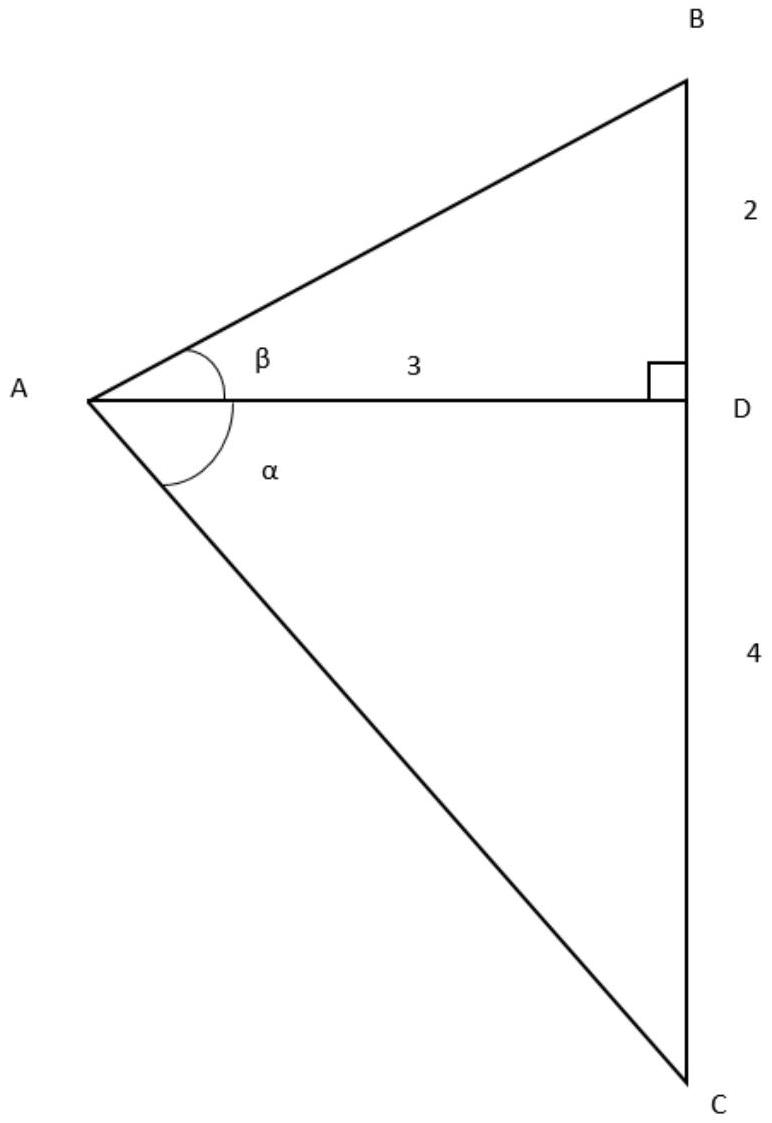
In the diagram below, AD is perpendicular to and . Also and .
(a) Find the exact value of .
(b) Find the exact value of .
Practice IB Mathematics Analysis and Approaches (AA) Topic AHL 3.10—compound Angle Identities with authentic exam-style questions for both SL and HL students. This question bank focuses on the exact syllabus content for AHL 3.10—compound Angle Identities and mirrors Paper 1, 2, 3 style where relevant.
Get instant solutions, detailed explanations, and build confidence with questions aligned to IB examiner expectations.
In the diagram below, AD is perpendicular to and . Also and .
(a) Find the exact value of .
(b) Find the exact value of .
(e) Hence find all possible values of , in radians with , for which .
Diagram not to scale.

A digital display, , with height two metres is mounted in a wall. The lower end of the display at is one metre above the eye level of an observer. The angles of elevation from the observer's eye at to the top and bottom of the display are and radians respectively. The horizontal distance from the observer's eye to the wall containing the display is metres. The observer's viewing angle, , is radians, as illustrated below.
(a) Show that
(b) Express as , where
(c) Find the greatest possible value of the angle , and the value of at which it occurs.
(d) Find where the observer should stand so that the viewing angle is .
A point moves around the unit circle centered at the origin with coordinates .
The -coordinate of is .
(a) Find all possible values of .
(b) If lies in the third quadrant, find the exact values of , , and .
(c) Verify that the identity holds for your values.
(a) Use the compound angle formula to find the exact value of .
(b) Find the exact values of:
(i) ;
(ii) .
(c) Show that .
(d) Solve for .
(a) Using the formula for and suitable double angle identities, prove the following identity: .
(b) Find an expression for in terms of and only.
(c) Hence find in terms of only.
(d) Let . the maximum and minimum possible values of , giving exact values.