If the work does not reach a standard outlined by the performance level descriptors, 0 marks are awarded for this criterion.
Number of marks
Research question
Research methods
Structure
1–2
A research question is stated, but it lacks relevance to the topic of investigation, clarity or focus.
Research methods are used, but these are mostly unsuitable for the research question.
Structural conventions are present in the essay but these do not support communication of the research.
3–4
The research question is relevant to the topic of their investigation and clear but only partially focused in relation to the scope of the essay.
Research methods that are mostly suitable for the research question are explained and applied with partial effectiveness
Structural conventions used in the essay support some aspects of the communication of the research
5–6
The research question is relevant to the topic of investigation, clear and focused in relation to the scope of the essay.
Research methods that are suitable for the research question are explained and applied effectively.
Structural conventions used in the essay effectively support communication of the research.
Required Sections and the EE Structure
The EE must be written in the style of an academic paper that has a professional feel to it. Therefore, the structure and layout of the EE is very important. The following sections are a requirement in the EE:
A title page that includes the title of the essay, the student code, the research question, the subject that the EE relates to and the word count.
The title of the EE should be short, descriptive and concise. It should not be phrased in question form.
The EE should not contain any identifiable material such as the student or school name.
A contents page together with page numbers. The numbers should start the page following the contents page.
An introduction that outlines the focus of the essay, the research methodology and the main argument.
The body of the essay which includes the research question, the background research, the variables, the procedure and the processed data.
A conclusion that summarises and explains the findings of the essay.
A reference list or bibliography.
Note
It is a requirement that the essay is written with font size 12 and 1.5 line spacing.
The choice of font is up to the student but it is recommended to use Arial.
Word Count
The word limit for the EE is 4000 words. Examiners, who ultimately mark the EE, are not required to read past the 4000-word limit so it is strongly recommended that students stick to this limit. The table shown specifies what is and isn't included in the 4000-word limit.
Included in the 4000-Word Limit:
The introduction to the essay
The body of the essay
The conclusion
Any quotations used in the essay
Any footnotes or endnotes that are not references
Not Included in the 4000-Word Limit:
The contents page
Headers
Maps, charts, diagrams and annotated illustrations
Tables of data
Diagrams and titles
Equations, formulas and calculations
Citations/references, whether parenthetical, numbered, footnotes or endnotes
The bibliography
The reflection and progress form (this is completed separately to the main essay and has a limit of 500 words)
Appendices
Appendices are not a required part of the EE, which means that examiners are not required to read them.
For this reason, any information that is essential to the argument of the essay should be placed in the main body of the essay.
It is acceptable to place large amounts of raw data and survey questionnaires in the appendix, as long as they are not central to the argument of the essay.
Footnotes and Endnotes
It is acceptable to include footnotes and endnotes in the EE for referencing.
In this case, they are not included in the overall word count for the essay.
If the information in the footnote or endnote is not used for referring, it must be included in the word count.
Therefore, it is recommended that footnotes and endnotes only be used for referencing purposes.
The same rule applies to economic diagrams and labels.
The Research Question
The research question should be clearly stated and focused.
It must be framed as a question.
Before you can develop a research question, you need to know what your topic will be.
This is often hard for students because they don’t even know what they don’t know.
It’s best to start by doing some online research by using AI chatbots or Googling economic, geographical, or other topics related to economics that you find interesting.
Read news articles and Wikipedia to get a feel for what might be trending or hot topics related to your area of interest in your local area or country.
You can then continue to follow this trail until you start to see topics that catch your interest and start to think about how they could come together with economic theory.
You can also approach identifying a research topic or question from the other angle.
Consider specific economic theories, concepts or models from your course such as price elasticity, market failure, externalities, taxation, unemployment, inflation, behavioral economics, etc.
Think about possible policies/issues of local relevance or importance in your local community or country on these topics.
Tip
Working locally allows for better access to potential primary data to support your analysis and gives the essay practical relevance as well as focus.
Example
Avoid vague or overly general questions like: “What are the effects of inflation in the UK?”
Better: “To what extent has inflation affected consumer spending on necessities in [town/city] between 2022–2024?”
Using the format “To what extent…”, “What is the impact of…” or “How effective is…” helps to ensure your research question will lend itself to critical and not just descriptive analysis, supporting you on criterion A and C.
An EE in economics requires the application of secondary (and possibly primary) data to theory.
Identifying usable data for the research question is one of the key challenges for economics EE students.
It’s good to know early if this will be an insurmountable problem for the topic you’re considering.
Hint
If you have a topic where you really can’t find usable data, then best to move on to another topic early in the process.
Tip
Here are some initial sources that you could explore for data:
General Data: https://www.statista.com/ (https://www.statista.com/)
Cost of Living Data: https://www.expatistan.com/cost-of-living (https://www.expatistan.com/cost-of-living)
But you will almost certainly need to do your own research and find additional data on your specific topic via online sources from NGOs, governments, and international organizations.
In short, to make a good proposal for an economics extended essay topic, you should be able to answer the following three questions:
What economic event or government policy am I evaluating?
What data (secondary required, primary optional) will I use to make the evaluation?
What economic theory will I need for the evaluation?
Remember that good research questions:
Allow analysis using economic theories and models.
Require evaluation, not just explanation.
Can be answered within 4,000 words using:
Secondary data (government reports, academic articles, news sources, local statistics).
Potentially primary data (surveys, interviews) you can access.
Example
To what extent has the minimum wage increase affected employment levels in the retail sector in [city]since 2022?
How has government taxation on sugary drinks affected demand in [country]between 2020–2024?
What has been the impact of petrol price changes on public transport use in [local area]?
Note
Choosing a research question that is made up of more than one question (a “double-barrelled” research question) is unlikely to result in a successful essay.
Example
Does Company X practice monopolistic behaviours and, if so, how does it help the firm to increase revenues?
What is the effect of European interest rate policy on aggregate demand in Greece and what should the government do to increase aggregate demand?
Example
Make sure the answer to your research question is not obvious.
To what extent is the market for mobile phone service in Country X an oligopoly
The above would not be appropriate when it is obviously an oligopoly as there are only three firms.
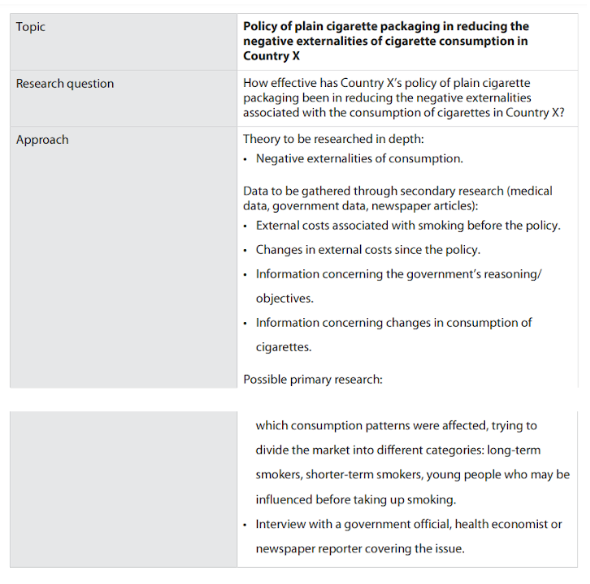
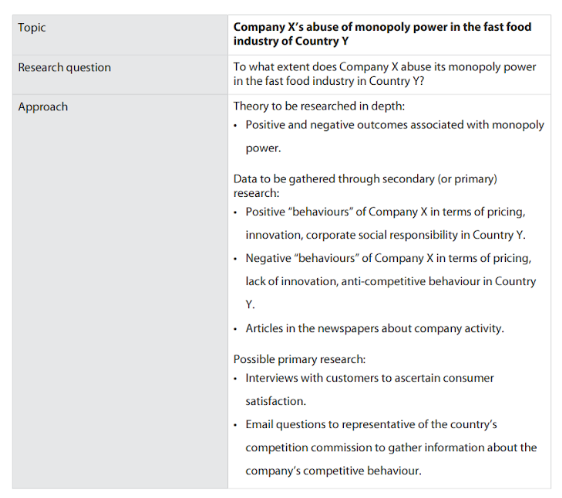
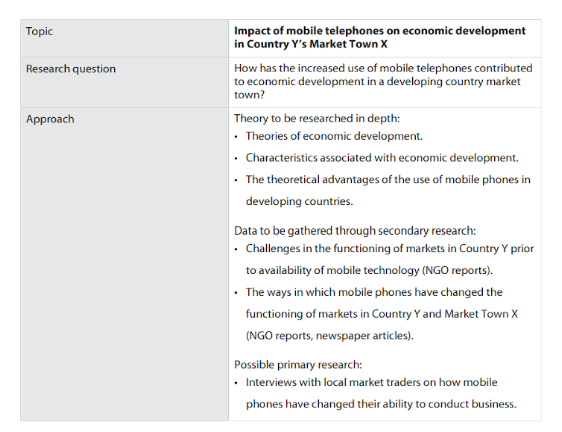
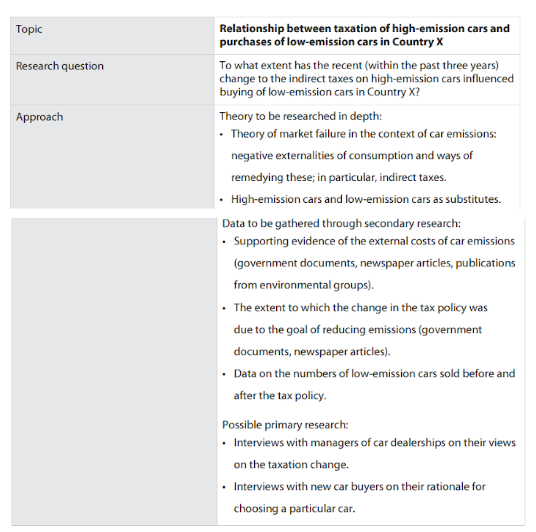
So what are some examples of good research topics and research questions? See below and notice how they relate to the three key characteristics mentioned above:
Example
Figure 1: Research topic on cigarettes
Example
Figure 2: Research topic on monopoly power in the fast food industry
Example
Figure 3: Research topic on mobiles and its impact on economic development
Example
Figure 4: Research topic on tax of varied emission cars
Example
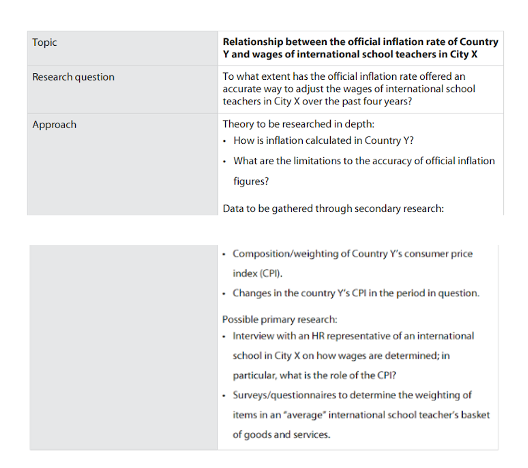
Figure 5: Research topic on inflation rate and wages
Remember that the EE and academic research process is usually a windy road.
That’s part of what the IB wants you to experience and learn through this assignment.
Finalizing your RQ is an important part of what you’re graded on in the EE.
It is acceptable to have a working research question or research topic at the beginning of the process as a starting point for your research.
The research question can then be refined as you learn more about the topic.
Primary vs Secondary Data
To answer the research question, a student can carry out surveys, observations, interviews, or experimental work (primary data) or base their research on existing data (secondary data).
An EE can involve primary data, secondary data, or a mixture of both.
The use of a simulation will also produce primary data.
If the chosen methodology involves a simulation, it must give some variability in the data.
A simulation that produces identical results every time is not suitable for the extended essay.
A simulation that chooses the variables for the student is also not suitable.
Hint
For students considering this method of data collection, it is advisable to discuss their ideas with their supervisor to ensure that the chosen simulation is suitable.
Secondary data is data not directly produced by the student; instead, it is collected from existing sources such as databases.
An EE can be written using secondary data only.
Methodology
In your written report, you will be expected to explain the methodology you are using in a separate paragraph or section.
You should explain clearly how you plan to answer your research question using economic tools, data, and research.
Indicate which type of data you are using and justify why this choice is appropriate and effective for your topic.
Next, describe the economic theories, models, and tools you will use to analyze the data.
Explain why these particular tools are suitable for your investigation and how they will help you interpret the data to answer your research question.
Identify and justify your sources of data, explaining why they are reliable, relevant, and appropriate for your research (such as coming from peer-reviewed academic journals or government sources).
Note any potential bias or lack of reliability in your sources.
Clarify how the data will be used (for example, to calculate key variables, identify trends, or construct diagrams).
Example
Data might be used to:
Calculate key variables
Identify trends
Construct diagrams
Also, address any assumptions or limitations involved in your approach.
This may include factors you assume will remain constant, potential biases in data collection, or external influences that could affect the accuracy of your results.
Discussing these shows critical thinking and strengthens the credibility of your approach.
Where surveys are carried out, explain the methodology and size of the sampling and how you have structured this to avoid bias.
Finally, explain how each source (both primary and secondary) will be used to answer the research question.
This is really important to ensure that the selection of your sources is informed.
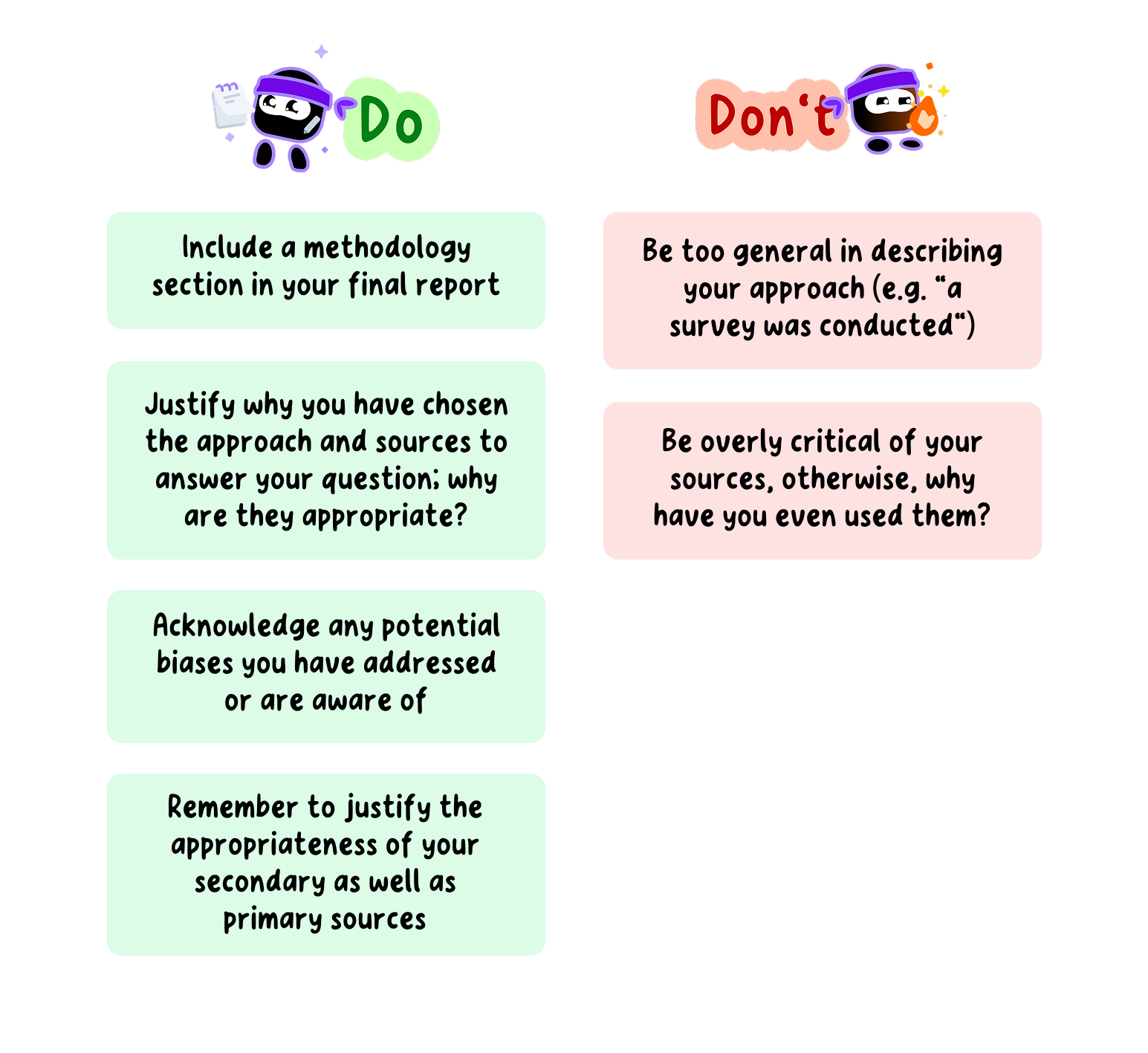
Do's and Don'ts for Criterion A of your Econ EE
Do
Don't
Include a methodology section in your final report
Be too general in describing your approach (e.g. “a survey was conducted”)
Justify why you have chosen the approach and sources to answer your question; why are they appropriate?
Be overly critical of your sources, otherwise, why have you even used them?
Acknowledge any potential biases you have addressed or are aware of
Remember to justify the appropriateness of your secondary as well as primary sources