Practice IB Design Technology (DT) Topic 10.5 Economic Viability with authentic exam-style questions for both SL and HL students. This question bank focuses on the exact syllabus content for 10.5 Economic Viability and mirrors Paper 1, 2, 3 style where relevant.
Get instant solutions, detailed explanations, and build confidence with questions aligned to IB examiner expectations.
A design firm is launching a new 3D-printed accessory. The annual fixed costs for the production facility are calculated at .
What is the break-even point for this product?
Koru is a start-up designing a compact, foldable bicycle helmet for commuters, see Figure 1. The team is deciding whether the product is economically viable and how to price it for launch.
The following estimates are available:
Outline one way a designer could reduce the variable cost per helmet without compromising perceived quality.
Outline how using break-even analysis would help Koru judge whether launching the helmet is economically viable.
Explain one advantage and one disadvantage of Koru using a penetration pricing strategy when selling the helmet direct-to-consumer online.
An industrial design company is planning the production run for a new ergonomic chair. The economic viability is assessed using the following data:
| Financial Category | Value |
|---|---|
| Monthly Fixed Costs | |
| Variable Costs (per unit) | |
| Wholesale Unit Price |
How many units must the company sell each month to reach the break-even point?
Aurora Audio is preparing to launch a set of modular, repairable wireless earbuds aimed at commuters. The product uses a charging case, two earbuds, and replaceable parts (battery module, speaker driver, and silicone tips). Aurora Audio is deciding whether the first production run should be made locally (higher labour cost, lower shipping cost) or overseas (lower labour cost, higher shipping cost and longer lead time).
Aurora Audio has estimated the following unit costs for the local production option (per set of earbuds):
| Cost item | Cost per unit (USD) |
|---|---|
| Electronic components (drivers, chips, battery cells) | 18.50 |
| Plastics/metal parts and finishing | 6.20 |
| Assembly labour | 9.80 |
| Quality testing and returns allowance | 2.00 |
| Packaging | 1.50 |
| Shipping to warehouse | 1.20 |
| Variable warranty provision | 1.80 |
In addition, Aurora Audio expects these fixed costs for the launch year:
| Fixed cost item | Annual cost (USD) |
|---|---|
| Tooling for injection moulds and jigs | 120,000 |
| Product certification and compliance testing | 35,000 |
| Website, photography and launch marketing | 85,000 |
| Salaries (2 staff) | 110,000 |
| Rent and utilities | 50,000 |
Aurora Audio plans to sell through:
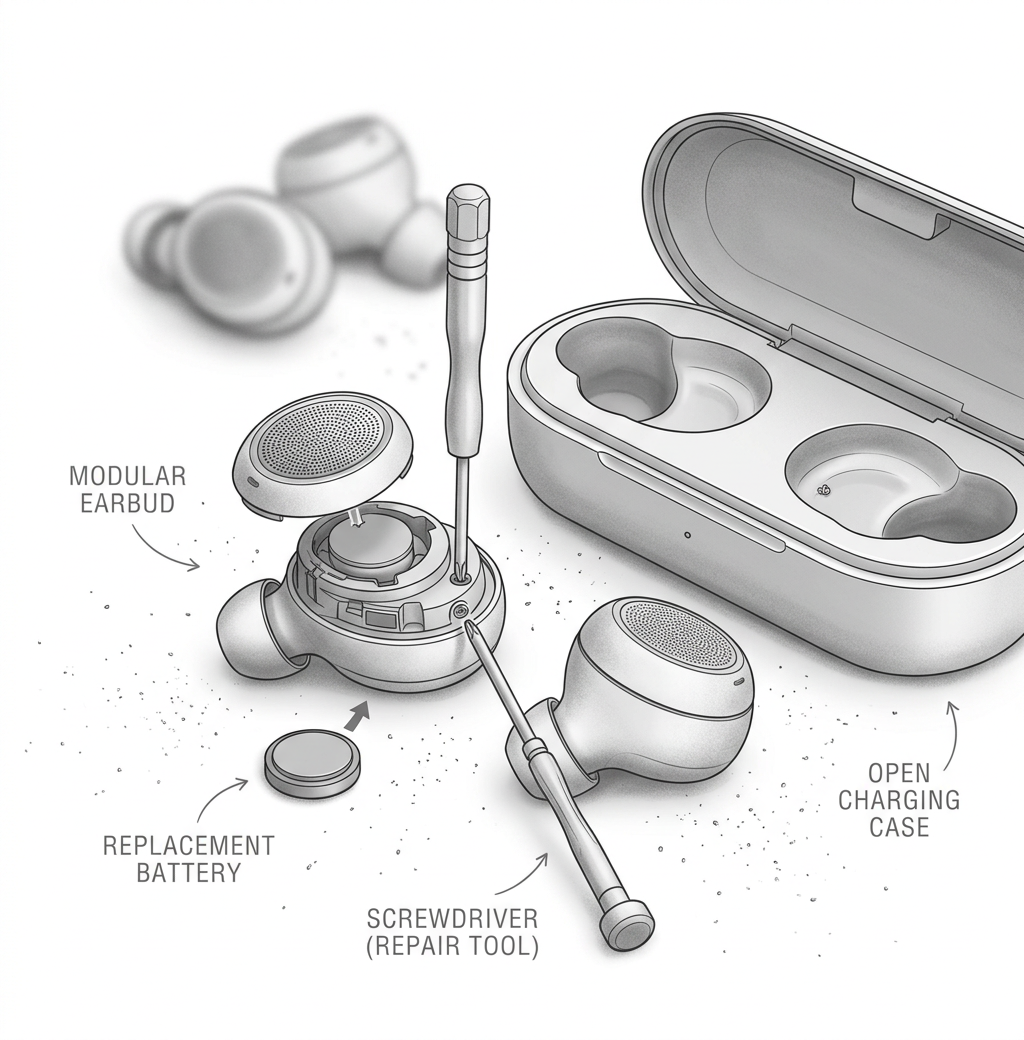
Figure 1 shows the earbuds and charging case.
Identify two different types of costs Aurora Audio must consider when designing and launching the earbuds, giving an example for each.
Aurora Audio is considering a pricing approach that supports its brand message of repairability and long service life.
Outline how a pricing strategy could communicate value rather than simply being the lowest price.
List two factors from the case study that would affect the final price Aurora Audio sets in each sales channel.
Explain how Aurora Audio could use cost information to set a viable retail price, taking into account both unit costs and channel requirements.
Evaluate three ways Aurora Audio could increase the likelihood of breaking even or making a profit, using information from the case study.
IB Design Technology