2.3 Analysis, Synthesis, Evaluation and Reflection | RevisionDojo
2.3 Analysis, Synthesis, Evaluation and Reflection
Global Politics
Criteria C and D: Analysis, synthesis, evaluation and reflection (14 marks)
Use this page when
Details
Building claims
Priority subsections: Analysis and synthesis; Build analytical paragraphs; Revision outcome: Each paragraph supplies a partial answer
Using participants
Priority subsections: Integrate engagement evidence; Diverse perspectives; Revision outcome: Participant evidence is contextualised and triangulated
Applying concepts
Priority subsections: Reflect on concepts and perspectives; Political concepts; Revision outcome: Concepts explain mechanisms instead of decorating prose
Evaluating
Priority subsections: Evaluation; Reflect on methods; Revision outcome: Limits change the scope or confidence of the judgment
Final review
Priority subsections: Evidence and reasoning audit; Reflection checklist; Revision outcome: The conclusion is supported, qualified and case-specific
Key Idea
Core point: Criteria C and D reward political analysis, synthesis of diverse perspectives, evaluation of evidence and engagement, and critical reflection on learning.
Action: Support the principle with evidence from both research and engagement.
Evidence check: Ask what evidence would disprove or qualify the claim.
Analysis and synthesis
Example
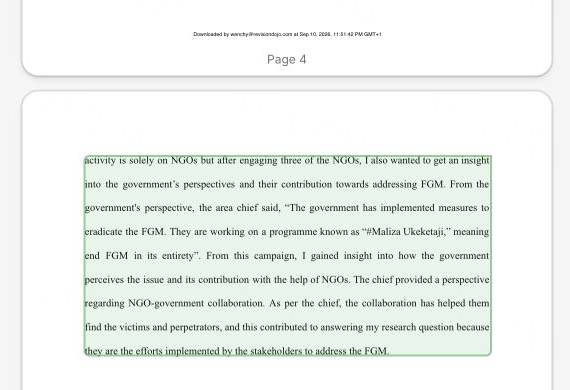
Grade 7 Global Politics HL exemplar on FGM in Kenya, combining NGO and government perspectives.
What to notice: The student moves from three NGO engagements to the area chief’s account of government action and NGO-government collaboration.
Examiner link: This demonstrates synthesis because the claim is tested across non-state and state perspectives rather than resting on one stakeholder group.
Format warning: This is a verified Grade 7 legacy-format exemplar. Use it only for the writing move identified in this callout, not for the current report structure, criterion totals or word allocation. Current assessment totals are 24 marks at SL and 30 marks at HL.
Focus
What strong work does
Analysis, not description
Build analysis around claims, evidence and reasoning rather than a diary of events. Use engagement records and precise local detail to explain what the evidence suggests and why it matters.
Course concepts
Use course concepts as analytical tools. Apply each concept accurately to an actor, relationship or outcome so it explains political behaviour instead of merely naming terminology.
Engagement context
Anchor every major claim in the specific engagement setting. Connect primary evidence to local institutions, policies and actor roles, and show how engagement changed or refined the interpretation.
Synthesis
Bring source and stakeholder perspectives into direct comparison. Explain where they agree, where they conflict and why their positions differ rather than summarising each perspective separately.
Scoped judgment
Reach a clear answer that reflects the strength and limits of the evidence. Weigh competing evidence, use qualified language and restrict conclusions to the context actually studied.
Analyse the political issue in the specific context of the engagement.
Use course concepts and relevant academic research to explain political relationships.
Bring engagement evidence and complementary research into the same argument.
Synthesise diverse source and stakeholder perspectives by identifying agreement, tension and unequal evidential weight.
Reach claims that no single source or engagement activity could support alone.
Exam technique
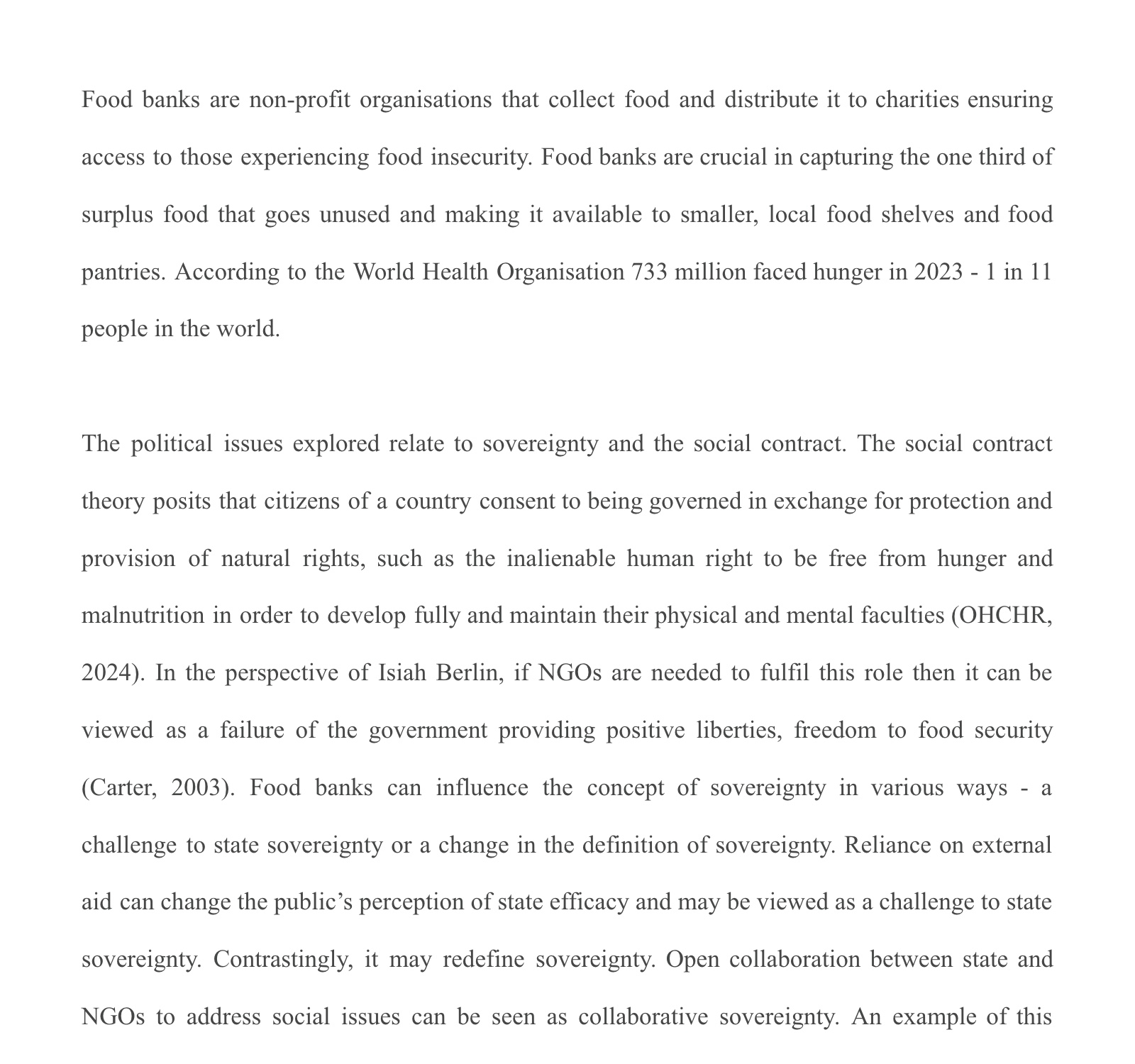
Verified Grade 7-filtered Global Politics HL exemplar on Czech food banks, applying sovereignty and social-contract theory.
Core point: Criterion C requires analysis and synthesis. Separate summaries of interviews and sources do not meet the highest standard.
Action: Check that the examiner can see the claim, evidence, reasoning and judgment.
Evidence check: Remove any sentence that supplies description without analytical value.
What to notice: The student links food insecurity evidence to positive liberty, state responsibility and competing interpretations of sovereignty rather than leaving the political concepts as definitions.
Examiner link: This supports Criterion C because contextual evidence and political theory are combined to explain how NGO provision can challenge or redefine sovereignty.
Format warning: This is a verified Grade 7 legacy-format exemplar. Use it only for the writing move identified in this callout, not for the current report structure, criterion totals or word allocation. Current assessment totals are 24 marks at SL and 30 marks at HL.
Evaluation
Focus
What strong work does
Selected sources
Evaluate the key sources that materially shaped the inquiry. For each one, explain its relevant strength, limitation or bias and how that affects the findings instead of merely calling it credible or reliable.
Engagement activities
Evaluate what each engagement activity could and could not reveal. Consider the value of the evidence produced alongside limits created by access, ethics, participant selection or method.
Personal position
Explain how the student’s initial position and relationship to the issue may have shaped choices and interpretation. Identify possible distortion and the steps taken to reduce or account for it.
Reflection
Describe a specific change in understanding, what caused it and why it matters to the final judgment. Retain unresolved uncertainty rather than claiming only that a great deal was learned.
Calibration
Match the confidence of the conclusion to the quality of the evidence. Identify the strongest, weakest and missing evidence, narrow any overclaim and state what remains uncertain.
Evaluate the position and possible bias of the student, engaged stakeholders and secondary sources.
Assess the purpose, access, expertise and limitations associated with each important perspective.
Explain whether evidence is representative, illustrative or uncertain.
Evaluate engagement activities as methods of learning about the political issue.
Use limitations to qualify the strength or scope of the final judgment.
Key Idea
Core point: Evaluation matters when it changes what you can reasonably conclude.
Action: Support the principle with evidence from both research and engagement.
Evidence check: Ask what evidence would disprove or qualify the claim.
What reflection is
Analyse a change, complication or confirmation in your understanding.
Connect that change to a specific encounter, observation or decision.
Explain how position, access and method influenced what you learned.
Evaluate uncertainty and disagreement rather than claiming a final neutral truth.
Definition
Core point: Reflection is critical examination of how experience and inquiry affected your interpretation. It is not a summary of activities or a statement of feelings alone.
Action: Apply the term to a named actor, mechanism or political outcome.
Evidence check: If the term could be deleted without changing the argument, apply it more precisely.
Use a before, encounter, after pattern
Before: state the assumption or expectation you brought to the issue.
Encounter: identify the evidence or experience that challenged or refined it.
After: explain the revised political understanding.
Significance: connect the shift to the inquiry question and a relevant concept.
Example
Core point: A student may begin by viewing non-participation as apathy, then learn through interviews that time, distrust and inaccessible consultation procedures restrict political agency.
Action: Identify why the example works, then adapt its logic to your own political issue.
Evidence check: Keep the political mechanism but replace every case-specific detail.
Reflect on positionality
Identify relevant features of your role, identity, school affiliation or prior beliefs.
Explain how participants may have responded differently because of who you are.
Consider which spaces and actors were accessible to you and which were not.
Avoid confessional detail that does not affect the inquiry.
Key Idea
Core point: Positionality matters when it changes access, interpretation, relationships or the credibility of evidence.
Action: Support the principle with evidence from both research and engagement.
Evidence check: Ask what evidence would disprove or qualify the claim.
Reflect on methods
Example
Grade 7 Global Politics HL exemplar on migrant workers in Singapore, qualifying its conclusion through research limitations.
What to notice: The student narrows the conclusion by naming the limited NGO sample and the small amount of first-hand evidence from migrant workers.
Examiner link: This is useful reflection because a methodological limitation changes the confidence and scope of the final judgment.
Format warning: This is a verified Grade 7 legacy-format exemplar. Use it only for the writing move identified in this callout, not for the current report structure, criterion totals or word allocation. Current assessment totals are 24 marks at SL and 30 marks at HL.
Assess how question wording, setting, sample size and participant selection shaped the evidence.
Explain the strengths and limits of interviews, observation or participation used in the project.
Identify a realistic improvement that would generate better political evidence.
Distinguish a method limitation from a personal inconvenience.
Tip
Core point: Write about the consequence of a limitation. A small sample matters because it narrows whose perspectives can support the conclusion.
Action: Use this advice on a specific claim, source or engagement activity.
Evidence check: Confirm that the change improves the answer to the inquiry question.
Reflect on concepts and perspectives
Example
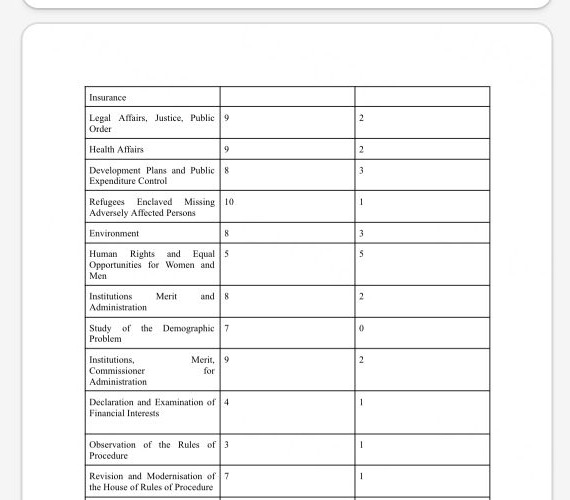
Grade 7 Global Politics HL exemplar on gender representation in the Cypriot Parliament, using committee data.
What to notice: The student converts committee membership into comparable evidence about where women exercise influence across policy areas.
Examiner link: The table creates a basis for analysing representation, institutional power and the difference between presence and decision-making influence.
Format warning: This is a verified Grade 7 legacy-format exemplar. Use it only for the writing move identified in this callout, not for the current report structure, criterion totals or word allocation. Current assessment totals are 24 marks at SL and 30 marks at HL.
Explain whether a course concept illuminated or oversimplified the issue.
Show how two stakeholders understood the same event differently.
Consider whether institutional authority and lived legitimacy diverged.
Recognize tensions between rights, security, equality, efficiency or other political priorities.
Active recall
Core point: Ask how your relationship with participants influenced what counted as credible political knowledge.
Action: Record your answer, identify the weakest evidence and revise the affected claim.
Evidence check: Write the quickest concrete fix beside any answer that is incomplete.
Avoid weak reflection
Do not retell the engagement chronologically.
Do not claim that every participant was unbiased or fully representative.
Do not list skills gained without connecting them to political understanding.
Do not invent dramatic personal transformation.
Do not hide failures that genuinely changed the inquiry.
Common Mistake
Core point: Reflection that could be copied into any project is too generic. Anchor each point in a precise moment, choice or piece of evidence.
Action: Resolve this issue before submission and explain any resulting limitation.
Evidence check: State what could go wrong and how the risk has been reduced.
Reflection checklist
A clear initial assumption is identified.
A specific experience or piece of evidence is analysed.
The revised understanding is political and conceptually grounded.
Positionality and method are evaluated.
The effect on the final judgment is explained.
Active recall
Core point: Could another student use the same reflection unchanged? If yes, add case-specific evidence and explain its political significance.
Action: Record your answer, identify the weakest evidence and revise the affected claim.
Evidence check: Write the quickest concrete fix beside any answer that is incomplete.
Criterion C: Analysis and synthesis (8 marks)
Focus
What strong work does
Analysis vs description
Build analysis around claims, evidence and reasoning rather than a diary of events. Use engagement records and precise local detail to explain what the evidence suggests and why it matters.
Use of course concepts/content
Use course concepts as analytical tools. Apply each concept accurately to an actor, relationship or outcome so it explains political behaviour instead of merely naming terminology.
Engagement-context focus
Anchor every major claim in the specific engagement setting. Connect primary evidence to local institutions, policies and actor roles, and show how engagement changed or refined the interpretation.
Synthesis of perspectives
Bring source and stakeholder perspectives into direct comparison. Explain where they agree, where they conflict and why their positions differ rather than summarising each perspective separately.
Judgement within scope
Reach a clear answer that reflects the strength and limits of the evidence. Weigh competing evidence, use qualified language and restrict conclusions to the context actually studied.
Tip
Core point: Use the following source-derived checks as a direct revision checklist.
Action: Use this advice on a specific claim, source or engagement activity.
Evidence check: Confirm that the change improves the answer to the inquiry question.
Write analysis, not a diary: turn each engagement moment into political meaning (what it reveals about power/agency/legitimacy) rather than “what happened.”
Use course concepts as tools: show understanding and application by explaining how a concept interprets your evidence, not by listing concepts.
Stay rooted in the engagement context: name the local setting, actors, and decision arena whenever you make a claim so the issue is clearly analysed in context.
Synthesize in-line: combine stakeholder perspectives and source perspectives in the same paragraph, then explain the reason for divergence (interests, constraints, power).
Compare with a rule: when perspectives clash, compare using one clear criterion (e.g., oversight, rights risk, effectiveness, feasibility) to make synthesis explicit.
Make the reasoning chain visible: use decision verbs (indicates, suggests, constrains, enables) to move from evidence to conclusion.
Weight evidence, don’t average it: show why one interpretation is more convincing in this context (quality of evidence; institutional power; access to decision-making).
Aim for 7–8 standard: the issue must be clearly analysed and perspectives must be effectively synthesized, not merely presented.
Structure guide
Set an argument line: state how/to what extent you answer the research question (directional, evidence-ready).
Define the local context: identify the political issue, key actors, and the institutional arena your engagement connects to.
Develop 2–3 analytical points: each point should be claim → engagement evidence → explanation using course concepts/content.
Integrate secondary sources: use them to corroborate, challenge, or contextualize what your engagement revealed.
Synthesize perspectives inside each point: compare engaged stakeholder perspectives with source perspectives and explain the political mechanism behind differences.
Weigh and conclude per point: end each point with a mini-judgement that links back to the research question and states what is now established.
Final self-check (Yes/No)
Yes / No test
If no, make this repair
Is my writing more analysis than description overall?
Add “this suggests/therefore” explanations after each evidence piece
Do I show understanding and application of relevant course concepts/content?
Replace name-drops with 1–2 in-context definition + application sentences
Is the issue analysed with reference to the specific engagement context?
Add local actors/process details and show how engagement shaped conclusions
Do I synthesize diverse perspectives (sources + engaged stakeholders), not just list them?
Combine two perspectives in one paragraph and directly compare them
Do I make a clear “how/to what extent” judgement that stays within scope?
Qualify claims (“in this context…”) and remove sweeping generalisations
Can a reader follow claim → evidence → explanation without guessing?
Reorder sentences so every claim is immediately supported and interpreted
Why this is good
Uses specific contextual evidence (what changed in law + what changed in practice) to analyse power and oversight, not general description.
Applies course concepts (legitimacy, power, rights) to interpret why the exemption matters politically.
Synthesizes perspectives by explaining why stakeholders disagree (different legitimacy standards and risk thresholds), rather than stacking quotes.
Moves toward a scoped judgement (“in this city, under these rules…”) instead of a sweeping claim about policing everywhere.
How to make it better
Insert your engagement evidence (e.g., what you observed at a meeting, what an interviewee argued, what community concerns surfaced) and show how it affected your weighting of perspectives.
Make the mechanism explicit: state which oversight steps are bypassed due to the exemption and who loses leverage (commission, council, public comment process).
Add a small, structured comparison of outcomes evidence (e.g., patterns in flight logs vs stated objectives) so your judgement isn’t only institutional/design-based.
Acknowledge limitations: advocacy framing from NGOs, self-presentation from agencies, and gaps in independent measurement - and explain how you mitigated them.
Criterion D: Evaluation and reflection (6 marks)
Focus
What strong work does
Evaluation of selected sources
Evaluate the key sources that materially shaped the inquiry. For each one, explain its relevant strength, limitation or bias and how that affects the findings instead of merely calling it credible or reliable.
Evaluation of engagement activities
Evaluate what each engagement activity could and could not reveal. Consider the value of the evidence produced alongside limits created by access, ethics, participant selection or method.
Personal positions and biases
Explain how the student’s initial position and relationship to the issue may have shaped choices and interpretation. Identify possible distortion and the steps taken to reduce or account for it.
Reflection as learning experience
Describe a specific change in understanding, what caused it and why it matters to the final judgment. Retain unresolved uncertainty rather than claiming only that a great deal was learned.
Calibration of conclusions
Match the confidence of the conclusion to the quality of the evidence. Identify the strongest, weakest and missing evidence, narrow any overclaim and state what remains uncertain.
Tip
Core point: Use the following source-derived checks as a direct revision checklist.
Action: Use this advice on a specific claim, source or engagement activity.
Evidence check: Confirm that the change improves the answer to the inquiry question.
Hit the top band by showing critical evaluation and reflection: evaluate sources + engagement, explain personal positions and biases, and show in-depth reflection on learning.
Use a repeatable move for every key item: Strength → Limitation → Implication (what it means for confidence, scope, or interpretation).
Treat interviews/observations as perspectives, not “facts”: evaluate incentives, role, and likely self-presentation effects in stakeholder accounts.
Make evaluation concrete by naming method limits: small/biased sample, access constraints, timing, gatekeeping, and how these shaped what you could learn.
Don’t hide bias - use it: explain your starting position, then show the specific checks you used (contrast perspectives, triangulation, neutral questioning).
Build “learning experience” reflection around change: what you believed before, what you believe now, and what evidence/experience caused the shift.
Include ethics/safety/confidentiality as evidence of judgement: when ethics limited access, state the trade-off and how you compensated with other sources/engagements.
Finish Criterion D by calibrating your claims: state what you can support strongly, what is tentative, and what evidence would strengthen the study.
Mini-template (copy/paste)
Start with a 2–3 sentence evaluation of research: identify your 2–3 most-used sources; give strengths/limits; state the implication for your findings.
Add a 2–3 sentence evaluation of engagement design: why these activities were useful; what kind of evidence they generated; what they could not show.
For each major engagement, write one “value vs limitation” sentence that includes ethics/access/sample and the consequence for interpretation.
Write a short bias/positionality segment: your starting view, where it came from, and how it might have shaped your choices/questions.
Write a short mitigation segment: how you reduced bias (contrasting stakeholders, triangulating sources, neutral prompts, anonymity) and what bias likely remains.
Write your learning reflection as change: what changed in your understanding of the issue (and/or power/legitimacy/rights), why it changed, and what you still don’t know.
End with calibration: strongest evidence supports [X]; weaker/limited evidence means [Y] remains tentative; next step to improve evidence would be [Z].
Final self-check (Yes/No)
Yes/No
Check
Quick fix if “No”
Did I evaluate both my selected sources and conducted engagement activities?
Add at least 1–2 evaluative sentences for each (not description).
For each key source/activity, do I state strength + limitation + implication?
Add the missing “so what” (confidence/scope/interpretation).
Do I explain my personal positions and biases (not just identify them)?
Add where the stance came from and how it could skew judgement.
Is my reflection in-depth with a clear before → after learning shift?
Add what changed, what triggered it, and how it reshaped conclusions.
Do I show how ethics/safety/access shaped my evidence quality?
State the constraint and what alternative evidence you used instead.
Are my conclusions calibrated to evidence limits (no overclaim)?
Narrow to the context studied; label uncertain claims as tentative.
Hypothetical example topic (fits the Engagement Project)
Political issue (local/community): Housing access and discrimination in rental markets
Example
Example focus: Example research question: To what extent do landlords’ “voucher refusal” practices in my city limit access to adequate housing for low-income residents, and how effective is the city’s proposed source-of-income (SOI) anti-discrimination policy in addressing this?
Example
Example focus: Example engagement (primary research):
Volunteered 6 hours with a tenant-rights drop-in clinic (observed intakes; did not handle confidential files).
Attended one city council housing committee meeting discussing the SOI policy.
Conducted 5 interviews: a legal-aid housing attorney, a housing authority staff member, a tenant-union organizer, a private property manager, and a city council staffer.
Example
Example focus: Example reflection (first person, Criterion D-style)
Before starting this project, I assumed the main reason voucher holders struggle to secure housing is landlord prejudice or greed. My engagement complicated that view. Volunteering at the tenant-rights clinic showed me how power operates through procedures rather than force: even when tenants “have” a voucher, landlords can delay responses, set short viewing windows, or require documentation that is technically legal but practically exclusionary. This made structural power feel real, not just theoretical.
At the city council meeting, I expected a simple human-rights argument (adequate housing) to be persuasive on its own. Instead, I saw how legitimacy is contested: supporters framed SOI protection as fairness and equal access, while opponents framed it as state overreach and an unfair burden on small landlords. The most significant shift in my thinking came from interviewing a property manager who described inspection timelines and reimbursement uncertainty as genuine constraints. I still believe refusal practices produce inequality, but I now understand why some landlords view the policy as costly and risky, which affects how politically “sellable” reforms are.
However, my findings have limitations. My interview sample was partly shaped by who replied to emails, so it may over-represent organized voices. People may also have presented themselves strategically (especially in interviews). Ethically, I avoided interviewing tenants in crisis directly because I could not guarantee support or avoid harm, which means I learned less about lived experience than I wanted. Overall, this project pushed me from a moral certainty (“bad landlords”) toward a political analysis focused on incentives, contested legitimacy, and unequal agency.
________________
Why this is good
Clearly shows learning and perspective shift (from a simple blame narrative to structural/political analysis), which is central to reflection.
Links experience to course concepts (power, structural barriers, legitimacy contestation, human rights/adequate housing) rather than staying at the level of “what I did.”
Evaluates engagement quality by identifying how each activity changed understanding (clinic ≠ council meeting ≠ stakeholder interview).
Acknowledges limitations and bias realistically (sampling, self-presentation, access constraints), showing critical thinking rather than perfection.
Mentions ethical judgement (avoiding potentially harmful interviews), aligning with IB ethical guidance and demonstrating responsible methodology.
How it could be better
Be more specific about evidence from engagement (e.g., “three clinic cases showed X pattern” or “two council members used Y framing”) while still protecting confidentiality.
Name the analysis approach (e.g., thematic coding of interviews into “fairness,” “risk,” “rights,” “costs”) to make the reflection more methodologically explicit.
Show your own positionality more directly (e.g., how your background, school/community, or political values shaped the questions you asked and what you noticed).
Strengthen triangulation by stating what you did when sources conflicted (e.g., how you checked landlord claims against policy documents or housing authority data).
Identify one concrete “next step” for learning (who you would interview next, what data you’d seek, or what engagement would address the biggest gap).
Criterion E: Communication (3 marks)
Focus
Details
Organization
What earns 3/3 (“effective”): Well organized; coherent flow that supports understanding; Must show (evidence in the report): Clear section order; consistent subheadings; purposeful sequence (context → engagement → analysis → conclusion); Quick test / fix: Can a reader find key parts in <30 seconds? If no: re-outline into 3–5 sections and reorder
Clarity of points
What earns 3/3 (“effective”): Points are easy to follow; no “hidden” claims; Must show (evidence in the report): One main idea per paragraph; topic sentences; defined key terms used consistently; Quick test / fix: Can you summarise each paragraph in 1 sentence? If no: split + rewrite using PEEL+R
Signposting
What earns 3/3 (“effective”): Reader always knows “what this section does” and “why it matters”; Must show (evidence in the report): Mini-intros for sections; explicit links back to the research question; Quick test / fix: Does every section end with a clear “Link to RQ”? If no: add 1–2 linking lines
Evidence presentation
What earns 3/3 (“effective”): Evidence is traceable and supports understanding; Must show (evidence in the report): Consistent labels (Interview A, Observation 1); appendix pointers; consistent citations; Quick test / fix: Can you tell where each claim came from? If no: add evidence tags + appendix references
Language + formatting
What earns 3/3 (“effective”): Clear writing that does not block meaning; Must show (evidence in the report): First-person reflective voice (where required); concise sentences; clean formatting; Quick test / fix: Do long sentences obscure meaning? If yes: shorten, remove filler, proofread
Tip
Core point: Use the following source-derived checks as a direct revision checklist.
Action: Use this advice on a specific claim, source or engagement activity.
Evidence check: Confirm that the change improves the answer to the inquiry question.
Aim for “well organized” by using subheadings and a logical progression (no jumping between unrelated points).
Make “coherently supports understanding” visible through signposting: start sections with purpose, end with link to RQ.
Use PEEL+R to keep clarity (Point; Evidence; Explanation; Link; Reflection) and stop paragraphs becoming a “dump” of details.
Keep engagement and research easy to distinguish with labels (e.g., Interview A, Observation 1, “secondary source”) and appendix pointers.
Use consistent terminology (don’t swap “policy,” “initiative,” “law,” “programme” unless you define the difference) to protect coherence.
Prioritise what the engagement taught you about the political issue (not a long diary of what happened) to keep points readable.
Do a final “reader-effort edit”: cut repetition, tighten topic sentences, and keep sentences short enough to track.
Proofread specifically for organization and clarity (Criterion E language), not just grammar.
Final self-check (Yes/No)
Check (answer Yes/No)
If “No”, fix in 10 minutes
Is the report well organized into a clear sequence of sections?
Write a 5-line outline and reorder sections to match it
Does each paragraph have one clear point?
Split the paragraph and add topic sentences
Can every claim be traced to engagement or research?
Do sections coherently support understanding with transitions?
Add 1 transition sentence at the start of each section
Is the writing clear (not overly long sentences / repeated background)?
Cut repeated context; shorten the 3 longest sentences
Are key terms and labels consistent throughout?
Do a “find/replace” pass for terms and standardise labels
PEEL+R (Guide Section): How to Use It in Your Global Politics Engagement Project
Use PEEL+R to turn research + engagement into analysis, not description. Each paragraph (or mini-section) should argue something, prove it, explain its political meaning, and reflect on what you learned.
P - Point (Your claim / finding)
What to write: 1–2 sentences that make an arguable claim about your issue in your specific local context.
A strong response should:
Actor(s) (who is doing what)
Power mechanism (how power operates: enforcement, funding, access, agenda-setting, legitimacy, etc.)
Affected group(s) (who benefits/loses)
Sentence starters:
“In [place], [actor] exercises power over [issue] mainly through [mechanism], which results in [impact].”
“A key tension is between [perspective A] and [perspective B] because [political reason].”
Avoid: topic statements like “Pollution is a big problem” (too descriptive).
________________
E - Evidence (Engagement + research data)
What to write: Specific evidence that supports your point. In Global Politics IA, your strongest paragraphs usually combine:
Primary/engagement evidence (Interview A, Observation 1, volunteering log, etc.)
Label your engagement evidence clearly: Interview A (Appendix I), Observation 1 (Appendix II).
Prefer short quotes or precise paraphrases over long quotations.
Use evidence that shows multiple perspectives, not just one “side.”
Useful phrasing:
“This is supported by Interview A (Appendix I), where…”
“This aligns/conflicts with [source], which argues…”
Avoid: “Many people think…” with no traceable evidence.
________________
E - Explanation (Political meaning + course concepts)
What to write: The “so what?” Explain why your evidence matters politically, using Global Politics concepts as tools (not name-drops).
Do this explicitly:
1. Interpret evidence: what it suggests/indicates about power
2. Apply a concept: legitimacy, authority, sovereignty, rights, structural power, political agency, etc.
3. Explain differences in perspectives: interests, incentives, constraints, unequal access to decision-making
Sentence starters:
“This suggests that power is operating through [concept/mechanism], because…”
“From a legitimacy perspective, [actor] frames [policy/action] as [justification], while [other actor] challenges it by…”
Avoid: “This links to legitimacy” (without explaining how the concept changes interpretation).
________________
L - Link (Back to your Research Question)
What to write: 1 sentence that explicitly ties your paragraph back to your research question wording (e.g., “to what extent”, “how”, “why”, “effectiveness”).
Sentence starters:
“Therefore, this evidence indicates that [partial answer to RQ] in [place].”
“This supports/challenges my RQ by showing that…”
Avoid: ending paragraphs without showing how they help answer the RQ.
________________
R - Reflection (Learning + limits + positionality)
What to write: 1–2 sentences in first person explaining:
what changed in your understanding, or
what limitation/bias affects your confidence, or
what ethical constraint shaped what you could find out
High-scoring reflection is specific:
“Before X, I assumed Y; after Interview B/Observation 1, I revised this because…”
“A limitation of this engagement is…, which means my conclusion about… is tentative.”
Avoid: generic lines like “I learned a lot” without specifying what and why.