Loading subject…
Structure 1. Models of the particulate nature of matter
S1.1 Introduction to the particulate nature of matter
S1.2 The nuclear atom
S1.3 Electron configurations
S1.4 Counting particles by mass: The mole
S1.5 Ideal gases
Structure 2. Models of bonding and structure
S2.1 The ionic model
S2.2 The covalent model
S2.3 The metallic model
S2.4 From models to materials
Structure 3. Classification of matter
S3.1 The periodic table: Classification of elements
S3.2 Functional groups: Classification of organic compounds
Reactivity 1. What drives chemical reactions?
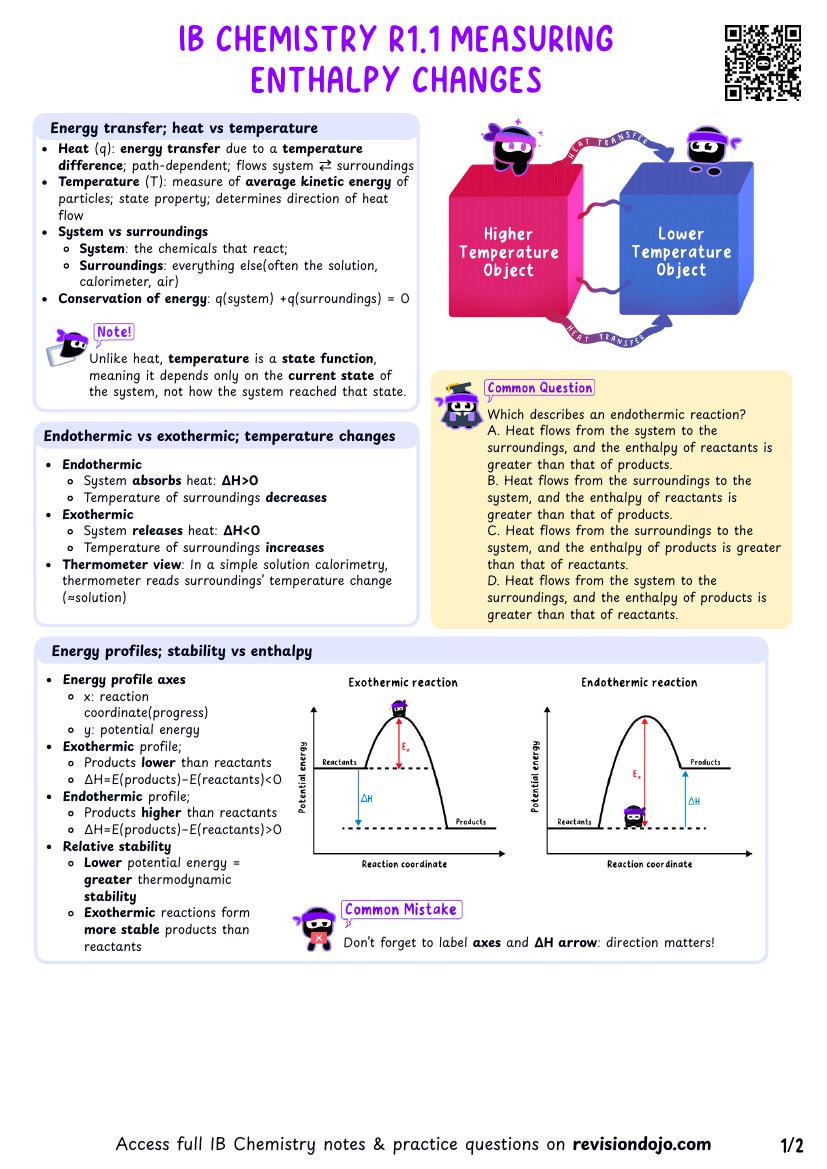
R1.1 Measuring enthalpy change
R1.2 Energy cycles in reactions
R1.3 Energy from fuels
R1.4 Entropy and spontaneity (HL)
Reactivity 2. How much, how fast and how far?
R2.1 How much? The amount of chemical change
R2.2 How fast? The rate of chemical change
R2.3 How far? The extent of chemical change
Reactivity 3. What are the mechanisms of chemical change?
R3.1 Proton transfer reactions
R3.2 Electron transfer reactions
R3.3 Electron sharing reactions
R3.4 Electron-pair sharing reactions
Browse summary cheatsheets for
S3.1A Periodic table: periods, groups & blocks
18 minute read
S3.1B Periodic trends across periods & down groups
27 minute read
S3.1C Metallic character & oxidation states
S3.1D Ionization-energy discontinuities & transition elements (HL)
14 minute read
S3.1E Variable oxidation states & coloured complexes (HL)
12 minute read
S3.1 the Periodic Table: Classification of Elements