Introduction
The Particulate Nature of Matter
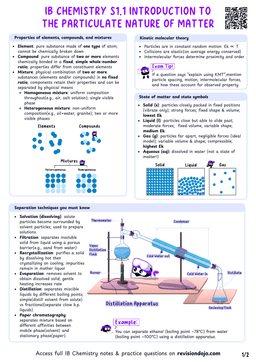
The particulate nature of matter is a fundamental concept in chemistry that explains how matter is composed of discrete particles. These particles can be atoms, molecules, or ions, and their arrangement and interactions determine the physical and chemical properties of substances.
States of Matter
Matter exists in three primary states: solid, liquid, and gas. Each state is characterized by distinct arrangements and behaviors of particles:
Solids
- Particle Arrangement: Particles in solids are closely packed in a fixed pattern, forming a lattice structure.
- Movement: Particles can only vibrate about their fixed positions.
- Properties:
- Fixed shape and volume.
- High density.
- Difficult to compress.
Liquids
- Particle Arrangement: Particles are closely packed but arranged randomly.
- Movement: Particles can flow past each other.
- Properties:
- No fixed shape; take the shape of their container.
- Fixed volume.
- Moderate density.
- Difficult to compress.
Gases
- Particle Arrangement: Particles are far apart and randomly arranged.
- Movement: Particles move freely and rapidly.
- Properties:
- No fixed shape or volume; expand to fill their container.
- Low density.
- Easy to compress.
Kinetic Theory of Matter
The kinetic theory of matter explains the properties of different states of matter based on the energy and movement of particles:
- Solids: Low kinetic energy; particles vibrate in place.
- Liquids: Moderate kinetic energy; particles flow past each other.
- Gases: High kinetic energy; particles move freely.
Understanding the kinetic theory is crucial for explaining phase changes and the behavior of gases under different conditions.
Phase Changes
Phase changes are physical changes where matter transitions between different states. These changes involve energy transfer but do not alter the chemical composition of the substance.
Types of Phase Changes
- Melting: Solid to liquid.