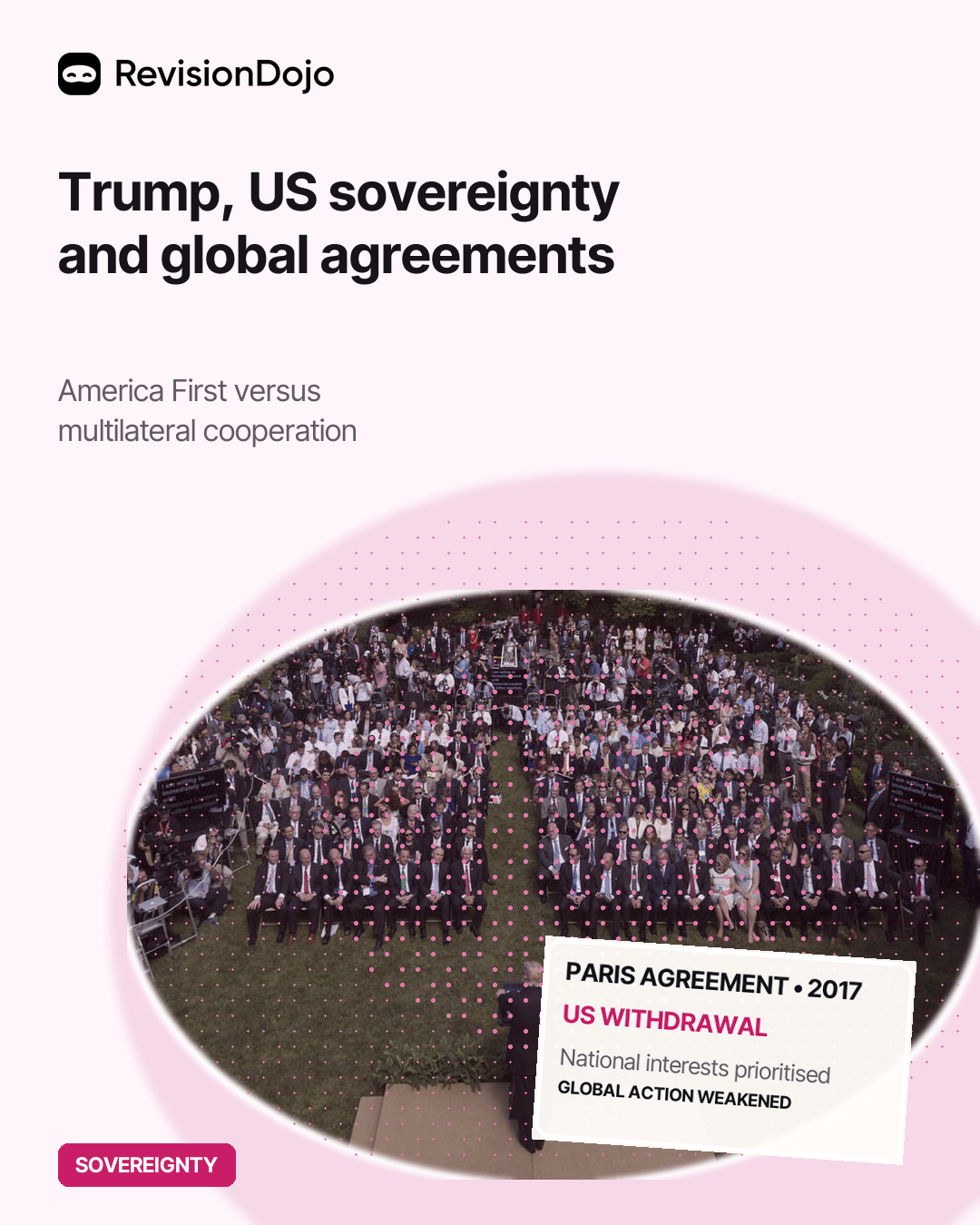
What Happened: In June 2017 , U.S. President Donald Trump announced that the United States would withdraw from the Paris Climate Agreement , arguing that the deal unfairly disadvantaged American workers and industries and restricted U.S. sovereign decision-making. Trump framed the withdrawal as prioritising American economic interests and national sovereignty over multilateral commitments, consistent with his broader "America First" foreign policy doctrine. This became a global politics case study because it illustrates the tension between national sovereignty and international cooperati
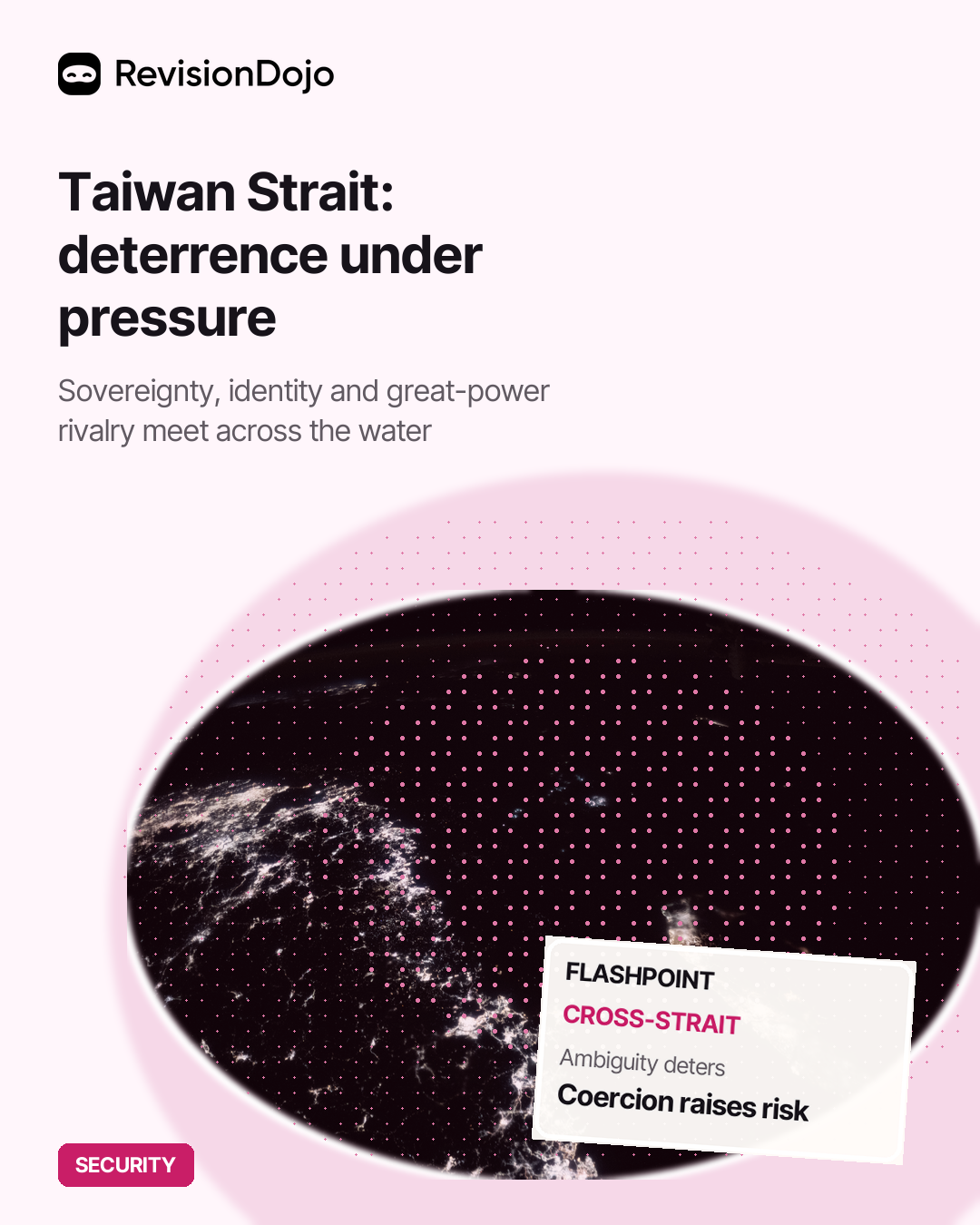
Context: Taiwan is a self-governing democratic state of 23 million people that has operated independently since 1949, when the Republic of China government retreated from the mainland following the Communist victory in the Chinese Civil War. The People's Republic of China claims Taiwan as a province and has never renounced the use of force to achieve "reunification" , while the United States maintains strategic ambiguity about whether it would defend Taiwan militarily. Taiwan is simultaneously a vibrant democracy, a critical technology hub (producing over 90% of the world's most advanced se
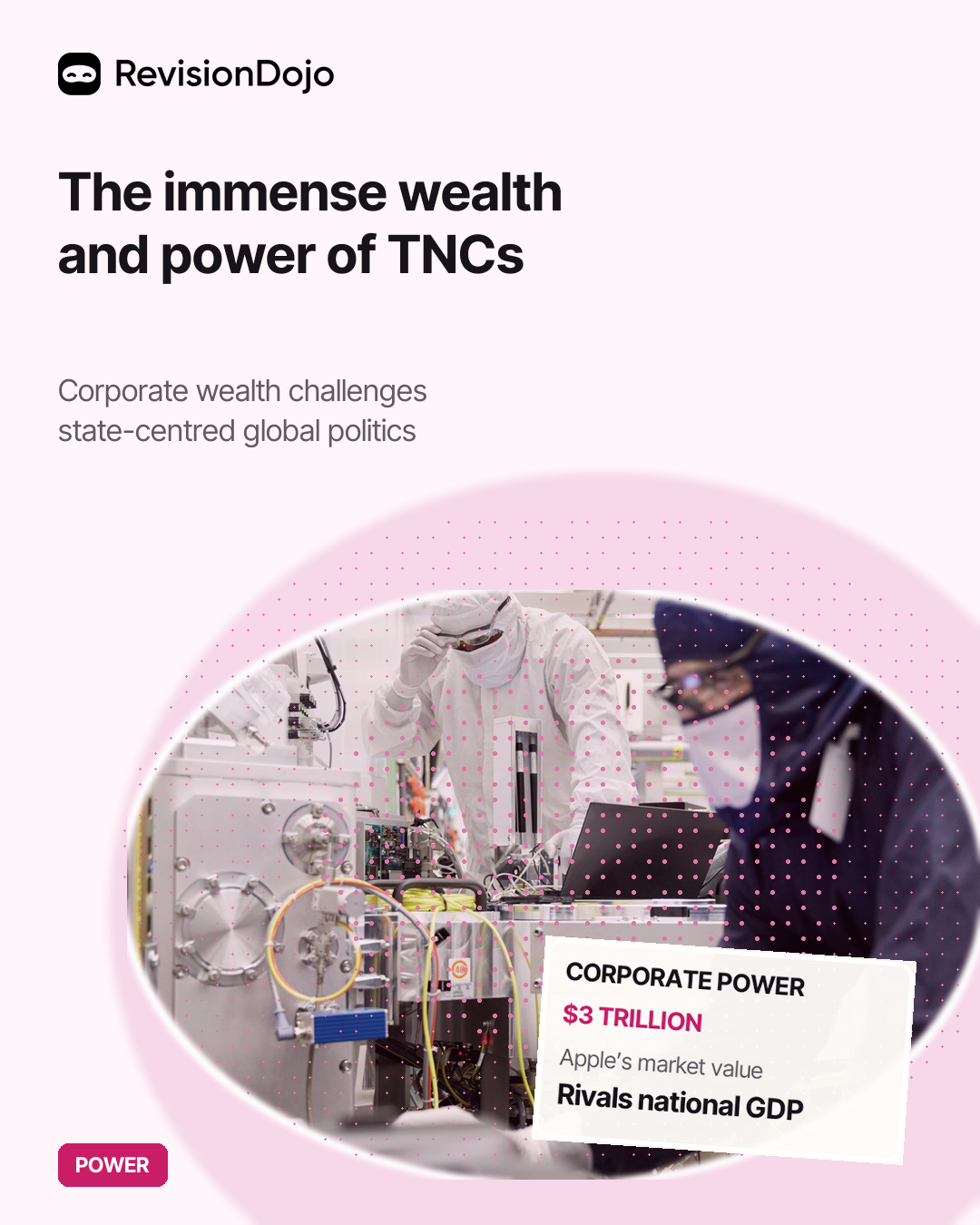
What Happened: Transnational corporations (TNCs) have grown to a scale of wealth and power that rivals and in some cases exceeds that of sovereign states, fundamentally challenging traditional assumptions about where economic and political power resides in the international system. In 2021, Apple committed $430 billion to investments across the United States including infrastructure and job creation, activities traditionally seen as the responsibility of governments, illustrating how TNCs increasingly perform state-like functions. Saudi Aramco's market value of approximately $2 trillion s
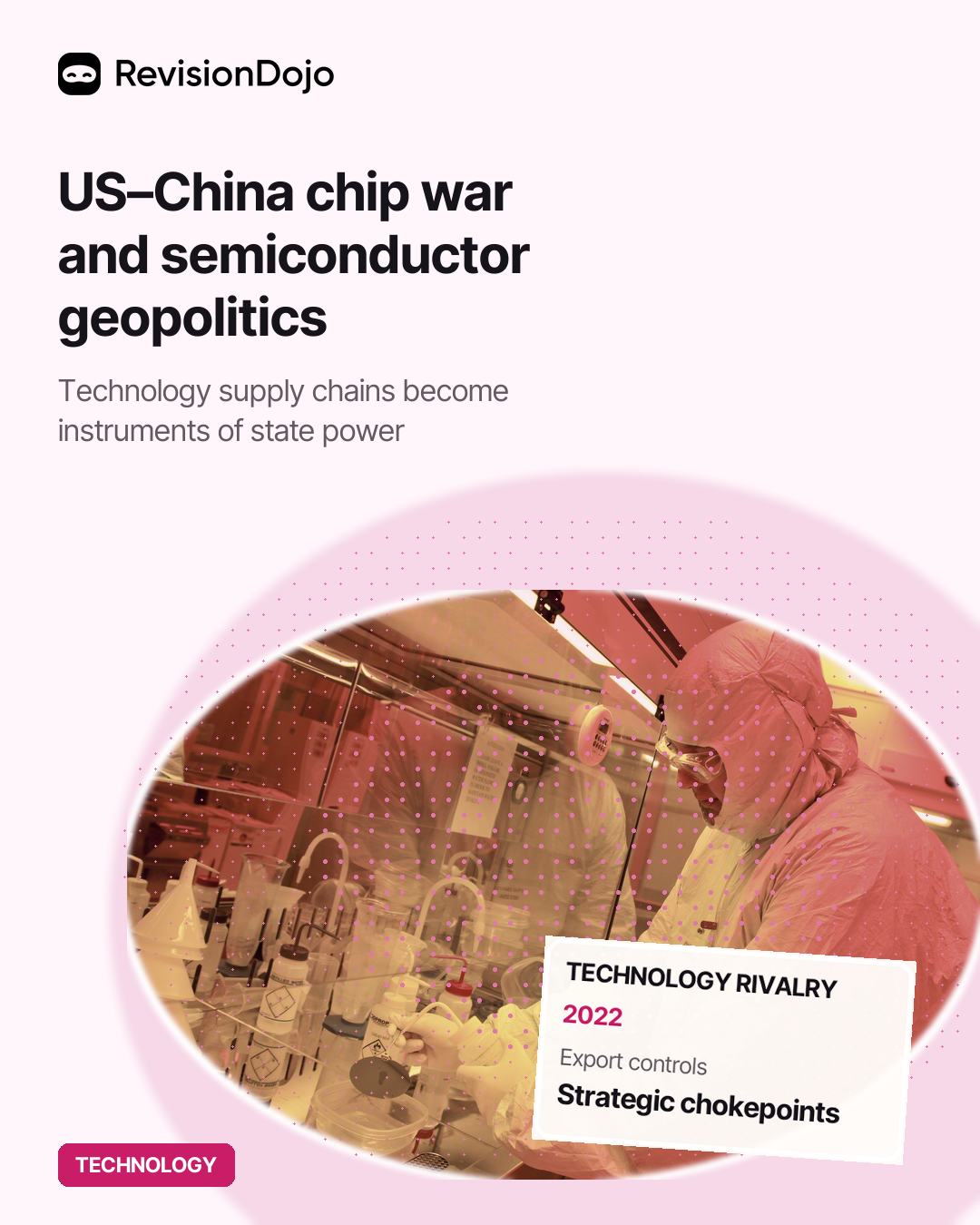
Context: In October 2022, the United States imposed the most sweeping semiconductor export controls in decades , restricting China's access to advanced chips, chipmaking equipment, and the expertise to manufacture them. The controls, expanded in 2023 and 2024, aim to deny China the computing power needed for advanced AI development and military modernisation, representing a fundamental shift from economic engagement to technological containment . The semiconductor industry is uniquely concentrated: Taiwan's TSMC manufactures over 90% of the world's most advanced chips , the Netherlands' ASM