Practice C.4 Conservation of biodiversity with authentic IB Biology exam questions for both SL and HL students. This question bank mirrors Paper 1A, 1B, 2 structure, covering key topics like cell biology, genetics, and ecology. Get instant solutions, detailed explanations, and build exam confidence with questions in the style of IB examiners.
Paper
Level
Question 1
HLPaper 1A
In 1789 Gilbert White, a naturalist, observed eight breeding pairs of swifts (Apus apus) in the English village of Selborne. On average, each pair of swifts produces two offspring per year. This would allow the population to rise to 1030 swifts over 200 years. A bird survey carried out in 1983 revealed only 12 breeding pairs in this village.
What could have prevented the numbers rising to 1030?
I. The number of nesting sites remained the same.
II. The food supply of the swifts remained constant.
III. Predatory birds in the area were exterminated.
Question 2
SLPaper 1A
Global warming threatens the survival of Arctic foxes. Which of the following factors could be involved?
I. Competition with other fox species spreading north
II. Reduction in numbers of prey species of Arctic foxes
III. Decrease in oxygen availability to Arctic foxes
Question 3
HLPaper 2
The fire ant (Solenopsis geminata) is an effective colonizer and has become invasive in a number of ecosystems.
Sometimes, efforts to eliminate this species have had an unexpected impact on community structure. It is argued that S. geminata can play a beneficial role in corn production.
The graph shows how the presence of S. geminata can impact insect diversity in areas where crops of corn are grown.
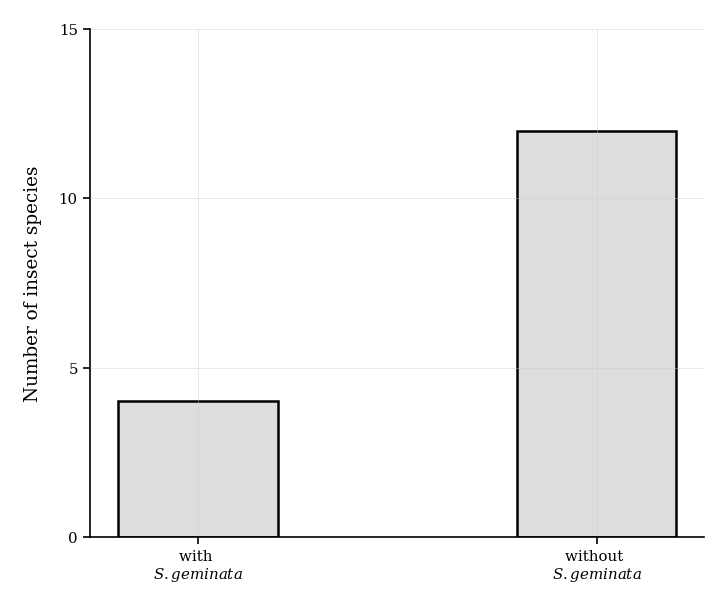
1.[1]
State the impact of S. geminata on insect species diversity.
2.[3]
Discuss whether S. geminata might play a positive role in corn production.
3.[2]
Researchers have argued that S. geminata is a keystone species in the corn agricultural system. Outline what is meant by a keystone species.
Question 4
SLPaper 1A
What contributes to the enhanced greenhouse effect?
Question 5
SLPaper 1A
In 1789 Gilbert White, a naturalist, observed eight breeding pairs of swifts (Apus apus) in the English village of Selborne. Each pair of swifts produces two offspring on average per year. In 200 years this should have produced swifts in the village of Selborne. A survey carried out in 1983 revealed only 12 breeding pairs in this village.
Which of the following possibilities could have prevented the numbers rising to ?
I. The number of nesting sites remained the same II. The food supply of the swifts remained constant III. Predatory birds in the area were exterminated IV. The climate became colder from 1789 onwards
Question 6
SLPaper 1A
What might increase in arctic ecosystems as a result of rising global temperatures?
Question 7
HLPaper 1A
The capture-mark-release-recapture method was used to determine the number of Sandhill Cranes (Grus canadensis nesiotes), an endangered species of bird, living on an island.
The following data were obtained:
- number of Sandhill Cranes initially caught, marked and released = 22
- total number of Sandhill Cranes caught in second sample = 14
- number of marked Sandhill Cranes in the second sample = 2
What is the population size of the Sandhill Cranes on the island?
Question 8
HLPaper 1A
Which of the following gases will contribute to the greenhouse effect?
I. Oxygen II. Nitrous oxide III. Argon
Question 9
SLPaper 1A
How does the precautionary principle affect the planning of public projects?
Question 10
SLPaper 2
The graph below shows the growth of a population of ring-necked pheasants (Phasianus colchicus) on Protection Island off the north west coast of the United States. The original population released by the scientists consisted of two male and eight female birds. Two of the females died immediately after release. 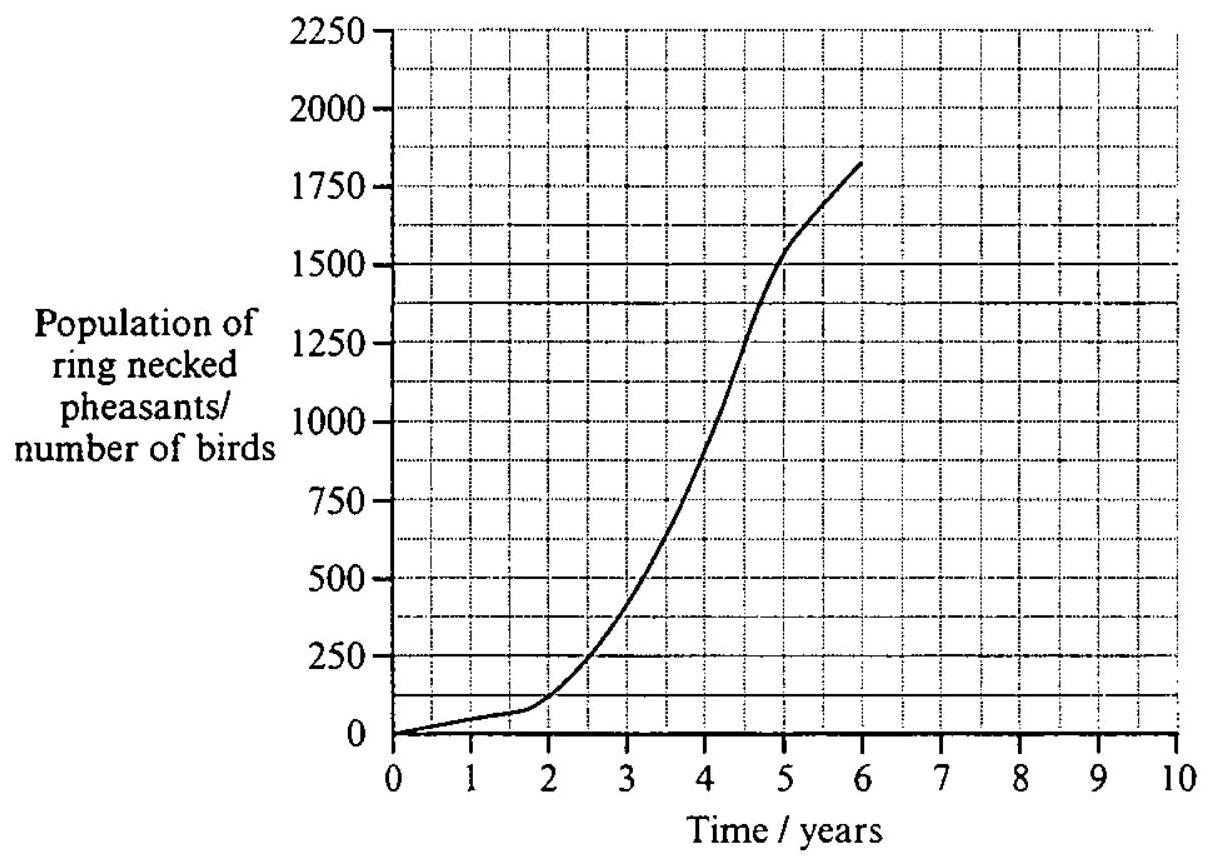
1.[1]
State the term used to describe the shape of a growth curve of this type.
2.[1]
The scientists predicted that the population would reach its carrying capacity of 2000 by year 8. Draw a line on the graph to show the population growth between years 6 and 10.
3.[2]
Suggest two factors that could limit the population increase between years 8 and 10.
4.[1]
Predict how the population growth would change if all the female birds in the original sample had survived.
5.[1]
Predict the effect on the carrying capacity if all the female birds in the original sample had survived.
6.[1]
State the year in which there was the greatest increase in biomass of trout caught by fishermen, compared with the previous year.
7.[3]
Using the data from the bar chart, discuss whether cormorants caused the decrease in the number of trout caught by the fishermen.