Practice C.3 Impacts of humans on ecosystems with authentic IB Biology exam questions for both SL and HL students. This question bank mirrors Paper 1A, 1B, 2 structure, covering key topics like cell biology, genetics, and ecology. Get instant solutions, detailed explanations, and build exam confidence with questions in the style of IB examiners.
Paper
Level
Question 1
HLPaper 1A
The diagram shows the carbon flux in gigatonnes per year between some of the Earth's global reservoirs.
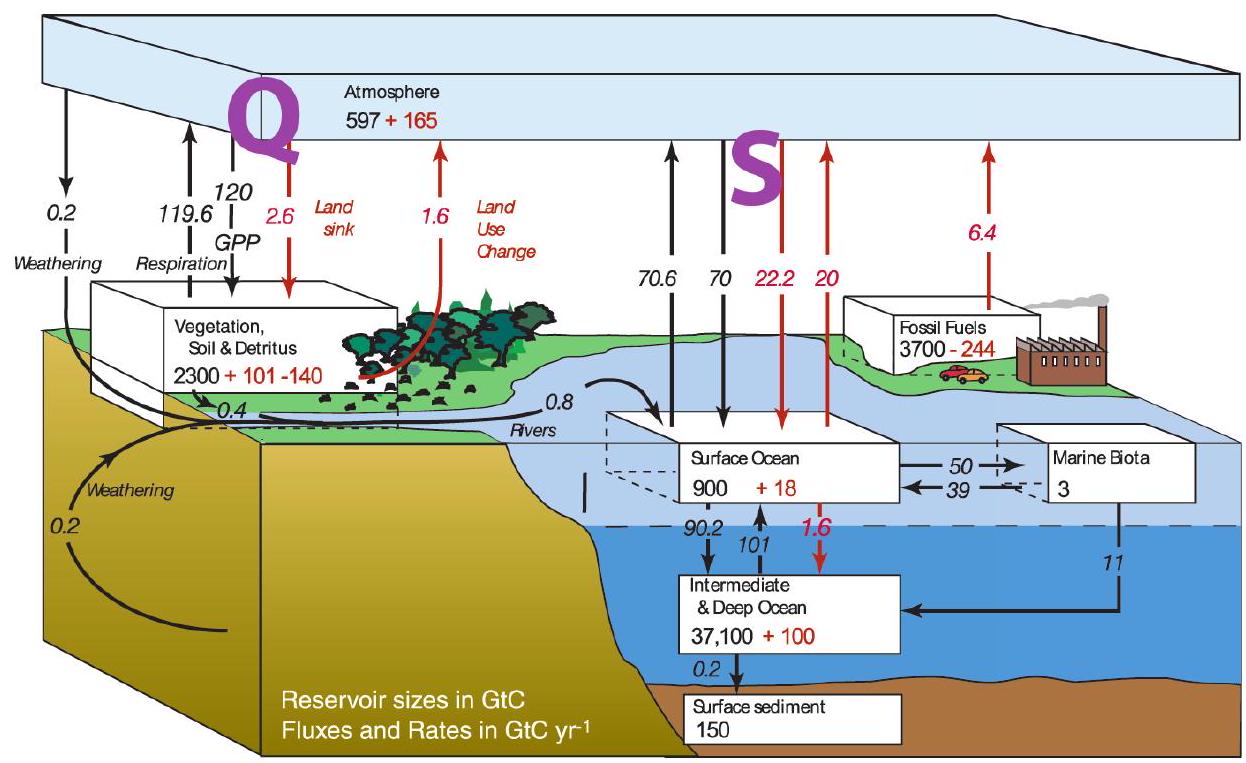
What can be deduced from the information in the diagram?
Question 2
HLPaper 1A
In 1789 Gilbert White, a naturalist, observed eight breeding pairs of swifts (Apus apus) in the English village of Selborne. On average, each pair of swifts produces two offspring per year. This would allow the population to rise to 1030 swifts over 200 years. A bird survey carried out in 1983 revealed only 12 breeding pairs in this village.
What could have prevented the numbers rising to 1030?
I. The number of nesting sites remained the same.
II. The food supply of the swifts remained constant.
III. Predatory birds in the area were exterminated.
Question 3
SLPaper 1A
Global warming threatens the survival of Arctic foxes. Which of the following factors could be involved?
I. Competition with other fox species spreading north
II. Reduction in numbers of prey species of Arctic foxes
III. Decrease in oxygen availability to Arctic foxes
Question 4
HLPaper 2
The fire ant (Solenopsis geminata) is an effective colonizer and has become invasive in a number of ecosystems.
Sometimes, efforts to eliminate this species have had an unexpected impact on community structure. It is argued that S. geminata can play a beneficial role in corn production.
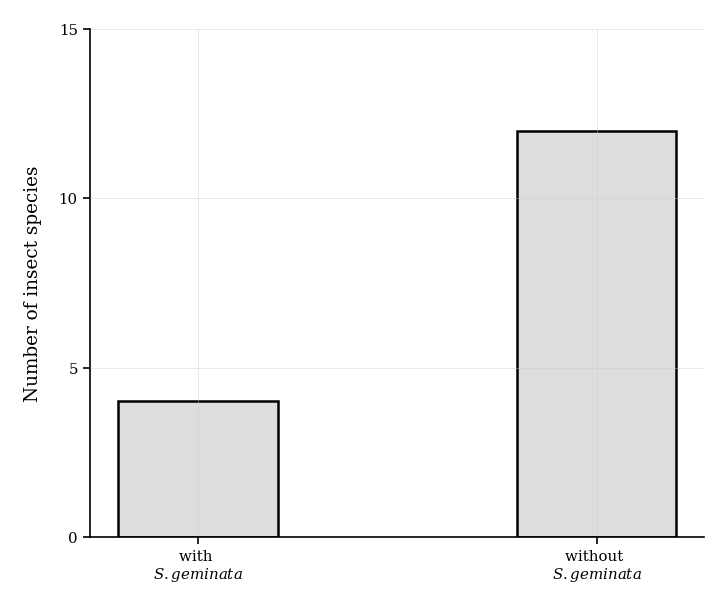
The graph shows how the presence of S. geminata can impact insect diversity in areas where crops of corn are grown.
1.[1]
State the impact of S. geminata on insect species diversity.
2.[3]
Discuss whether S. geminata might play a positive role in corn production.
3.[2]
Researchers have argued that S. geminata is a keystone species in the corn agricultural system. Outline what is meant by a keystone species.
Question 5
HLPaper 1A
Genetically modified maize, called Bt maize, is thought to be affecting the monarch butterfly (Danaus plexippus) in the USA. What is the reason for this?
Question 6
HLPaper 2
Sockeye salmon (Oncorhynchus nerka) spend the first years of their lives in the freshwater lakes of Alaska before migrating to marine waters. Their first months in marine waters are spent foraging and growing near the shore line. They then move to offshore regions of the North Pacific Ocean for 2 to 3 years. 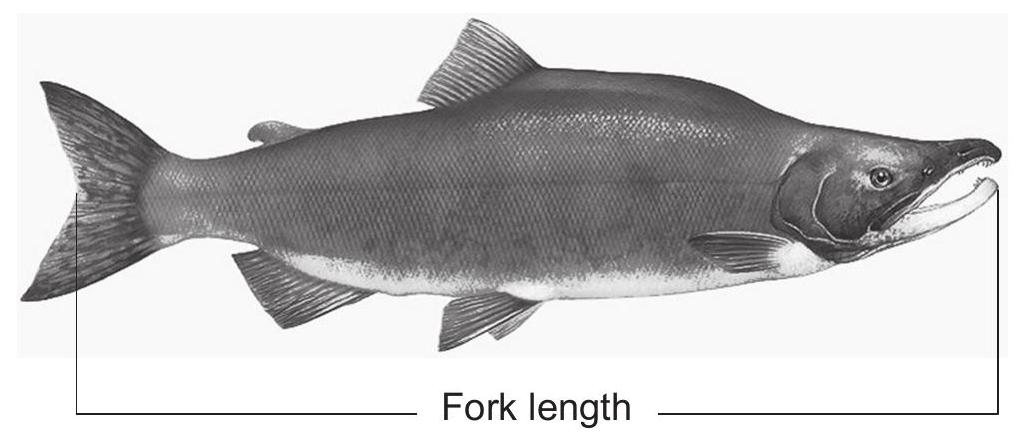 [Source: "Oncorhynchus nerka" by Timothy Knepp of the Fish and Wildlife Service. US Fish and Wildlife Service. Licensed under Public Domain via Commons https://wccyusoueahdpdicsyrg.supabase.co/storage/v1/object/public/question-images/images/b9c32b2e-53b8-4722-a4a4-2c906ad6d8f4.jpg] The graph shows fork length frequency of juvenile O. nerka caught during their first months in marine waters in autumn 2008 and ocean age one O. nerka caught 15 months later during winter 2009 in the North Pacific Ocean.
 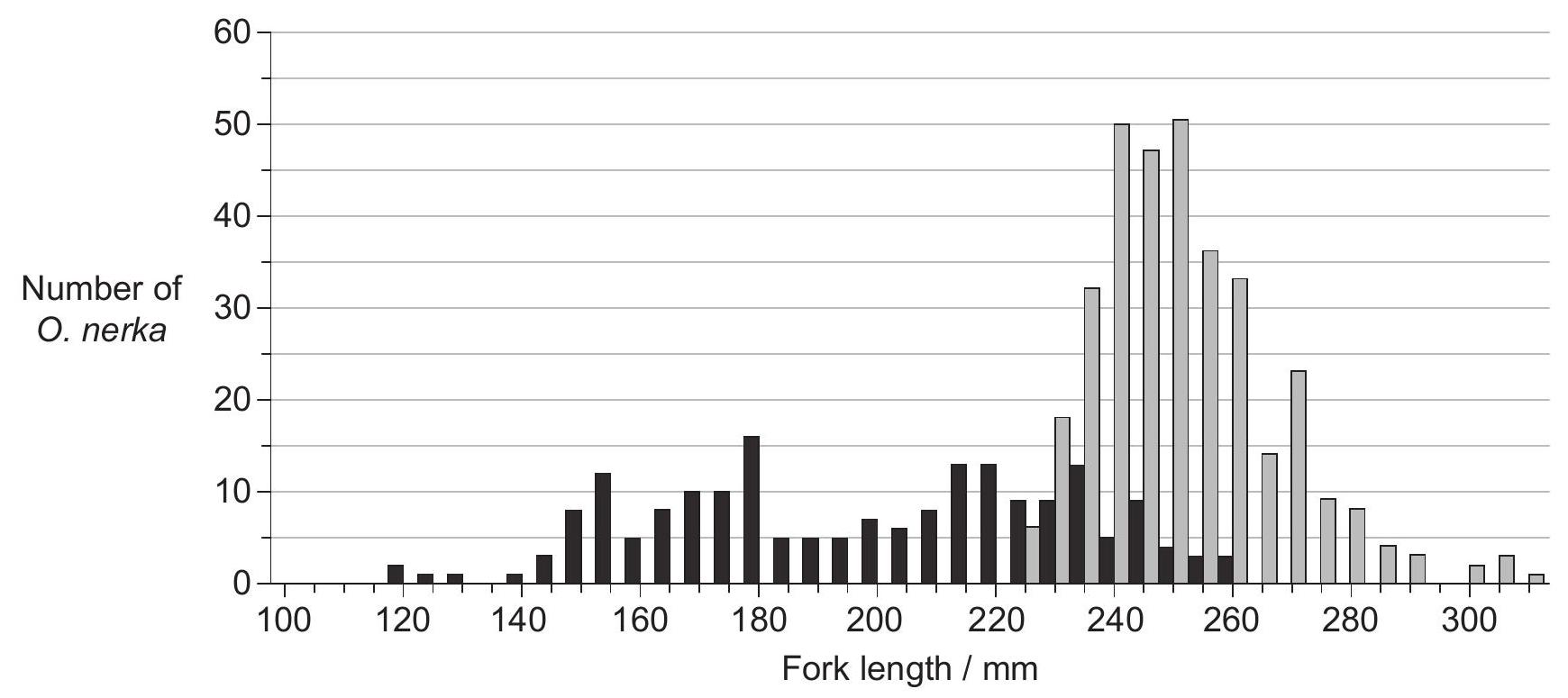 Key: □ autumn 2008 (juvenile O. nerka) □ winter 2009 (ocean age one O. nerka) [Source: Adapted from Edward V. Farley, Alexander Starovoytov, Svetlana Naydenko, Ron Heintz, Marc Trudel, Charles Guthrie, Lisa Eisner and Jeffrey R. Guyon (2011) 'Implications of a warming eastern Bering Sea for Bristol Bay sockeye salmon'. ICES Journal of Marine Science, 68 (6), pages 1138-1146, by permission of Oxford University Press.]

1.[1]
Identify the total number of O. nerka with fork length from 240 to 245 mm caught in autumn 2008 and winter 2009.
2.[2]
Compare the data in the graph for autumn 2008 and winter 2009.
3.[2]
Suggest two factors that could affect the distribution of O. nerka in the North Pacific Ocean.
4.[1]
State the range of lipid content measured in O. nerka caught during autumn 2008.
5.[2]
Outline any correlation between total lipid content and fork length in autumn 2008 and in winter 2009.
6.[2]
Suggest reasons for the differences in lipid content.
7.[1]
Describe the relationship between the distance of upstream migration and the concentration of PCBs in O. nerka.
8.[1]
State the concentration of PCBs in muscle lipids at 125 km from the ocean estimated by the correlation line.
9.[1]
As the O. nerka migrate upstream they no longer feed. Suggest a reason for the relationship of distance of upstream migration and concentration of PCBs in muscle lipids.
Question 7
SLPaper 1A
What contributes to the enhanced greenhouse effect?
Question 8
SLPaper 1A
Carbon sinks are any reservoirs that absorb and store carbon dioxide from the atmosphere. Which process increases the size of the carbon sink in oceans?
Question 9
SLPaper 2
1.[4]
Define habitat, population, community and ecosystem.
2.[6]
Outline how energy flows through an ecosystem.
3.[5]
Discuss the benefits and possible harmful effects of altering species by one example of genetic modification.
Question 10
SLPaper 1A
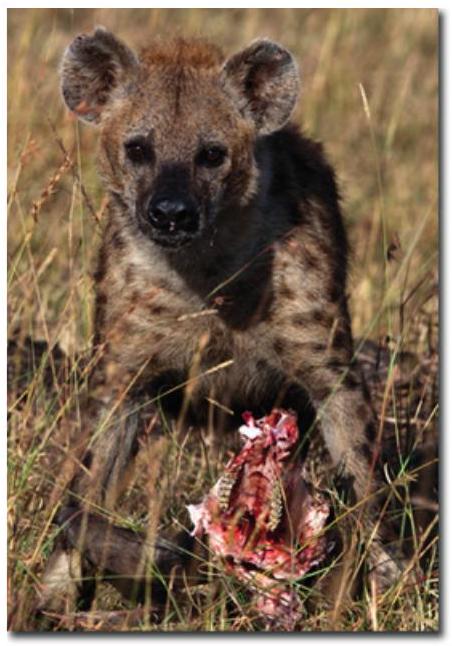
Image I shows a spotted hyena (Crocuta crocuta) and image II shows a leopard tortoise (Geochelone pardalis).
Image I
[Source: DesertUSA.Com] Image II
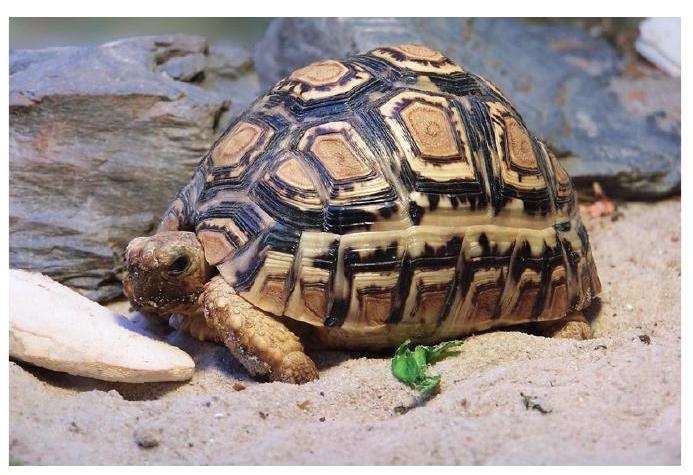
[Source: "Geochelone pardalis bw 01" by Berthold Werner - Own work. Licensed under CC BY-SA 3.0 via Commons - https://commons.wikimedia. org/wiki/File:Geochelone_pardalis_bw_01.jpg#/ media/File:Geochelone_pardalis_bw_01.jpg ]
Based on their diet, the feces of spotted hyenas appear white because of high calcium content. Leopard tortoises eat hyena feces. What would explain such tortoise behaviour?