The extended essay (EE) is a compulsory component of the DP core.
The EE is an opportunity for DP students to explore a topic of interest in their chosen subject.
It allows for the development of research skills, communication skills, and encourages critical thinking.
Although an EE can be taken in different subjects, this guide will focus on Global Politics
Undertaking an EE in Global Politics allows students to research a topic of interest in this academic area.
This could involve the collection of primary or secondary data, depending on the chosen topic.
The EE has a word count of a maximum of 4000 words, together with a 500-word reflective statement.
It is expected that the EE will involve approximately 40 hours of student work.
What is distinctive about a Global Politics Extended Essay?
A Global Politics Extended Essay explores a question that connects to power, justice, human rights, and the dynamics of global interactions.
It challenges students to critically examine real-world political issues through multiple perspectives, theories, and case studies.
If you are interested in understanding how political decisions shape societies and individuals, and how global actors navigate conflict, cooperation, and change, a Global Politics EE will be a deeply engaging and rewarding choice.
Global Politics invites you to investigate pressing global issues such as globalization, sovereignty, inequality, development, and sustainability.
You will engage with political ideas and debates while grounding your research in authentic examples from international organizations, state policies, and grassroots movements.
By combining conceptual analysis with empirical evidence, your essay will demonstrate how theory and practice interact in shaping the global landscape.
Writing a Global Politics Extended Essay gives you the opportunity to:
Challenge assumptions about power, justice, and equality by analyzing political structures and relationships.
Conduct an in-depth inquiry into a significant global issue, linking theoretical frameworks with contemporary or historical case studies.
Deepen your understanding of key global politics concepts such as legitimacy, interdependence, and human rights, through engagement with relevant political theory and literature.
Apply political theories and methodologies to formulate and defend a clear, evidence-based argument.
Develop a nuanced understanding of how local and global forces interact to shape the dynamics of world affairs.
Figure 1
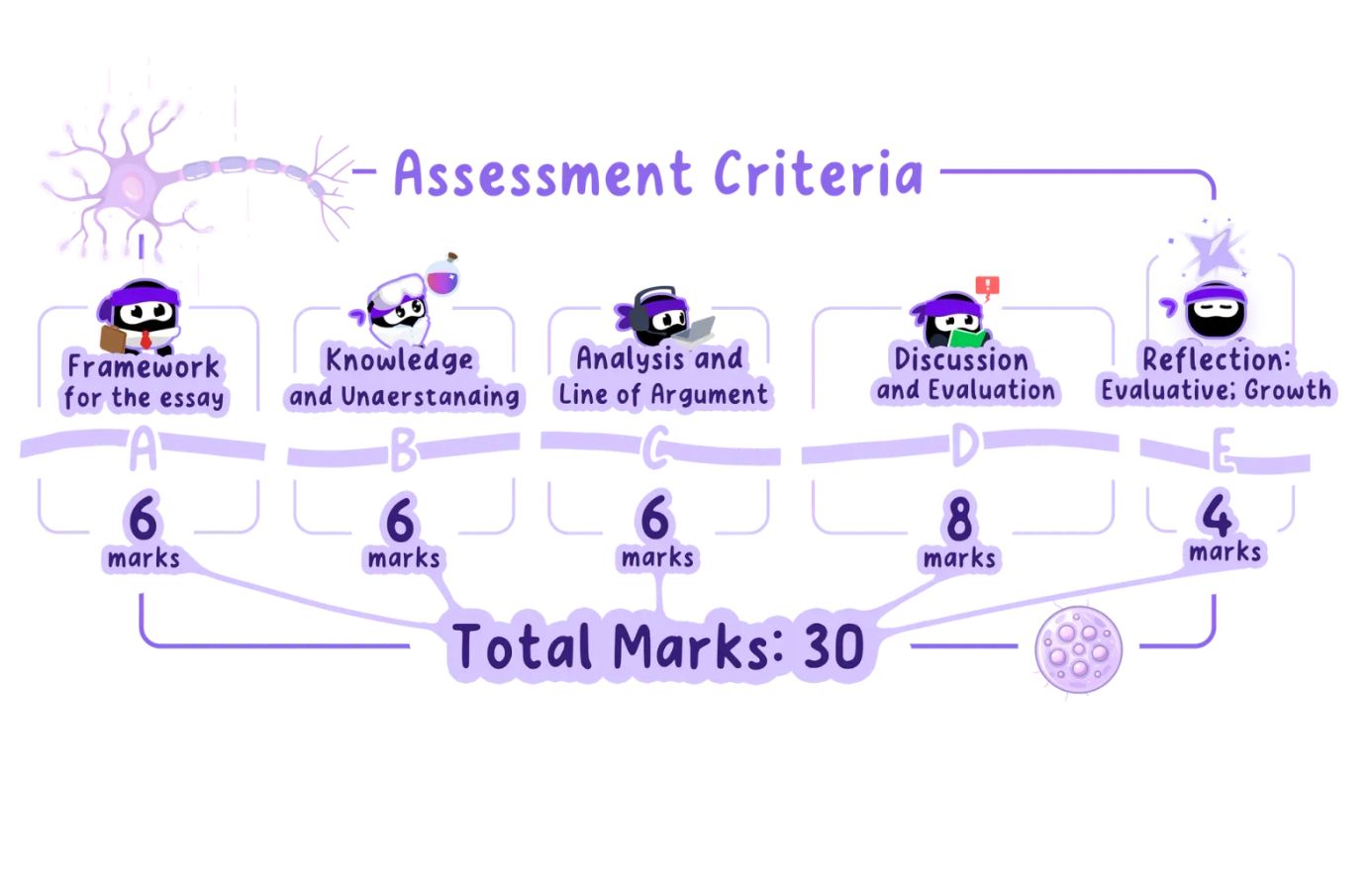
The EE is externally assessed by IB examiners, against five criteria, which are listed below.
Criterion
Description
Maximum Marks
A: Framework For The Essay
Assesses the focus of the research question, the appropriateness of the research methods, and the clarity of structure.
6 marks
B: Knowledge and Understanding
Evaluates the student’s grasp of the topic, use of relevant subject-specific concepts and terminology, and understanding of the context.
6 marks
C: Analysis and Line of Argument
Judges the quality of analysis, coherence, and consistency of the argument throughout the essay.
6 marks
D: Discussion and Evaluation
Considers the student’s ability to discuss findings critically, evaluate evidence, and present a balanced, well-reasoned conclusion.
8 marks
E: Reflection
Assesses the extent to which the student reflects on the research process, evaluates their learning, and demonstrates intellectual and personal growth.
4 marks
Total Marks: 30
Note
Together with Theory of Knowledge (TOK), the Extended Essay (EE) can contribute a maximum of three additional points to a student’s overall IB Diploma score.
A student must achieve a grade D or above for the EE to be awarded a Diploma.
A grade E in the extended essay is known as a failing condition.
Supervision in the EE
Figure 2
Note
The feedback given should be related to how the work could be improved.
The essay must not be heavily annotated or edited by the supervisor.
Each student is assigned a supervisor during the Extended Essay (EE) process, usually the teacher of the chosen subject.
The supervisor is an essential part of the EE process. Although the EE is a student-led piece of work, the student must be supervised and should have regular meetings with their tutor to discuss progress.
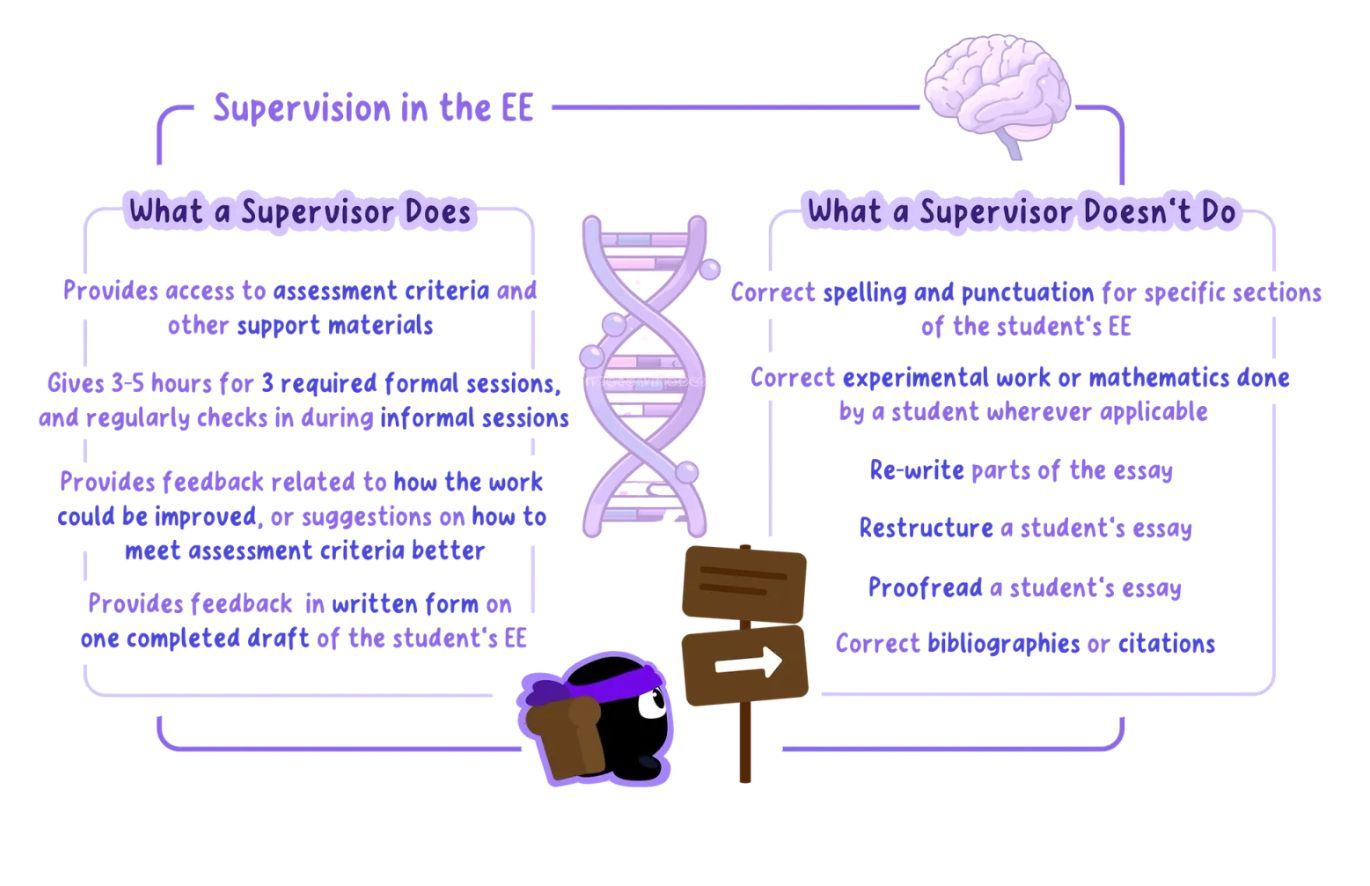
The supervisor is responsible for ensuring that students understand the EE writing process, including access to the assessment criteria and support materials such as exemplar essays.
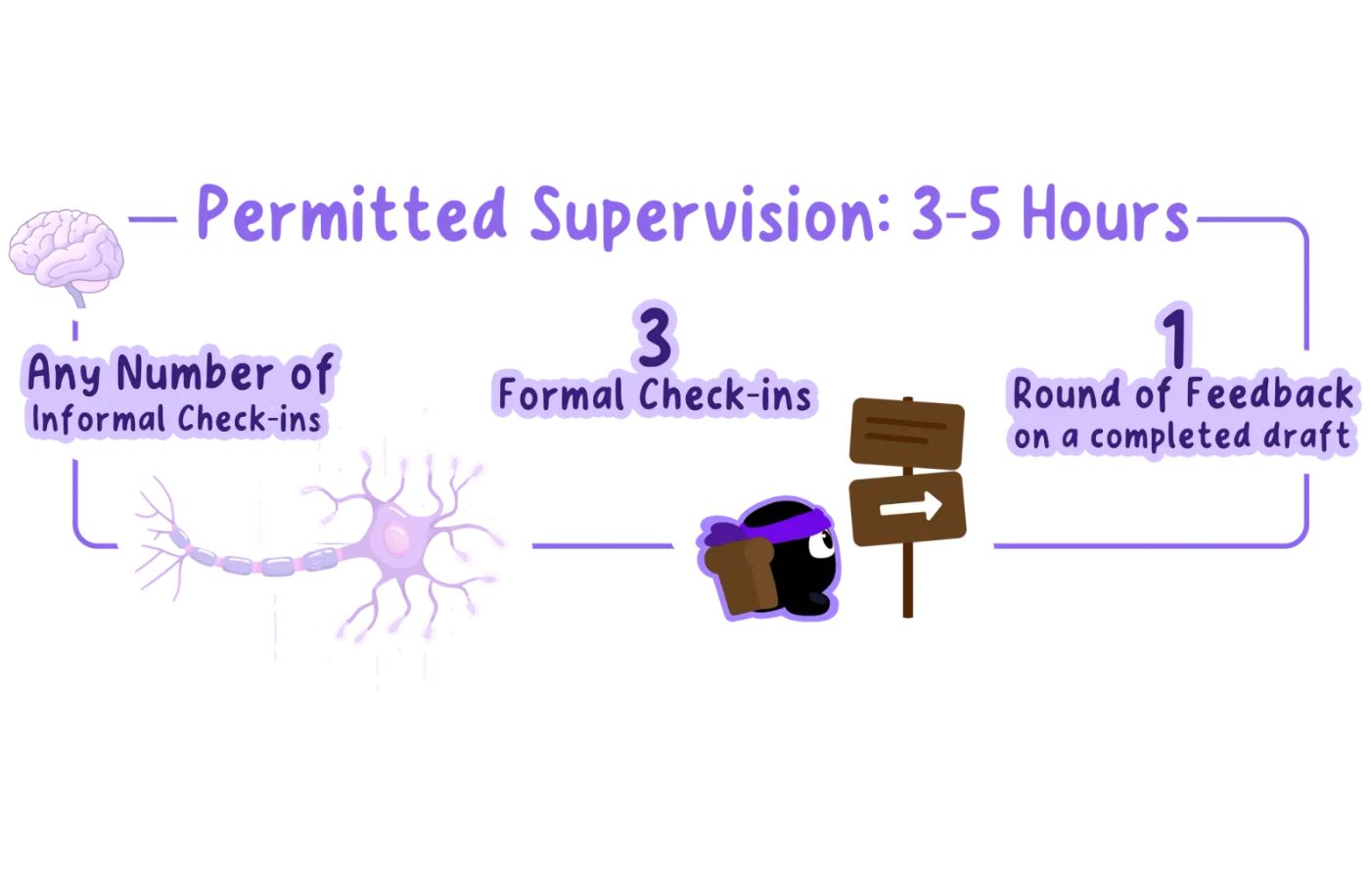
The total supervision time must be between three and five hours, including informal check-ins and the three required formal reflection sessions. Supervisors should also be available for additional meetings beyond the mandatory sessions.
Supervisors are responsible for providing feedback on one completed draft of the essay and are permitted to give written feedback on that single draft only.
Note
Permitted Supervision: 3–5 Hours
Any Number of Informal Check-ins
3 Formal Check-ins
1 Round of Feedback on a Completed Draft
The following is a list of what supervisors cannot do:
Correct spelling and punctuation
Correct experimental work or mathematics
Re-write any part of the essay
Indicate where whole sections of the essay would be better placed
Proofread the essay for errors
Correct bibliographies or citations
Figure 3
Academic Integrity
The IB takes academic honesty extremely seriously, and the Extended Essay (EE) is no exception.
Any work that is not the student’s own must be correctly cited.
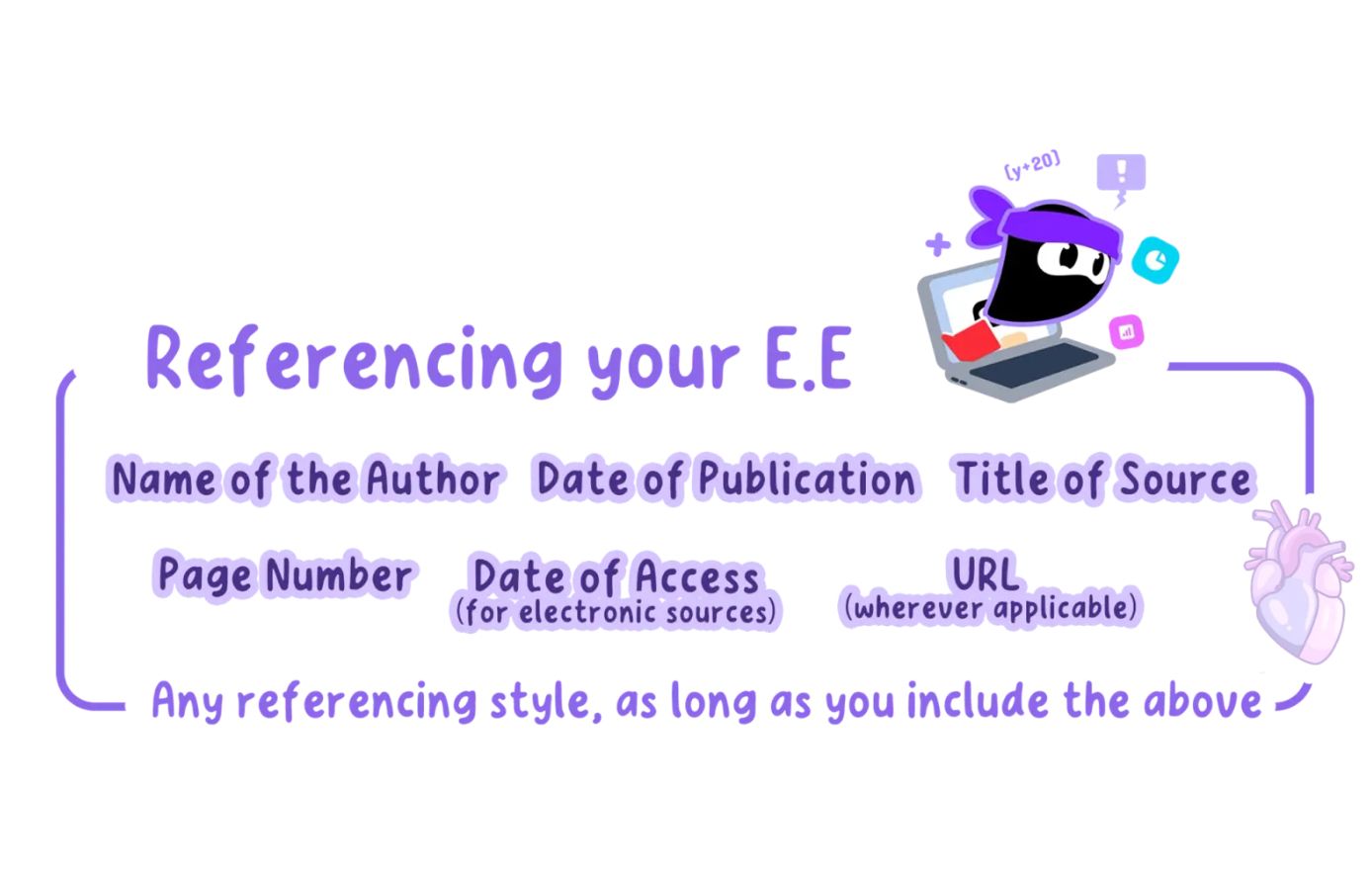
The actual reference style is not prescribed, but whichever style is used must include:
Name of the author
Date of publication
Title of the source
Page number (if applicable)
Date of access for electronic sources
URL (where applicable)
Example
This includes paraphrasing, in-text citations, secondary data, literature values, graphs, figures, and diagrams.
Figure 4
Choosing a Topic
The Global Politics Extended Essay offers a wide range of potential topics that explore the complexities of power, justice, human rights, and development in today’s interconnected world.
Students can investigate global challenges such as climate change, migration, conflict, governance, inequality, and technological change.
Each of these issues can be transformed into a focused research question that connects directly to the core and optional themes of Global Politics.
The choice of a Global Politics EE topic may come from several sources.
It could stem from your own personal experience or interest in a particular global issue.
It might relate to current debates in international affairs or be an extension of a class topic studied in more depth.
You may also choose to explore a new and emerging issue that connects to your curiosity about how politics shapes global life.
Your topic should stay firmly within the Global Politics framework.
It should engage with key concepts such as power, sovereignty, legitimacy, human rights, and sustainability.
While global issues often overlap with other disciplines, your essay must retain a political focus by analyzing actors, power dynamics, and decision-making processes.
Many topics can be approached from multiple perspectives, but your essay should make clear how it is situated within Global Politics.
For example, if your interest lies in sport, technology, or the environment, you could examine how political power, governance, or international norms influence these areas.
A successful essay combines conceptual understanding, case study analysis, and critical evaluation of real-world political issues.
Example
Explore global discourses around women in sports and analyze how these influence political decision-making related to gender rights and equality.
Examine how digital surveillance technologies challenge the balance between state sovereignty and individual privacy in democratic societies.
Investigate the role of non-state actors, such as NGOs or multinational corporations, in shaping human rights enforcement across borders.
Analyze how international climate agreements reflect power asymmetries between developed and developing nations in the pursuit of sustainability and justice.
Evaluate the effectiveness of peacebuilding strategies employed by the United Nations in reducing structural and cultural violence in post-conflict regions.
Assess how foreign aid policies influence political development and dependency in low-income countries.
Note
What makes these topics effectively grounded in Global Politics is the way they are conceptually and methodologically approached.
It is not simply the global issue itself that defines the essay, but rather the use of political concepts, theories, and analytical methods that provide insight into power relations, governance, and global interactions, allowing you to develop well-constructed, evidence-based arguments.
Researching and Writing Your Essay
In Global Politics, extended essays rely primarily on secondary sources, such as academic articles, books, reports, and policy papers, to build a conceptually grounded and evidence-based argument.
The use of primary data, such as interviews or surveys, can be valuable but should only supplement, not replace, secondary research.
Your knowledge of the discipline’s theoretical frameworks, methodologies, and perspectives is essential when researching and writing your essay.
Effective essays in Global Politics demonstrate an understanding of how to apply political theories, case studies, and conceptual analysis to real-world global issues.
Although all extended essays include some form of literature review, the nature and role of sources vary depending on your topic and research question.
In Global Politics, most essays draw on secondary research to interpret and analyze primary data produced by governments, NGOs, think tanks, and international organizations.
It is crucial to understand what constitutes a credible and relevant source in political inquiry, as well as which methods of analysis are most appropriate.
For example, while a history essay might rely on first-hand accounts of events, a Global Politics essay would instead use academic commentary, policy analysis, and conceptual evaluation to interpret the political significance of those events.
Note
A strong Global Politics Extended Essay often combines:
Case studies, where theoretical ideas are tested against real-world events.
Comparative analysis, examining differences in how political systems or actors respond to similar issues.
Discourse or content analysis, focusing on how language, media, or political communication shape power and legitimacy.
Critical evaluation of theories, such as realism, liberalism, feminism, or postcolonialism, to explore their explanatory power.
A successful essay maintains a clear disciplinary focus, uses precise political terminology, and follows the analytical conventions of the Global Politics course.
It is important to ensure that all arguments and evidence directly address your research question, are conceptually informed, and are supported by credible sources.
Examples of Global Politics Extended Essay topics
Example
Example #1
Topic: Women, power, and conflict
Research question: To what extent is female leadership more effective at managing conflict? A comparison of New Zealand and France.
Approach:
Review literature on power, leadership, terrorism, and feminism.
Analyze responses by Jacinda Ardern and Emmanuel Macron to terrorist attacks.
Evaluate leadership effectiveness using soft power and legitimacy frameworks.
Example #2
Topic: Big data, apps, and human rights
Research question: To what extent does large-scale data collection by mobile apps violate the right to privacy? A case study of Snapchat in the European Union.
Approach:
Review key concepts of big data, privacy, human rights, and data protection.
Examine Snapchat’s data practices and relevant EU legislation (GDPR).
Link findings to political theories on interdependence and universal rights.
Example #3
Topic: International intervention and peacebuilding
Research question: How effective has UN peacekeeping been in achieving positive peace in the Central African Republic?
Approach:
Review theories of peacebuilding, sovereignty, and collective security.
Analyze UN reports, NGO data, and academic evaluations.
Assess outcomes using Galtung’s positive and negative peace framework.
Example #4
Topic: Sustainable development and climate justice
Research question: To what extent does the Paris Agreement reflect fairness between developed and developing nations?
Approach:
Review theories of global governance, sustainability, and climate justice.
Analyze the negotiating positions of key actors such as the EU, the US, and the Global South.
Evaluate outcomes using principles of distributive justice and equity in environmental politics.
Example #5
Topic: Human rights and migration
Research question: How effectively has the European Union balanced border security with the protection of asylum seekers’ rights since 2015?
Approach:
Review concepts of human rights, sovereignty, and security.
Examine EU asylum policies, Frontex operations, and NGO reports.
Assess the balance between humanitarian obligations and political pressures using human rights frameworks.
Common Mistake
Descriptive writing: Summarizing events instead of analyzing them through Global Politics concepts or theories.
Broad or vague questions: Failing to define a focused case, actor, or time period.
Weak disciplinary focus: Writing more like history or economics than political analysis.
Lack of theory: Ignoring frameworks such as realism, liberalism, feminism, or postcolonialism.
Poor source quality: Relying on biased or non-academic sources instead of peer-reviewed or institutional materials.
A good Global Politics topic is...
Focused: Narrow in scope and clearly defined.
Analytical: Uses theory to explain causes and consequences, not just describe.
Researchable: Supported by credible data and academic literature.
Conceptual: Engages explicitly with Global Politics key concepts such as power, sovereignty, and justice.
Debatable: Open to multiple interpretations and perspectives.
Do
Don't
Apply political theories consistently throughout the essay.
Write a narrative summary with minimal analysis.
Use real-world case studies to illustrate arguments.
Choose a topic that is too broad or too recent.
Link every paragraph to Global Politics concepts.
Rely on media commentary or biased sources.
Engage with multiple perspectives such as state, NGO, and individual.
Drift into economic or sociological analysis.
Reference academic and institutional sources such as UN, NGOs, and journals.
Forget to define key terms like power or legitimacy.
Maintain a clear and evaluative argument throughout.
Overuse quotes or description without analysis.
The Researcher's Reflection Space (RRS)
It is strongly recommended that students use the researcher’s reflection space (RRS) to document the EE process.
The RRS is an important resource when writing the 500-word reflective statement and can take the form of a reflective journal, which can be an online resource or a physical resource.
Students should discuss the RRS and the form that it could take early in the EE process.
View Exemplars
And thousands of other examples from high-scoring students.