Question
View answerSLPaper 1A
A unicellular organism maintains internal pH after acidification, releases ammonia and increases dry mass without dividing. Which processes are shown?
A unicellular organism maintains internal pH after acidification, releases ammonia and increases dry mass without dividing. Which processes are shown?
Cell P has naked circular DNA and cytosolic 70S ribosomes; Q has histone-bound linear DNA and cytosolic 80S ribosomes. A 70S inhibitor cannot enter organelles. Which prediction and classification are correct?
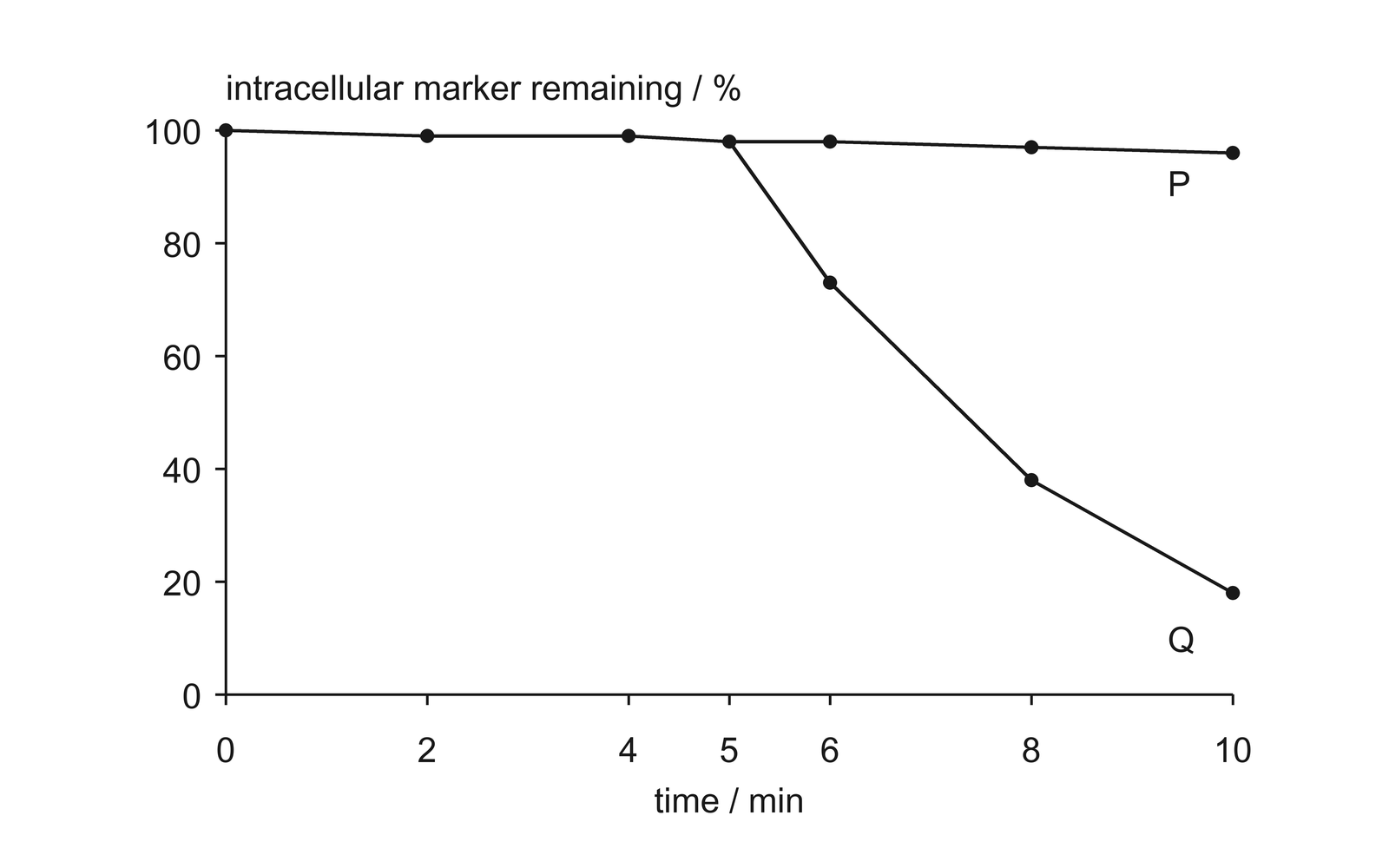
At minute 5, plant cells in isotonic solution received cellulase (P) or a lipid solvent (Q). Which conclusion is supported?
Entity X metabolizes and reproduces independently, but repeated microscopy shows no cellular organization. If X is accepted as living, what follows?
A theoretical model predicts that all living organisms consist of one or more cells. What would most directly falsify this prediction?
Practice IB Biology Topic A2.2 Cell Structure with authentic exam-style questions for both SL and HL students. This question bank focuses on the exact syllabus content for A2.2 Cell Structure and mirrors Paper 1A, 1B, 2 style where relevant.
Get instant solutions, detailed explanations, and build confidence with questions aligned to IB examiner expectations.