
IB Grading: What Counts as a Passing Score in IB?
Results day has a specific kind of silence. It’s the quiet of people who have trained themselves to turn effort into numbers, then stare at those numbers like they’re weather forecasts.
If you’re here, you’re probably asking the simplest question with the most complicated emotional weight: what is a passing score in IB? The answer lives inside IB Grading rules that are both straightforward and surprisingly strict. You don’t just “pass” by collecting points. You pass by meeting thresholds, completing the Core, and avoiding a few hidden trapdoors.
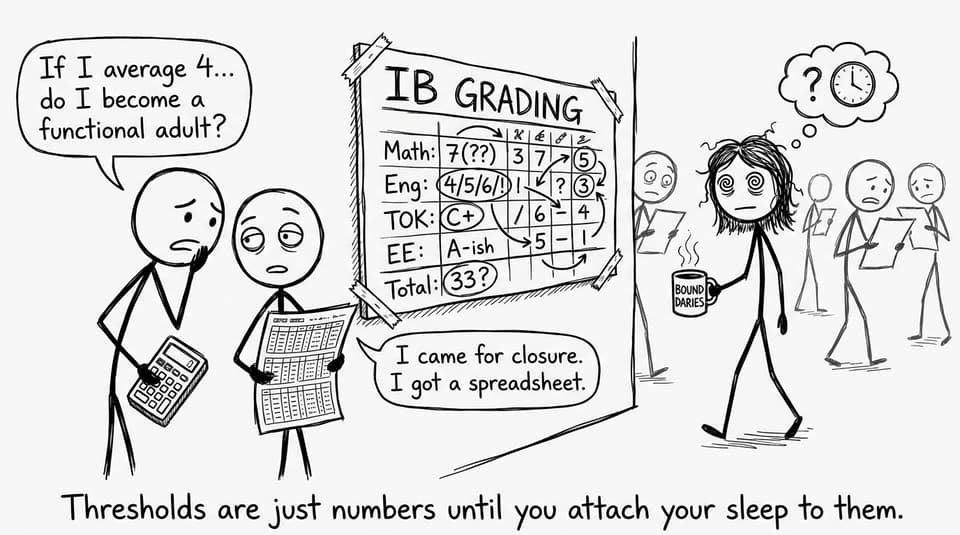
Quick checklist: the IB passing score in one screen
Use this as your calm reference when everyone else is yelling random numbers in the hallway:
-
Total points: 24+ out of 45 (including TOK/EE bonus points)
-
Six subjects: each scored 1 to 7 (max 42 points total)
-
Core: TOK + Extended Essay can add 0 to 3 points; CAS must be completed (no points, but required)
-
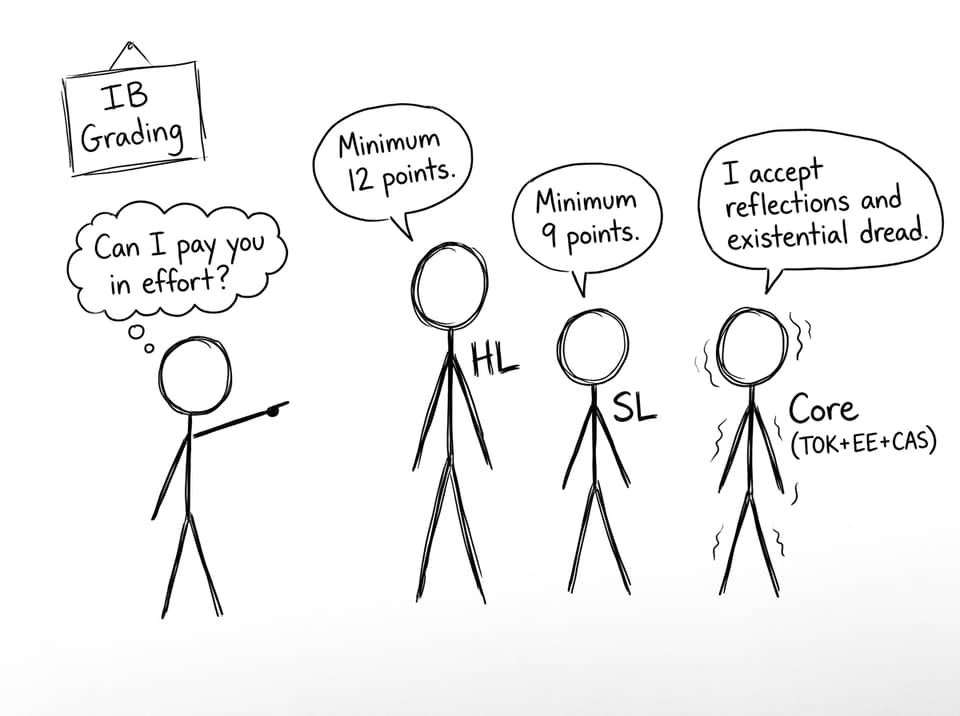
HL threshold: at least 12 points across your three HL subjects
-
SL threshold: at least 9 points across your three SL subjects
-
Avoid failing conditions: for example, no 1s, and no HL grade of 2
If you want a deeper breakdown of how points add up, keep How Do IB Points Work? A Simple Guide bookmarked.
IB Grading, explained like a human (not a spreadsheet)
At the center of IB Grading is a clean structure:
-
You take six subjects.
-
Each subject is graded 1 to 7.
-
That’s up to 42 points from subjects.
-
Then you add the Core: TOK + EE can give up to 3 bonus points, bringing the maximum to 45.
-
CAS is required for the diploma, but it doesn’t add points.
Those numbers are simple. The part students miss is that the IB also cares about distribution. In other words: you can’t “average your way out” of a weak area if that weakness hits a failing condition.
For a fuller overview of realistic score ranges and what they usually mean, see What Is a Good IB Score? Student Guide.
What is a passing score in IB? The 24-point rule (with conditions)
The phrase most people remember is: 24 points. That’s the baseline threshold. But IB Grading doesn’t award the diploma just because your total is 24 or higher.
To pass the IB Diploma, you generally need:
-
At least 24 points overall (including bonus points)
-
At least 12 points across your HL subjects
-
At least 9 points across your SL subjects
-
Completion of CAS
-
TOK and EE submitted and awarded in a way that meets diploma requirements
-
No failing grades that trigger non-award rules (like a 1, or a 2 at HL)
If you want the full version with the logic spelled out clearly, read What Is the 24-Point Rule in the IB Diploma?.
The hidden tension inside IB Grading: total points vs. “must-not-fail” rules
A lot of IB stress comes from misunderstanding this one idea:
-
Total points measure overall performance.
-
Failing conditions protect the diploma from major gaps.
So yes, you can technically reach 24 points and still be in danger if your score pattern hits a rule. This is why students near the pass line should stop thinking in averages and start thinking in constraints.
If you’re hovering around the boundary and trying to interpret predicted results, My IB Predicted Grade Is 23/42 (25 With Bonus) is a reassuring read.
What do the 1-7 subject grades actually mean?
In IB Grading, each subject grade is a rough signal of how consistently you meet the assessment criteria.
-
7: Excellent
-
6: Very good
-
5: Good
-
4: Satisfactory
-
3: Mediocre
-
2: Poor
-
1: Very poor
A “passing feeling” for many students is a 4. But the diploma pass isn’t built on feelings. It’s built on a structure: enough total points, enough HL and SL points, and no critical failures.
The Core matters more than students admit
When students talk about passing, they often talk only about subjects. But IB Grading includes the Core because the IB Diploma is meant to be more than six exams.
TOK and EE: small points, big consequences
TOK + EE can award 0-3 points. That sounds tiny until you realize it’s often the difference between:
-
23 and 24
-
“retake panic” and “diploma awarded”
If you’re close to the line, the Core is not optional in practice, even if it feels optional emotionally.
CAS: no points, but still a gate
CAS doesn’t add points, yet it can block the diploma if it isn’t completed. It’s the classic IB move: “This won’t help your total, but it can stop you from graduating.”
Why aiming above the passing score makes IB Grading easier
It sounds harsh, but it’s actually comforting: the safest way to “pass” is to stop aiming for the pass line.
University offers rarely care about your minimum
Universities often set entry requirements well above 24. Some programs want 30s; competitive courses can expect higher. Even when a university accepts 24, it may not be your best option set.
If you’re wondering what a 24 means in the real admissions world, read What Universities Can I Enroll in With a 24 IB Diploma Score? and, for US-specific context, What US Universities Accept IB Scores of 24?.
The higher your buffer, the less you fear one bad paper
Aiming for 28-32 doesn’t just improve your options. It reduces the fragility of your outcome. One rough exam day becomes survivable. In IB Grading, resilience often looks like margin.
To understand why many students land in a certain band, Why Most IB Students Score Between 24-34 Points gives context without judgment.
A practical plan to clear the IB Grading thresholds
You don’t need a heroic schedule. You need a repeatable loop that turns weaknesses into points.
The “threshold-focused” study loop
-
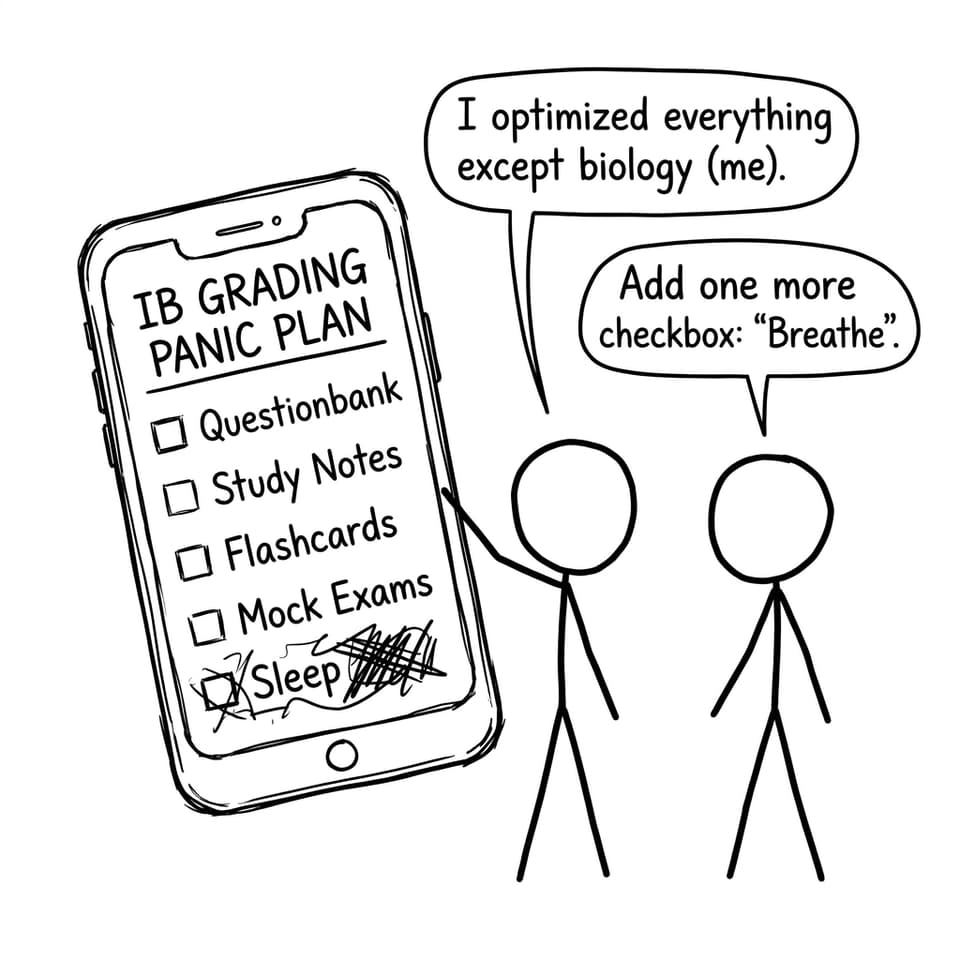
Clarify one topic fast using Study Notes
-
Practice immediately with exam-style questions
-
Get feedback and write a one-line “error rule”
-
Convert recurring errors into Flashcards
-
Simulate pressure weekly with timed Mock Exams or Predicted Papers
RevisionDojo is built around that loop: Questionbank, Study Notes, Flashcards, AI Chat, Grading tools, Predicted Papers, Mock Exams, Coursework Library, and Tutors. When your goal is to satisfy IB Grading thresholds, the biggest advantage is removing friction: less searching, more practicing.
Start here if you want an all-in-one workflow: RevisionDojo App: The Smarter Way to Prep for IB Exams and the main hub RevisionDojo for IB.
If you’re short on time, train like you’re near the pass line
If you feel close to the boundary, prioritize activities that create measurable improvement:
-
Topic-filtered sets in the Questionbank
-
Short daily Flashcards for retention
-
One timed session per week to make timing mistakes visible
For a realistic final stretch framework, use Is 1 Month Enough to Study for IB Exams? and IB: The Last 2 Weeks Before Exams (What Matters).
Closing: turn IB Grading from fear into a plan
A passing score in IB isn’t a mystical number. It’s a set of thresholds inside IB Grading that you can understand, track, and meet with the right habits: 24+ points, enough HL and SL totals, Core completion, and zero avoidable failing conditions.
If you want one place to run that entire improvement loop, use RevisionDojo as your basecamp: drill weaknesses with the Questionbank, tighten recall with Flashcards, patch gaps with Study Notes, ask AI Chat when you’re stuck, build stamina with Mock Exams and Predicted Papers, and get sharper feedback with Grading tools, the Coursework Library, and Tutors.
Passing is the minimum. Understanding the system is the advantage. And in IB, advantage is usually what buys you calm.