
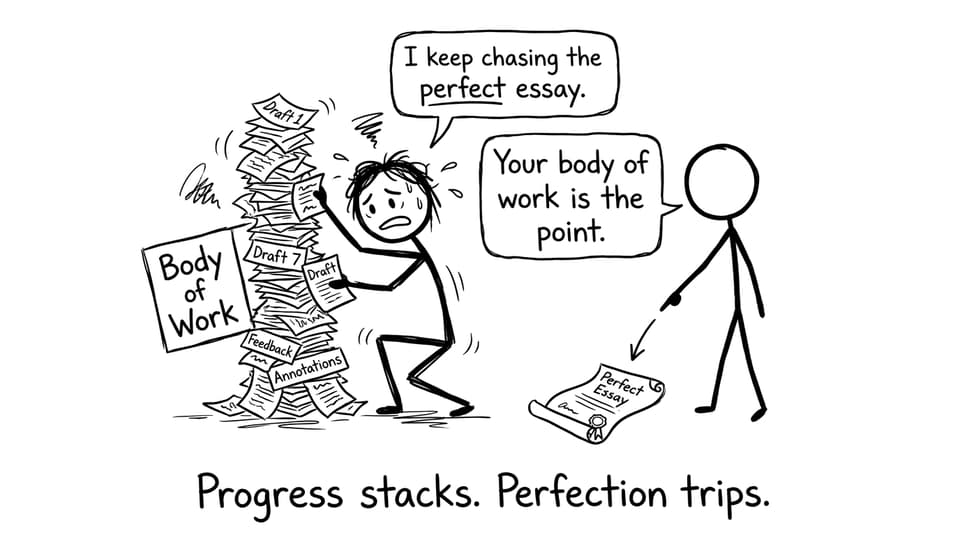
A week before exams, most IB English students do the same thing: they hunt for the single perfect paragraph that will save them.
It makes sense. One paragraph feels controllable. A whole year of reading, annotating, drafting, failing, and trying again feels messy.
But the course was never built to reward a one-off miracle.
In IB English, the best results usually come from something quieter: a body of work. Not one brilliant performance, but a trail of thinking that proves you can interpret texts, explain authorial choices, and stay consistent under pressure.
What is a body of work in IB English?
A body of work is the complete collection of what you produce over time: your annotations, thesis attempts, quote banks, plans, practice responses, reflections, and feedback loops.
In IB English, it also means something more specific: your growing ability to spot patterns (tone, structure, imagery, argument), connect them to meaning, and communicate that clearly.
Think of it like this: an examiner does not grade your potential. They grade what appears on the page (or what you say in the IO). A body of work is how you make sure your best thinking shows up on demand.
If you want a central home for building that system, start with IB English A Lang & Lit Resources, where skills, tools, and practice materials sit in one place.
A quick body of work checklist (save this)
Use this as a weekly reset for IB English revision:
-
One-page text map per work: themes, turning points, authorial choices.
-
Quote bank: 10-12 flexible quotations/moments, each tagged by theme + technique.
-
3 thesis templates you can adapt quickly.
-
Timed practice: at least one short response each week.
-
Feedback captured: one list titled “What I repeat when stressed.”
-
One improvement rule for next time (not ten).
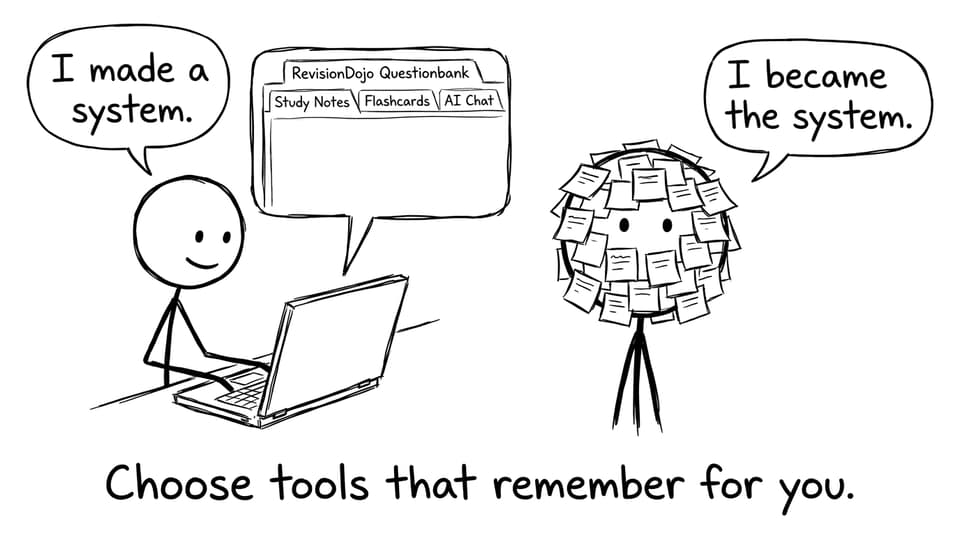
This is also where RevisionDojo’s Flashcards help: turn quote tags and technique effects into fast retrieval prompts, so your body of work stays usable, not just stored.
Why a body of work matters for IB English exams
A body of work matters because exam pressure changes how your brain behaves.
Under timed conditions, you do not “rise to the occasion” as much as you fall back on what you have rehearsed. In IB English, that rehearsal is not memorising essays. It is repeatedly practicing the move: technique -> evidence -> effect -> meaning.
Three big payoffs show up when you build a real body of work:
It gives your analysis consistency
Examiners reward control: clear interpretations, purposeful evidence, and a steady line of argument. That steadiness is a habit, not a mood.
To train it, use structured practice like Step-by-Step Guide to Revising IB English Paper 1 and pair it with RevisionDojo’s Questionbank to keep your practice varied.
It creates context, not just content
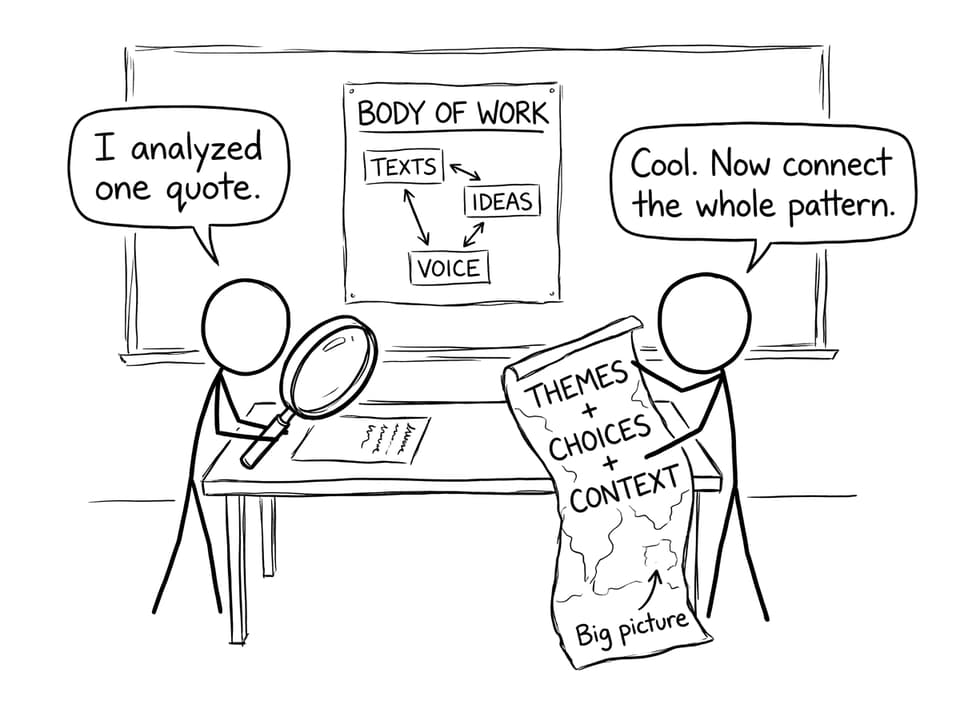
A single quote is small. A cluster of connected moments across a text is powerful.
That’s why body-of-work thinking also improves Paper 2 planning. You start noticing what the text keeps returning to: tensions, symbols, structural cycles, repeating language.
For comparison practice, you can build those clusters using How to Write a Good Essay for IB English Literature as a structure guide.
It makes you faster without making you shallow
Speed in IB English is not rushing. It’s recognition.
When you have a body of work, you recognise common patterns faster: tone shifts, framing devices, contradiction, motif. RevisionDojo’s Study Notes and Cheatsheets are useful here because they reduce the time you waste re-learning the same concepts.
What counts as a “body of work” across IB English tasks?
In IB English, you are assessed in different formats, but a body of work connects them.
Paper 1: your body of work is your method
Paper 1 rewards a repeatable process: annotate with purpose, find patterns, write a focused thesis, and develop analysis.
To build that method, combine:
Then use RevisionDojo’s AI Chat to test yourself: ask it to challenge your thesis, propose counter-readings, or identify gaps in evidence.
Paper 2: your body of work is your comparison library
Paper 2 becomes calmer when you stop treating texts like separate islands.
A strong body of work for Paper 2 includes theme tables, comparison lenses, and mini-outlines you can reuse. If you are unsure about the course load, it helps to know the scale: How Many Texts Do You Study in IB English Literature?.
RevisionDojo’s Mock Exams can simulate timing, while the Grading tools help you see which criteria you are under-serving (often analysis depth or organisation).
The IO: your body of work is your global issue trail
For the Individual Oral, a body of work is the chain of preparation that leads to a confident 10 minutes: global issue definition, extract selection, technique analysis, and links to the wider work.
If you need a structure anchor, use IB English Lit How to Master IO Notes.
In Lang & Lit, remember that one of your choices can be a non-literary body of work, so your preparation should include multiple texts from that creator or campaign, not just one isolated piece.
How to build your IB English body of work (without burning out)
A body of work should feel like a bridge, not a burden.
Build in small, repeatable units
Try this weekly loop for IB English:
-
20 minutes: close reading and annotation
-
15 minutes: thesis + outline
-
15 minutes: one timed paragraph
-
10 minutes: self-grade using a rubric and write one improvement rule
RevisionDojo’s Predicted Papers and Exam builder can keep the practice fresh, while still aligned to what you need.
Store your work so Future You can actually use it
Great notes that you cannot retrieve are just decoration.
Use one consistent tagging system: theme, technique, authorial purpose, and “best for Paper 2 vs Paper 1.” If note-taking is your weak link, use Effective Note-Taking Strategies for IB English Language and Literature.
Get feedback earlier than you feel ready
Most students wait until a draft is “good.” That is usually too late.
Use RevisionDojo’s Grading tools (including graders) to get quick, criteria-based feedback, and if you want human direction, use Tutors for targeted fixes like organisation, thesis clarity, or analysis depth.
Seeing the complete picture
A body of work is what turns IB English from a stressful performance into a practiced craft.
You do not need to feel ready. You need a trail of repetitions that makes readiness inevitable.
If you want to build that trail faster, use IB English A Lang & Lit Resources as your hub, then lean on RevisionDojo’s Questionbank, Study Notes, Flashcards, AI Chat, Grading tools, Predicted Papers, Mock Exams, Coursework Library, and Tutors to keep your body of work organised, honest, and exam-ready.
Because the “complete picture” is not one perfect essay. It is you, getting reliably good at the same high-scoring moves again and again.