

Biodegradable sounds like a comforting promise: this thing won’t stick around. But in IB Chemistry, comforting words are rarely precise words. On an exam, “biodegradable” is not a vibe, a marketing label, or “it disappears.” It’s a chemical claim about microorganisms, bond types, and conditions. Once you see it that way, you can explain why one plastic vanishes in compost while another turns into tiny fragments that still hang around.
If you’re revising IB Chemistry, biodegradable materials are a perfect intersection of polymers, environmental impact, and green chemistry decision-making. And they’re exactly the kind of topic where examiners reward clear definitions.
What is a biodegradable material? (IB Chemistry definition)
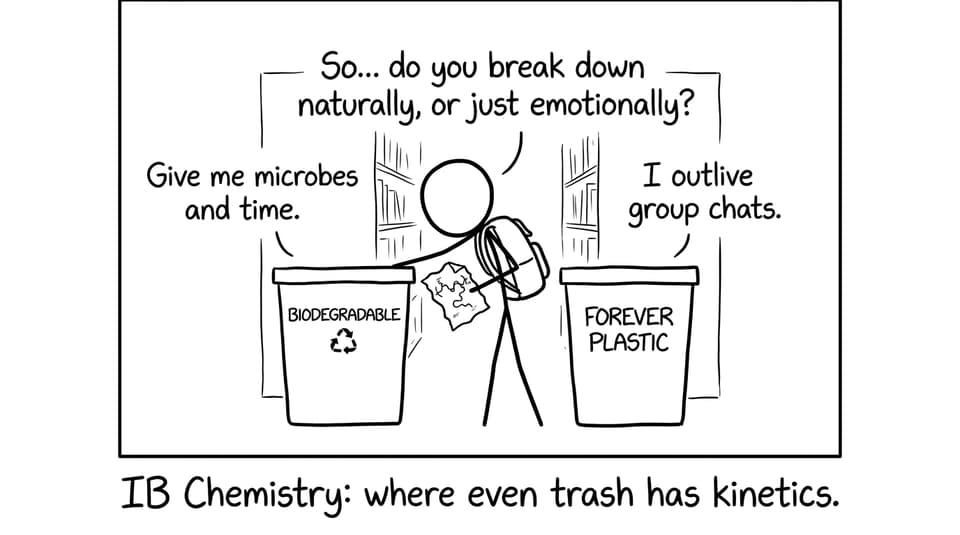
A biodegradable material is a substance that microorganisms (such as bacteria and fungi) can break down into simpler, non-toxic products like water, carbon dioxide, methane (in anaerobic conditions), and biomass.
In IB Chemistry, the important parts of that definition are:
-
It must break down via biological action (not just sunlight or oxygen).
-
The breakdown products should be environmentally harmless (or at least not persist as problematic residues).
-
The process should occur on a reasonable timescale in realistic conditions.
Biodegradation is different from photodegradation (sunlight-driven) and simple oxidation (reaction with oxygen). Those can happen without microbes, and on exams that distinction matters.
Quick exam checklist: how to spot “biodegradable” in a question
When a question mentions a “biodegradable” polymer or packaging, run this IB Chemistry checklist:
-
Who breaks it down? Look for microbes/enzymes.
-
What bonds are vulnerable? Esters, amides, carbonyl-adjacent bonds.
-
What conditions are given? Oxygen? Moisture? Warmth? Composting?
-
What products form? CO₂ in aerobic conditions; CH₄ possible anaerobically.
-
What’s the comparison material? Often polyethylene/polypropylene as “not biodegradable.”
For more polymer context, pair this with Polymerization Explained Clearly while revising.
How biodegradation works (the story of a polymer chain)
In IB Chemistry, biodegradation is easiest to remember as a chain being reduced, step by step, until life can metabolize it.
Fragmentation: making the big smaller
First, the material’s surface changes: cracking, swelling, or becoming brittle. This increases surface area, giving microbes more access. Sometimes this step is helped by heat, UV, or mechanical stress, but the key idea remains: the material becomes easier for organisms to attack.
Depolymerization: enzymes cut the chain
Next, enzymes (or water in hydrolysis) break polymer chains into smaller units. This is where functional groups matter most. Condensation polymers (like polyesters) often degrade more readily than pure hydrocarbon chains.
Mineralization: turning molecules into “simple outputs”
Finally, microorganisms use the smaller molecules as food.
-
In aerobic conditions: mostly CO₂ + H₂O + biomass
-
In anaerobic conditions: CH₄ can form alongside CO₂ and biomass
This is why disposal conditions are not a minor detail in IB Chemistry essays and short answers.
What makes a material biodegradable in IB Chemistry?
Biodegradability is strongly linked to structure. Examiners love answers that connect properties to bonding.
Functional groups that invite attack
Polymers containing ester or amide links are often more biodegradable because these bonds can be cleaved (for example by hydrolysis and enzymes). Carbonyl-containing structures can create reactive sites and increase polarity.
Crystallinity vs amorphous regions
Highly crystalline polymers pack tightly, making them harder for water and enzymes to penetrate. Amorphous regions are more accessible, so biodegradation tends to be faster there.
Chain length and branching
Longer chains and heavy branching can slow breakdown because there are more bonds to cleave and less efficient packing for microbial processing.
Environmental conditions: the hidden variable
Warmth, moisture, oxygen availability, and microbial diversity all change the rate. A biodegradable polymer in a cold ocean is not the same as that polymer in industrial composting conditions.
If you want an exam-ready framework for sustainability claims, link this topic to IB Chemistry Green Chemistry Explained Simply.
Examples you can safely use in IB Chemistry answers
In IB Chemistry, it helps to separate natural materials from engineered polymers.
Common natural biodegradable materials
-
Cellulose (paper, plant fibers)
-
Starch
-
Proteins
-
Cotton and wood
These resemble molecules that organisms already know how to digest.
Common biodegradable polymers
-
PLA (polylactic acid)
-
PHAs (polyhydroxyalkanoates)
-
Some biodegradable polyesters
For a deeper polymer-specific extension, see IB Chemistry Guide to Biodegradable Polymers.
Why some plastics are not biodegradable
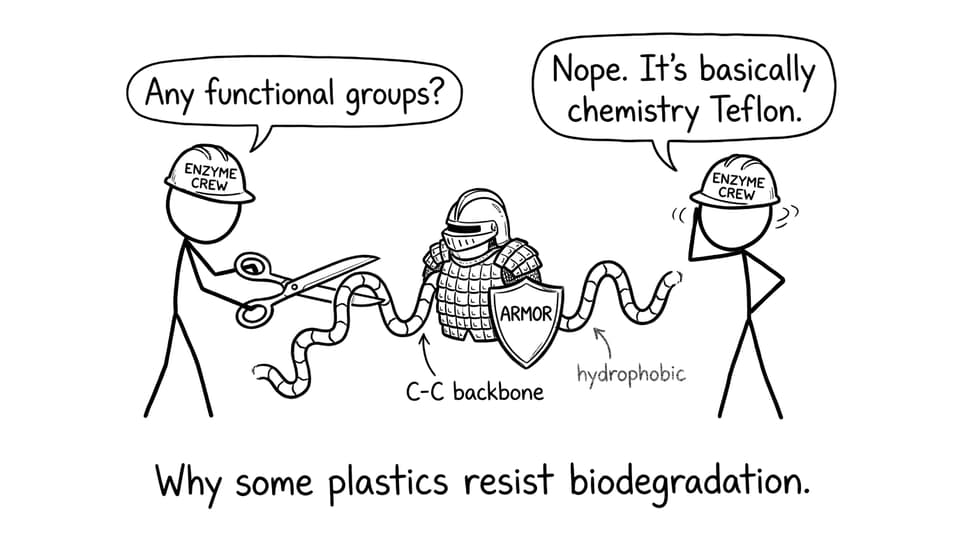
The classic non-biodegradable plastics in IB Chemistry explanations are polyethylene and polypropylene.
They resist biodegradation because:
-
Their backbones are mostly strong C to C and C to H bonds.
-
They’re nonpolar and hydrophobic, so water and enzymes struggle to interact with them.
-
They often lack the functional groups that enzymes can “grab onto.”
This is the chemistry behind persistence in landfills and microplastic formation.
Biodegradable vs compostable (don’t lose marks here)
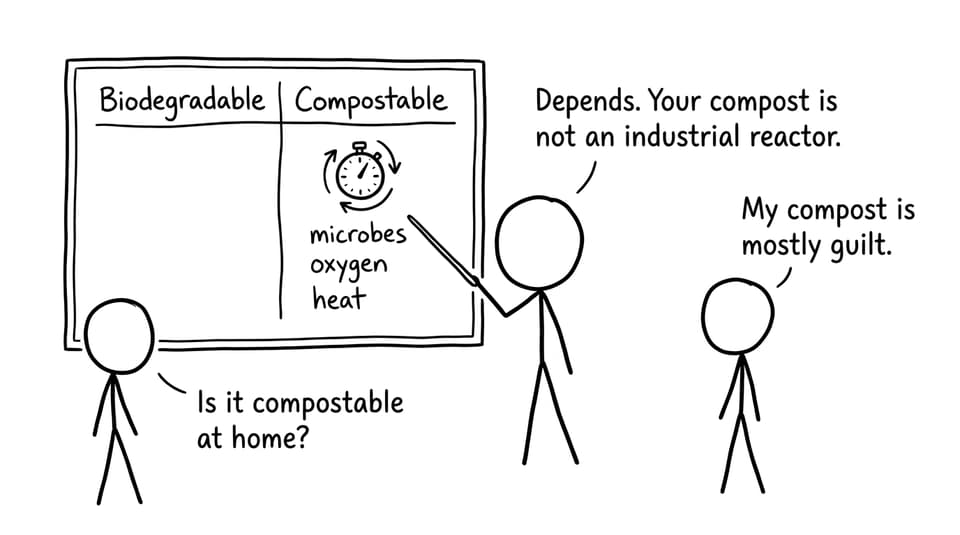
“Compostable” is a stricter claim than “biodegradable.” In IB Chemistry, you should treat compostable as biodegradable plus a time-and-conditions requirement.
-
Biodegradable: can be broken down by microorganisms, but the timeframe and conditions may vary widely.
-
Compostable: must break down under compost conditions and typically within a defined timeframe, leaving no harmful residue.
How to revise this topic efficiently with RevisionDojo
When students say they “get” biodegradability but still miss questions, it’s usually because they haven’t practiced applying the definition to unfamiliar materials. RevisionDojo is built for that application step:
-
Use the IB Chemistry Resources hub as your base.
-
Drill polymer questions in the IB Chemistry Questionbank, and target material-structure links with the S2.4 From Models to Materials Questionbank.
-
Consolidate definitions through IB Chemistry Revision Notes (SL/HL) and the topic pages like S2.4.4 Polymers and S2.4.4 Polymers Notes.
Then, use Flashcards and AI Chat to pressure-test your wording until you can define biodegradable material in one clean sentence.
Conclusion: the exam-ready takeaway
A biodegradable material is not “something that disappears.” In IB Chemistry, it is a material that microorganisms can break down into simpler, largely harmless products, and the speed depends on structure and conditions. Remember the big drivers: functional groups, crystallinity, chain structure, and the environment.
If you want this topic to feel effortless under timed conditions, practise it like the exam will test it: definitions, structure-to-property explanations, and comparison with non-biodegradable plastics. Build that habit with RevisionDojo’s Questionbank, Study Notes, Flashcards, AI Chat, Grading tools, Predicted Papers, and Mock Exams inside the IB Chemistry hubandand make biodegradable material questions one of the easiest marks you collect.