
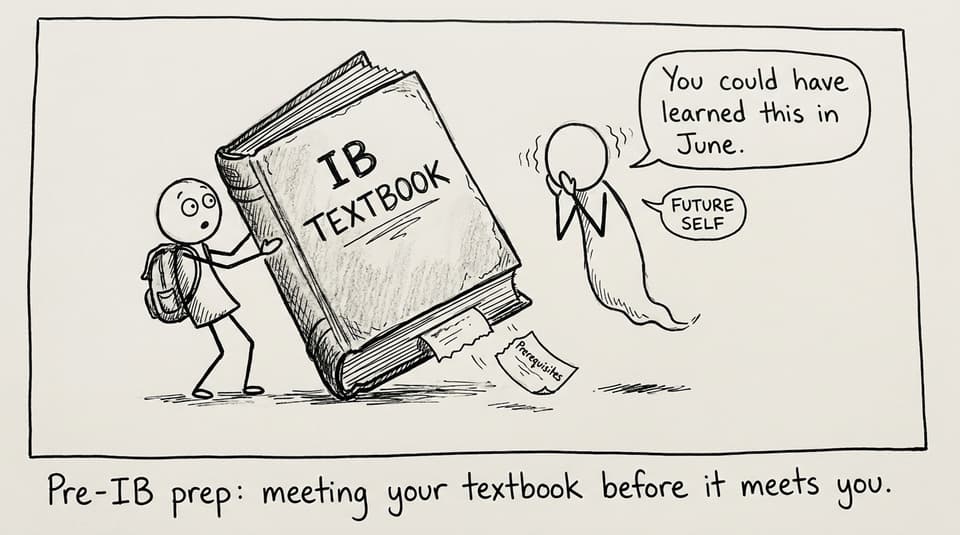
Your first IB Textbook won’t announce itself with fireworks. It’ll sit there quietly, thick, confident, and slightly smug. Then you’ll open it and realise it assumes you already know things you haven’t thought about since last year (or since you promised yourself you’d “revise in summer”).
That moment is normal. It doesn’t mean you’re behind. It means the IB is built like a staircase, and the IB Textbook starts you on step five.
This guide is your step-zero plan: the essential knowledge and habits you can build before the programme starts, so your IB Textbook becomes a tool, not a threat.
Pre-IB preparation checklist (save this)
Use this checklist to decide what to review before your first week:
-
Skim your IB Textbook table of contents for each subject and mark “unknown” topics.
-
Rebuild core maths fluency: algebra, functions, graphs, and statistics basics.
-
Refresh science fundamentals: the scientific method, data handling, and key concepts per subject.
-
Practise academic writing: paragraph structure, evidence, and clear explanations.
-
Learn citation basics and source credibility (you’ll use this everywhere).
-
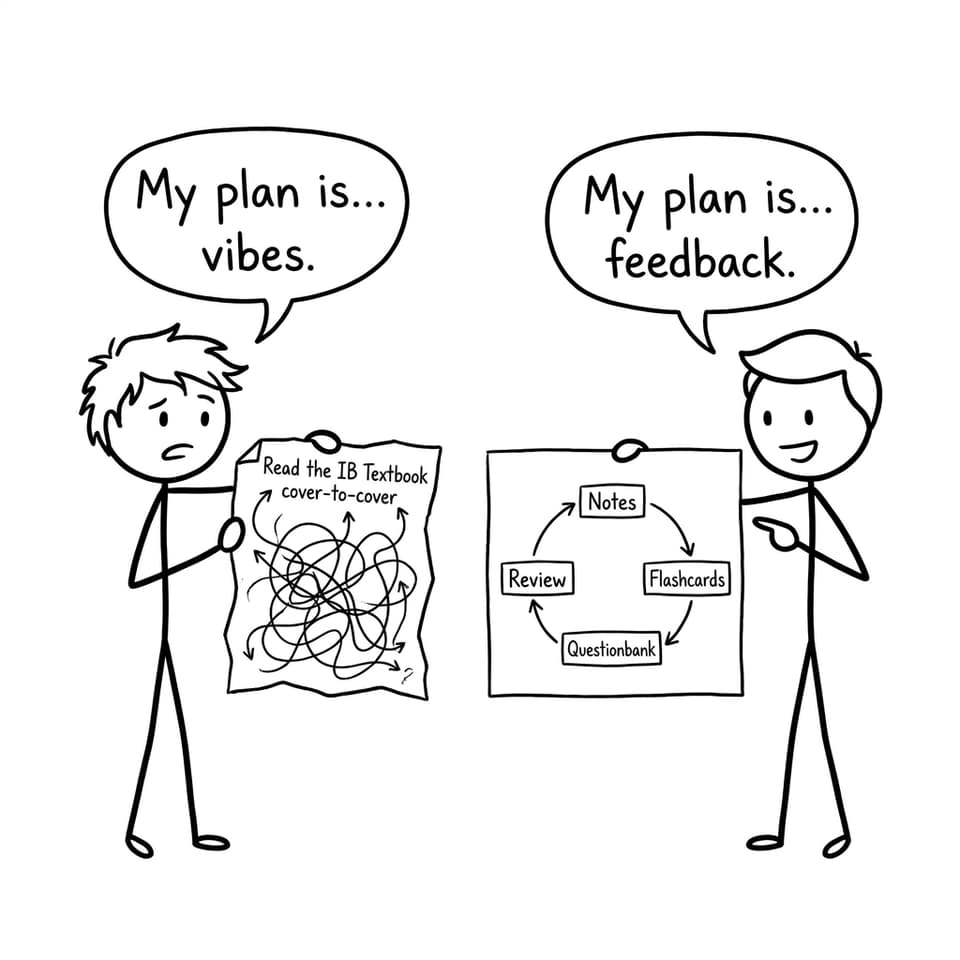
Set a weekly system: recall + practice + feedback (not just reading).
When you want a system that keeps this simple, RevisionDojo ties it together with Study Notes, Flashcards, Questionbank, AI Chat, Grading tools, Predicted Papers, Mock Exams, a Coursework Library, and Tutors.
What your IB Textbook expects you already know
An IB Textbook is not written like a friendly teacher. It’s written like a map: efficient, dense, and focused on what comes next. That’s why pre-IB prep is less about “getting ahead” and more about removing friction.
Mathematics foundations (the quiet make-or-break)
Most students don’t struggle in IB maths because they can’t learn new content. They struggle because small gaps in old content make new topics feel impossible.
Before you start, be comfortable with:
-
Manipulating algebra without hesitation (factorising, rearranging, simplifying)
-
Functions: domain/range, transformations, interpreting graphs
-
Basic trigonometry (including radian measure comfort)
-
Statistics essentials: mean, variance/standard deviation conceptually, interpreting distributions
-
Probability basics (independent vs dependent events)
A practical test: if you can’t do a typical algebra rearrangement in under 60 seconds, your IB Textbook will feel heavier than it needs to.
For practice loops that feel closer to exam reality than rereading, use RevisionDojo’s Questionbank feature alongside the planning ideas in How to Study for IB Exams: Step-by-Step Guide.
Science foundations (learn the language of data)
Whether you take Biology, Chemistry, or Physics, your IB Textbook assumes you can think in measurements and evidence.
Make sure you can:
-
Use the scientific method properly (hypothesis, variables, controls, limitations)
-
Read graphs and tables quickly (trend, gradient, anomalies)
-
Handle units and significant figures with care
-
Write clear conclusions from data (not just restating results)
Subject-specific refreshers that pay off fast:
-
Biology: cell structure, enzymes, basic genetics vocabulary
-
Chemistry: periodic table familiarity, bonding basics, balancing equations
-
Physics: algebra with equations, vectors vs scalars, foundational mechanics ideas
Once the year begins, you can keep concepts tight by using concise explanations from International Baccalaureate Resources: How to Study Smarter and then immediately testing yourself with targeted questions.
Language and humanities (writing is your multiplier)
In many IB subjects, marks are awarded for thinking on paper: clear claims, relevant evidence, and structured explanation. Your IB Textbook will model this, but it won’t slow down to teach it.
Before IB starts, practise:
-
Analytical paragraphs (claim -> evidence -> explanation -> link)
-
Explaining a concept in two levels: “simple” then “precise”
-
Using subject vocabulary accurately (especially in economics, history, and sciences)
-
Reading actively: highlighting arguments, not just facts
If you want a broader roadmap for the whole programme, The Complete IB Revision Guide is a solid overview to orient your expectations.
The skills your IB Textbook won’t teach (but will punish you for missing)
Research and citation (small habits, big stress reduction)
You don’t need to master MLA/APA overnight, but you do need the instinct to track sources. IB work tends to reward credibility and punish vagueness.
Start with three habits:
-
Save links and bibliographic info as you research (immediately, not later)
-
Learn to identify reliable sources (author, date, method, bias)
-
Paraphrase properly (understand first, then write in your own words)
This matters for coursework, but it also matters for how you learn from your IB Textbook: you’ll constantly move between textbook explanations, class notes, and outside sources.
Time management (less motivation, more design)
IB workload doesn’t overwhelm you in one dramatic day. It overwhelms you through quiet accumulation: one missed practice set, one delayed draft, one weekend that vanished.
Build a repeatable weekly rhythm now:
-
3-5 short recall sessions (10-20 minutes)
-
2-4 focused study blocks (45-90 minutes)
-
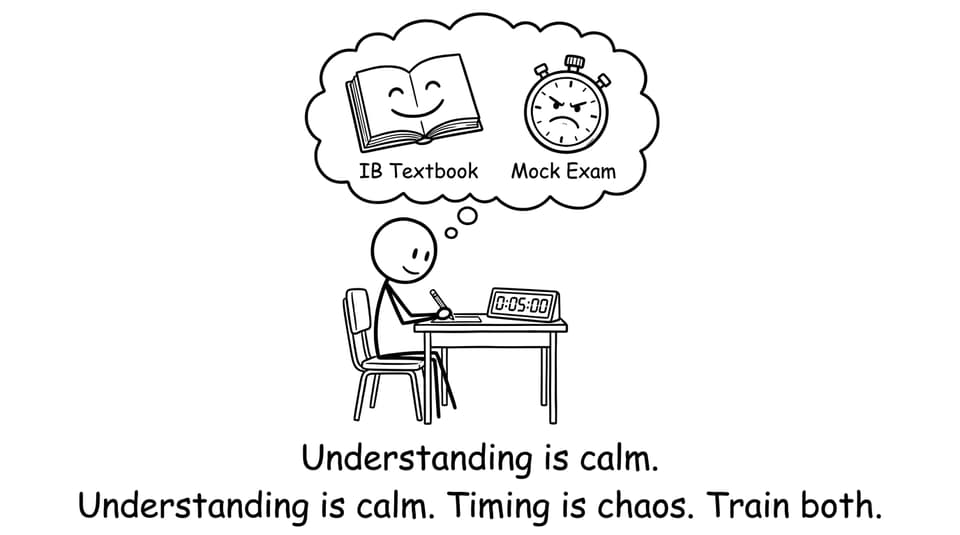
1 timed session (even a mini one)
If you want a simple structure you can actually stick to, borrow the loop from How to Study for IB Exams Without Burning Out and keep it consistent.
How to use your IB Textbook without getting trapped in it
A lot of students treat the IB Textbook like a moral obligation: if you haven’t read it all, you haven’t worked hard enough.
But high scorers usually do something calmer. They use the textbook like a reference, not like a lifestyle.
Try this three-step method:
Use the IB Textbook to clarify, not to delay
Read only what you need for the next skill. Then stop.
Convert reading into recall
After a section, close the IB Textbook and write 5 questions you could be tested on. Those become flashcards. RevisionDojo makes this easy with the Flashcards feature, especially when you’re trying to keep daily recall small but consistent.
Prove learning with exam-style practice
Reading feels productive because it’s smooth. Exams don’t feel smooth. That’s why practice matters.
Use a bank of questions to test the same topic you just studied, then review mistakes like data. For an overview of how to structure that, see Best Resources for IB Exam Preparation and IB Question Bank: Thousands of Practice Questions.
A final note before you start
Pre-IB preparation is not about becoming perfect. It’s about reducing surprise. The IB Textbook will still be challenging, but it won’t feel like it’s written in a private language everyone else learned earlier.
If you want one home base to run the full cycle: learn, recall, practise, and get feedback; start with RevisionDojo for IB, then use Countdown to IB Exams: A Guide to Effective Studying to turn that preparation into a weekly routine you can actually keep.
Your future self doesn’t need you to be heroic. They need you to be consistent, and to meet the IB Textbook on your terms first.